Scalping In Trading
10 Chapters

Scalping In Trading

Meaning, how it works, and should you do it? Scalping vs intraday trading — what is the main difference?

Last Updated on 23 July, 2026|20 minutes read|Arpit Seth1 Author

Scalping is a short-term style where you place many trades a day, holding positions for seconds to minutes. In India it works best on Nifty 50, Bank Nifty and liquid large-caps using 1-min or 3-min charts.

Most traders who try scalping quit within three months. Not because the approach does not work, but because they treat it like a gamble with a fast-forward button.

The traders who do it profitably share one trait: they built a system, and they follow it without compromise. This course walks you through that system, one chapter at a time, what scalping is, the strategies that survive Indian market conditions, how to protect capital across 10+ trades a day, and what separates the profitable few from the 91% who lose money in F&O.

Chapter 1

What is Scalping in Trading? Meaning, How It Works & Should You Do It?

Scalping is the fastest form of active trading — in and out within minutes, capturing small but repeatable price moves. This chapter explains what scalping really means, how it works in practice, how it differs from intraday and swing trading, and how to decide if it is right for you.
What is Scalping in Trading? Meaning, How It Works & Should You Do It?

The Four Pillars of Profitable Scalping Trading

1. Market Condition Recognition
Before you place a single trade, answer one question: is the market trending, ranging, or choppy? 

2. Strategy Selection
Every scalping strategy has a natural environment where it thrives. VWAP pullback scalping works in trending markets where price respects the volume-weighted average as dynamic support. Bollinger Band mean reversion works in sideways sessions. Opening Range Breakout exploits the first 15–30 minutes of daily volatility. A combination of these can help you to create the best NIfty 50 scalping strategy.

3. Execution Quality
When your target is 10–15 points in an option premium, a poorly placed order can erase the trade before it starts. Market orders, limit orders, spread width, and broker latency—every execution decision has a direct rupee cost. 

4. Psychological Control
Scalping generates more decisions per hour than almost any other trading style. That creates decision fatigue, and fatigue creates errors. 
Chapter 2

Scalper Mindset and Discipline

Scalping does not fail because of bad setups. It fails because of poor execution under pressure. This chapter focuses on the behavioural side of scalping, including discipline, decision-making, and emotional control, and how they shape trading performance.

Scalper Mindset and Discipline

Risk Management for Scalpers

Risk management is not the exciting part of scalping. It is the part that determines whether you're still trading next month.

Treat every rule below as non-negotiable, not a guideline, and not something you revisit after a losing streak.

The Five Core Rules

  • Rule 1: Risk Per Trade — 0.5% to 1% Max
  • Rule 2: Daily Loss Limit — Set a daily loss limit
  • Rule 3: Cap Consecutive Losses
  • Rule 4: No Averaging Down
  • Rule 5: Track Everything

    Learn about risk management here.

The Psychology of Scalping

Scalping is the most psychologically demanding trading style. You make more decisions in one session than a swing trader makes in a month. That intensity creates failure modes that don't exist in longer-timeframe trading.

Here are the four that end most scalping careers.

The Four Scalper Traps

1. Revenge Trading

2. Overtrading

3. Lowering Your Setup Standards

4. Decision Fatigue

For a deeper look at trading psychology and how self-worth affects performance under pressure, read our dedicated guide: Trading Psychology & Risk Management: The Missing Edge.

Chapter 3

Risk and Money Management

In scalping, outcomes are shaped over a series of trades. This chapter looks at how risk is controlled, how position size is decided, and how small decisions begin to affect results when trades are frequent.

Risk and Money Management

The Psychology of Scalping

Scalping is the most psychologically demanding trading style. You make more decisions in one session than a swing trader makes in a month. That intensity creates failure modes that don't exist in longer-timeframe trading.

Here are the four that end most scalping careers.

The Four Scalper Traps

1. Revenge Trading

2. Overtrading

3. Lowering Your Setup Standards

4. Decision Fatigue

For a deeper look at trading psychology and how self-worth affects performance under pressure, read our dedicated guide: Trading Psychology & Risk Management: The Missing Edge.

Chapter 4

Ideal Time, Candle Patterns & Chart Structures to Scalp Options

Most traders think of scalping as a function of speed; the faster you act, the more you gain. That is not accurate. A scalper who enters 20 trades in a poor time window will almost always underperform a scalper who takes 3 trades in the right window with clear setups. This chapter separates clock time from trade time — the roughly 2.5 hours of the session where scalping is actually viable.

Ideal Time, Candle Patterns & Chart Structures to Scalp Options

When to Scalp: Best Hours for Indian Markets

Not every hour of the trading day is equal. Scalping in the wrong window is like fishing in an empty pond; you can follow every step correctly and still come up empty.

Here's how the NSE session breaks down for scalpers:

  • 9:15 AM – 10:15 AM: Prime Time

The first hour carries the highest volume, the widest price swings, and the most genuine directional moves of the day. 

  • 10:15 AM – 12:30 PM: Secondary Window

Volume drops, but tradeable setups still appear, especially in stocks with breaking news or earnings. 

  • 12:30 PM – 2:00 PM: The Dead Zone

Volume thins out. Price chops in a range.

  • 2:00 PM – 3:30 PM: The Second Window

Volume picks up as European markets open and institutional positioning for the close begins. 

Broker Speed & Slippage

Slippage is the gap between the price you intended and the price you got. On a volatile Nifty option with a market order, that gap runs 2–5 points. Across 10 trades a day, you're losing 20–50 points to slippage, possibly more than your daily target.

This is why low-latency execution isn't a nice-to-have for scalpers. It's a structural cost that either works for you or against you. Sahi's infrastructure is built for speed: ultra-low latency market data from exchange to screen, with chart rendering 60% faster in Scalper 2.0.

Read how the feed is engineered here.

Chapter 5

Using Option Greeks for Scalping

Option premiums do not move in a fixed relationship with the index. Their behaviour changes with price movement, time, and momentum, and these changes are explained through Option Greeks. This chapter focuses on how Greeks like Delta, Gamma, and Theta affect option premium movement during scalping.

Using Option Greeks for Scalping

Options Scalping

Options scalping on Nifty and Bank Nifty is the dominant form of active retail trading in India. Understanding its mechanics isn't optional if you trade F&O; it's table stakes.

Why Options Over Futures?

Options give you leverage without the full margin requirement of futures. A Nifty 50 options lot (65 units) at an ATM premium of ₹150 costs ₹11,250 to enter. 

Understand ATM, ITM, and OTM options here.

Expiry Day Scalping

Nifty 50 weekly expiry (every Tuesday) is the most volatile and the most opportunity-rich session for options scalpers.

On expiry day, theta decay accelerates dramatically in the final hours. ATM options that opened at ₹100+ can decay to ₹5 by 3:00 PM if the market stays flat. Gamma spikes near ATM strikes, meaning option premiums move faster relative to the underlying. 

Read the full expiry day rules here.

Chapter 6

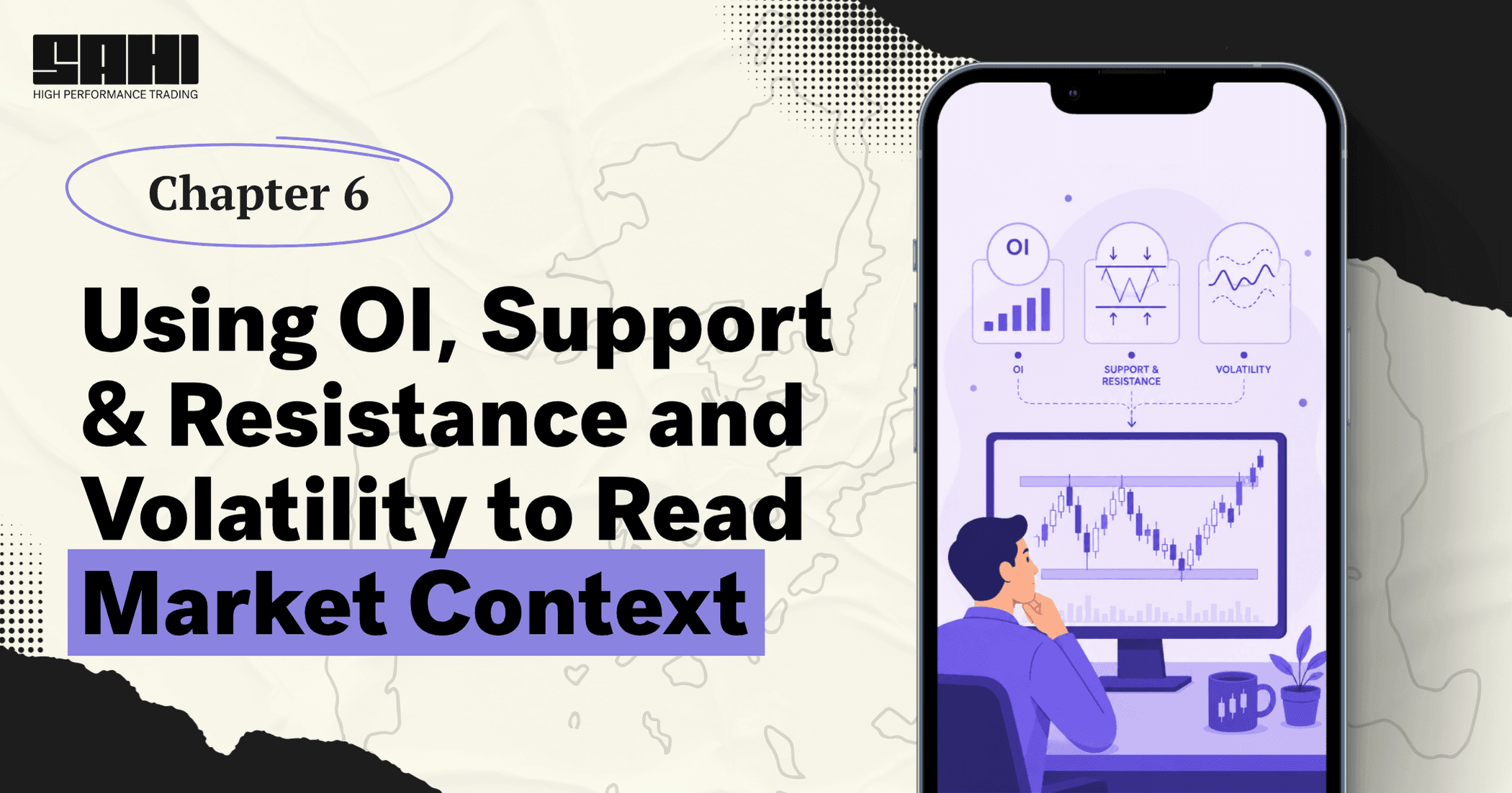
Using OI, Support & Resistance and Volatility to Read Market Context

A setup does not behave the same way in every market condition. The same breakout that works cleanly in a trending market can fail completely in a low-volume or range-bound session. This chapter focuses on how OI, support and resistance, volatility, and Vega help explain positioning, reaction zones, and changing premium behaviour during scalping.

Using OI, Support & Resistance and Volatility to Read Market Context

Open interest (OI) is the total number of outstanding futures or options contracts that have not been closed or settled in a derivatives market. The NSE publishes this data, real-time for every strike price and expiry series through its option chain. Know more about these in this chapter:

  • Context affects how scalp setups behave and whether momentum is likely to sustain
  • OI helps identify where traders are positioned and where reactions may occur
  • Heavy Put OI often behaves like support, while heavy Call OI often behaves like resistance
  • Key levels become more important when they align with OI and volatility
  • Volatility affects premium responsiveness, movement speed, and holding conditions
  • Vega explains how implied volatility affects option premiums
  • Strong scalp setups usually involve alignment between structure, OI, volatility, and premium behaviour
  • The goal is not to predict every move, but to trade when conditions support follow-through
Chapter 7

Using Indicators (EMA, VWAP, RSI, Bollinger Bands) for Scalping Execution

How scalpers use EMA, VWAP, RSI, Bollinger Bands and ATR to read trend, momentum, volatility and participation during live execution.

Using Indicators (EMA, VWAP, RSI, Bollinger Bands) for Scalping Execution
Chapter 8

Common Scalping Mistakes and Trade Failure Scenarios

Why scalp trades fail: execution mistakes, weak context, poor strike selection, and changing market conditions, and how traders can recognise these failure patterns early.

Common Scalping Mistakes and Trade Failure Scenarios

In this chapter know about:

  • Most scalp trades fail because of execution, context, or risk-management issues rather than the setup alone.
  • Chasing breakouts often reduces reward potential while increasing risk.
  • Strong OI zones can influence momentum and continuation probability.
  • Volatility conditions affect both price movement and premium behaviour.
  • Strike selection directly impacts option responsiveness.
  • Holding trades too long can reduce gains as momentum fades.
  • Revenge trading often causes more damage than the original loss.
  • Indicators work best when used alongside context and structure.
  • Emotional bias can distort decision-making and execution.
  • Consistent scalping depends on process quality rather than prediction.
Chapter 9

Reading the Option Chain for Scalping

Charts show price action. The option chain shows how market participants are positioned. How scalpers use OI, Change in OI and Volume to build bias, find levels and validate setups.

Reading the Option Chain for Scalping

In this chapter know more about:

  • The option chain provides insight into market positioning and participation.
  • OI and Volume are the most useful intraday columns for scalpers.
  • Highest Put OI often acts as support, while highest Call OI often acts as resistance.
  • OI levels change throughout the session and should be monitored dynamically.
  • OI build-up helps determine whether participation supports the move.
  • Option chain is most effective when used alongside charts and indicators.
  • OI should support trade bias, not create it independently.
  • Strong OI levels can still fail during periods of high momentum and volatility.
  • Price action remains the final source of confirmation.
Chapter 10

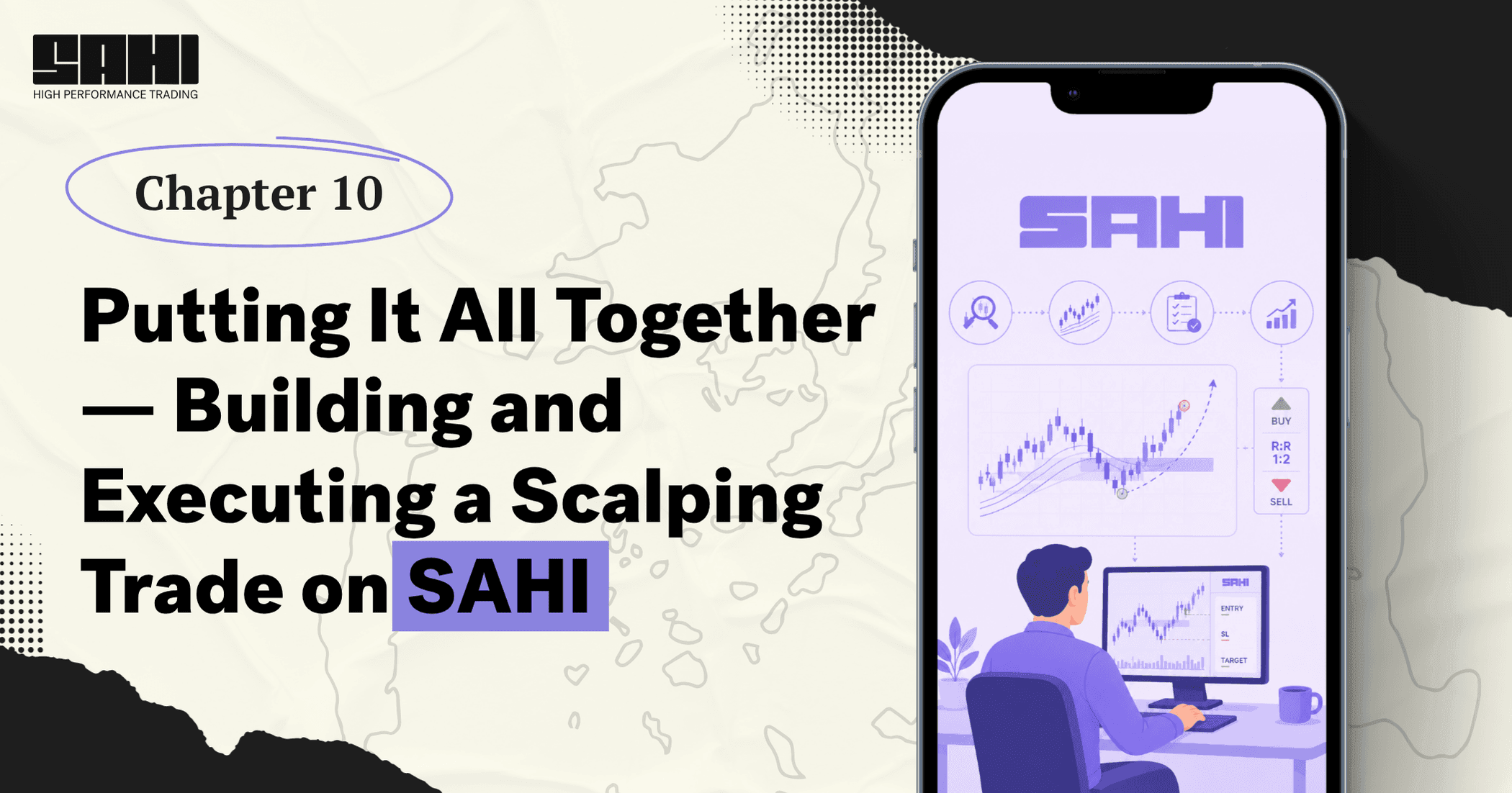
Putting It All Together: Building and Executing a Scalping Trade on SAHI

The complete scalping workflow on SAHI: pre-market preparation, combining price action with the option chain, strike selection, bracket-order risk management, live trade management and post-trade review, all inside one example trade.

Putting It All Together: Building and Executing a Scalping Trade on SAHI

Ultimately, know how to implement the earlier learnings and know:

  • SAHI’s combined view of the underlying chart, option chart, and option chain turns the session into one integrated workflow.
  • Preparation determines how clean the rest of the session feels.
  • A setup is acted on only when structure, indicators, and OI positioning align.
  • Strike selection, entry timing, and risk management are decided before the trade is live.
  • Trade management uses the Greeks to explain what the premium is doing in real time.
  • The session ends with an execution review, not just a P&L check.