
Opening Range Breakout (ORB): How Traders Capture the Market’s First Real Move
A practical guide to understanding the ORB intraday strategy and how traders use the market’s opening range to identify early breakout opportunities.

Every trading day begins with a burst of activity.
Overnight global markets close, new information gets absorbed, institutional orders hit the market, and traders react to news that arrived after the previous session ended. The result is often the most volatile part of the day, which is the first hour after the market opens.
Many intraday traders believe this early volatility contains valuable information about where the market might head next. One strategy that revolves entirely around this idea is the Opening Range Breakout (ORB).
Rather than chasing random moves during the session, the ORB strategy focuses on a very specific question: what happens when price escapes the first range the market forms after opening?
When that range breaks, momentum often follows.
Understanding the Opening Range
The opening range is simply the high and low formed during the first few minutes of trading. Traders typically observe the market for a short window after the open and mark two levels on their charts: the highest price reached during that period and the lowest price touched.
In the Indian markets, this observation window often ranges from 15 minutes to 60 minutes after the 9:15 AM open. A trader might watch price action between 9:15 and 9:30, or extend the range until 9:45 or even 10:15 depending on their preference.
Once that window closes, two key levels emerge: the Opening Range High (ORH) and the Opening Range Low (ORL). These two levels become the most important reference points for the rest of the day.
Traditionally, traders mark these levels manually every morning by identifying the high and low of the opening window. On SAHI Charts, the Opening Range Breakout levels are auto-plotted directly on the chart, allowing traders to immediately see the ORH and ORL without manually drawing the range.
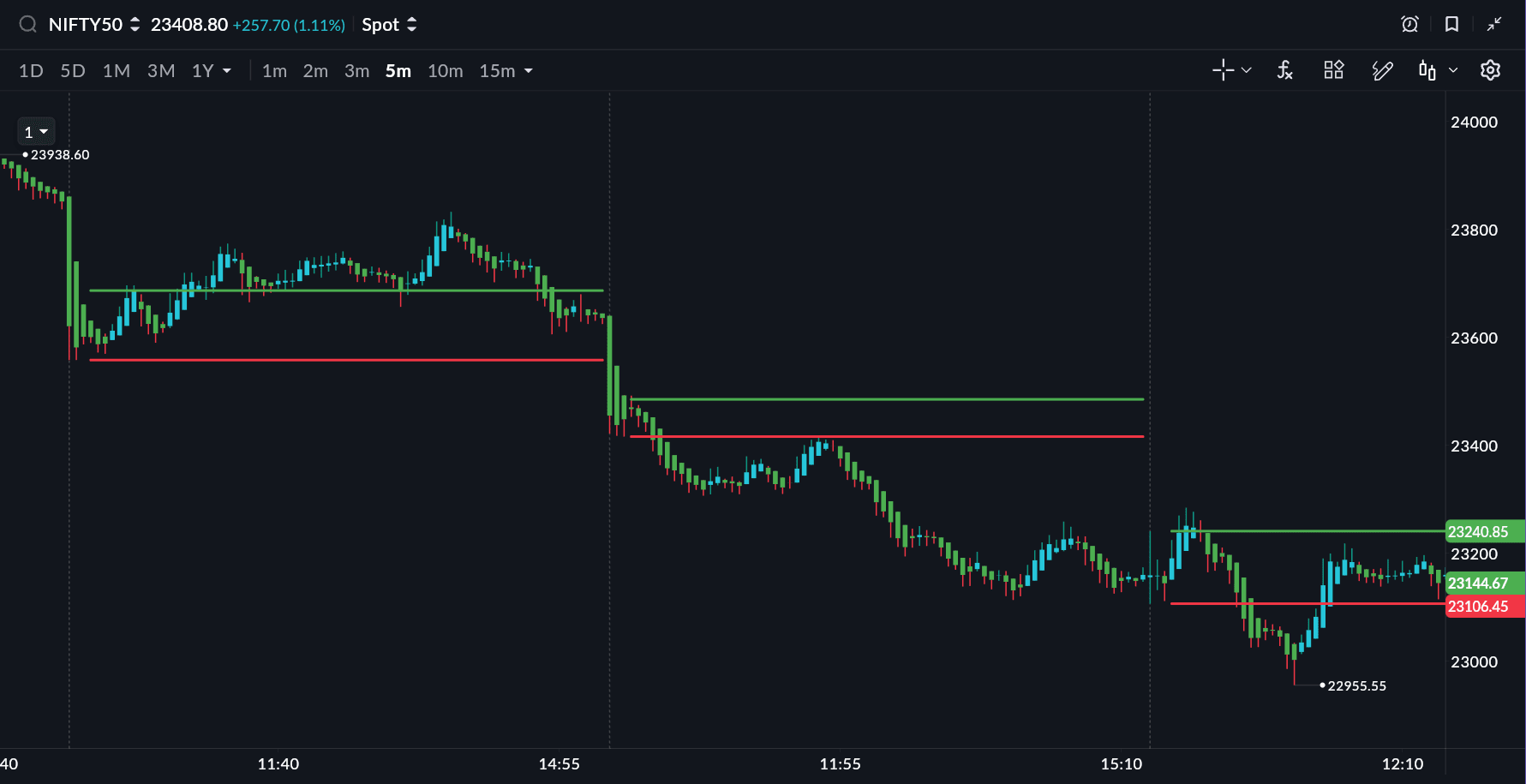
The idea behind ORB is straightforward. If price pushes above the opening range high, it suggests buyers are gaining control. If price falls below the opening range low, it indicates sellers may be taking charge.
Instead of predicting direction, the strategy simply waits for the market to reveal its hand.
How the Strategy Plays Out During the Day
Imagine the Nifty opens at 9:15 AM and spends the next fifteen minutes moving between 22,850 and 22,920. During this period, price fluctuates but never breaks out of that zone.
By 9:30 AM, a clear opening range has formed.
The high of the range sits at 22,920 and the low at 22,850.
Now the real observation begins.
If the market later closes a candle above 21,920, traders interpret it as a bullish breakout from the opening range. That move signals that buyers are strong enough to push price beyond the initial balance of the market.
In this scenario, a trader might enter a long trade after the breakout, while placing a stop loss near the opposite side of the range.
The same logic applies on the downside. If price breaks below the opening range low, it can signal bearish momentum, prompting traders to look for short opportunities.
What makes the ORB strategy appealing is its simplicity. Instead of scanning dozens of indicators or reacting to every tick of the market, the trader simply waits for price to leave the range where it spent its first few minutes.
Why the First Hour Matters So Much
The opening phase of the trading session often reflects institutional positioning.
Large participants such as mutual funds, hedge funds, and proprietary trading desks frequently execute orders shortly after the market opens. These orders react to overnight developments such as global market moves, macroeconomic announcements, or company news.
Because of this, the opening period tends to generate high liquidity and strong directional impulses.
When price breaks the opening range, it can indicate that the early flow of orders has created a directional imbalance in the market. Traders using ORB attempt to ride that imbalance.
This is why the strategy is particularly popular in highly liquid instruments like Nifty, Bank Nifty, and large-cap stocks such as Reliance Industries or HDFC Bank.
These markets tend to react quickly to global cues and institutional flows, making the opening range especially relevant.
Managing Risk in ORB Trades
Despite its simplicity, the ORB strategy still requires disciplined risk management.
Many traders use the opposite boundary of the opening range as a stop-loss level. If price breaks the range but then reverses back into it, the breakout has effectively failed.
Another common practice is limiting trades to one setup per day. Since the strategy aims to capture the first directional move of the session, taking multiple ORB trades can often lead to overtrading.
Traders also pay close attention to the size of the opening range itself. A very narrow range may lead to frequent false breakouts, while an extremely wide range can increase the risk on each trade.
Because of this, some traders combine ORB with additional context such as volume expansion, VWAP positioning, or overall market sentiment before entering a position.
The Challenge: False Breakouts
Like any price-based strategy, ORB is not immune to false signals.
Markets occasionally break the opening range only to reverse sharply moments later. These “fake breakouts” tend to occur during low-volatility days or when the market lacks a clear directional catalyst.
Experienced traders therefore treat ORB as a framework rather than a guarantee. They pay attention to broader market context, sector momentum, and news-driven volatility before committing to a breakout trade.
When the ORB Strategy Works Best
The ORB strategy tends to perform best on days when the market opens with clear momentum or strong global cues. Gap openings, major economic events, or strong sector moves often increase the likelihood of meaningful breakouts.
On quiet days, however, the market may simply oscillate within the opening range without establishing a strong trend. Recognizing these conditions is part of developing experience with the strategy.
Final Thoughts
The Opening Range Breakout strategy remains one of the most widely used intraday trading approaches for a reason. It strips trading down to its most basic element: price behaviour around a clearly defined level.
Instead of trying to predict the market, the strategy simply waits for confirmation that buyers or sellers are taking control.
For traders who prefer structured, rule-based approaches, ORB offers a straightforward way to approach the market’s most active period the opening hour with a clear plan.
And in a trading environment where noise and overanalysis are common, sometimes the simplest frameworks remain the most effective.
All topics
Click the link, confirm the box next to sahi.com is checked — ignore any other results.