
Common Scalping Mistakes and Trade Failure Scenarios
Why scalp trades fail: execution mistakes, weak context, poor strike selection, and changing market conditions, and how traders can recognise these failure patterns early.
 12 minutes read|
Scalp trades usually fail because of execution mistakes, weak context, poor strike selection, or changing market conditions. This chapter explains the most common failure patterns and how traders can recognise them early.
Why Scalping Trades Fail
One of the biggest misconceptions in trading is that every losing trade comes from a bad setup. In practice, the setup is often only one part of the outcome. Trades usually fail because multiple factors begin working against the trader at the same time, such as:
- poor execution at entry or exit
- hesitation that leads to delayed decisions
- weak market context before entry
- chasing price after the move has already started
- ignoring price action, support and resistance, OI, or overall risk structure
The important part is that many of these problems are within the trader’s control. Early identification can help prevent small mistakes from turning into avoidable losses.
This chapter focuses on the most common pain points for an option scalper and how they usually appear during live market conditions.
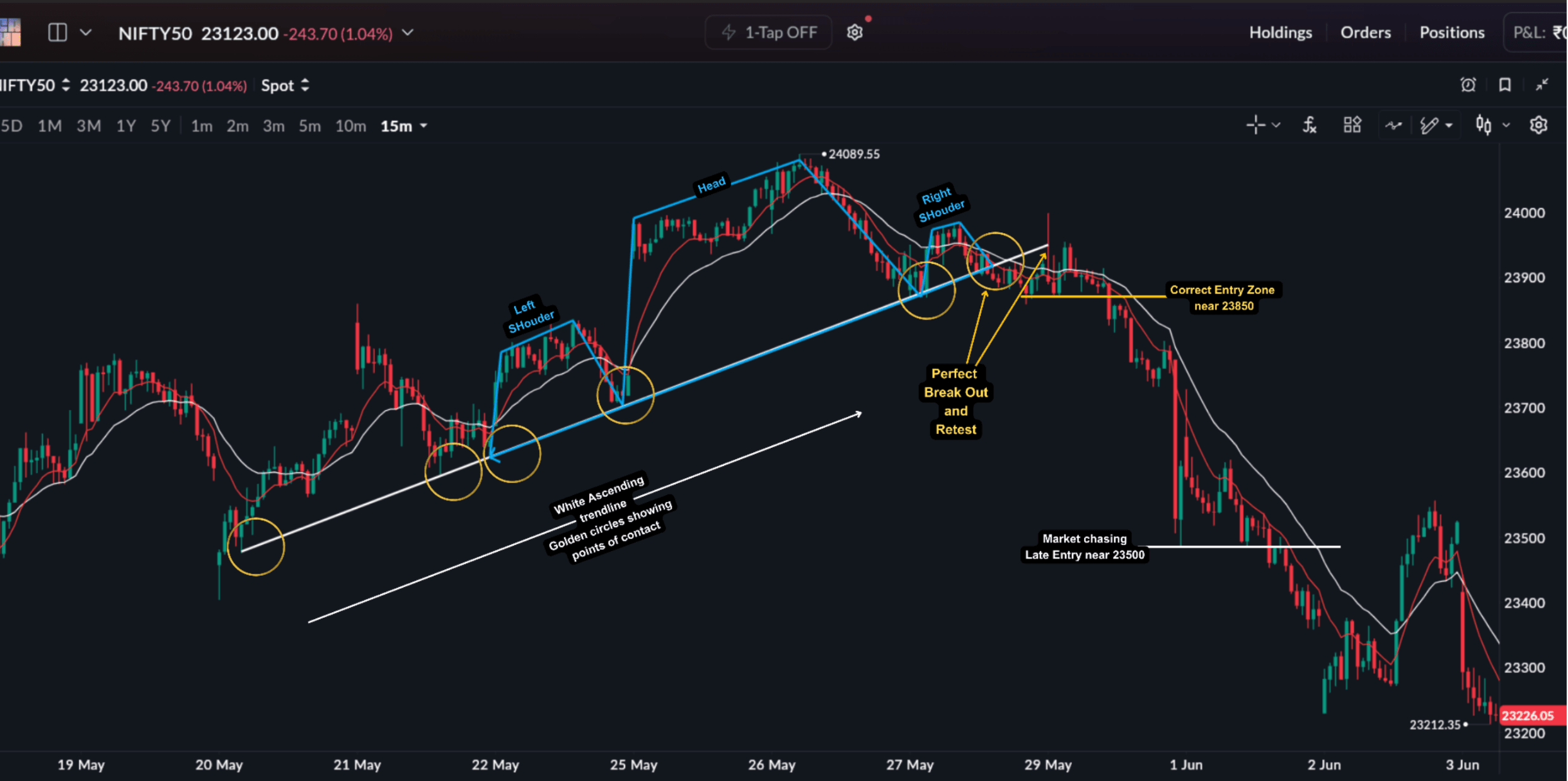
Chasing Breakouts Late
Breakouts are one of the most popular setups among scalpers. They are also one of the most commonly mismanaged.
A breakout entry is valid only when it is taken at the right stage of the move, usually near the beginning. Once the breakout has already expanded significantly, the trade is no longer a breakout entry. It becomes chasing.
Late entries create specific problems:
- stop-loss becomes larger while reward potential becomes smaller, leading to poor risk-reward
- the entry is made at an inflated premium, reducing room for further premium expansion
- the probability of a pullback increases
- the setup itself may still be valid, but the entry timing is no longer ideal
In practice, this usually happens when a trader watches a breakout form, hesitates, and enters only after the move becomes more obvious. By that point, much of the premium expansion has already happened.
This becomes even more important in options because premium expansion often happens faster than traders expect. A delayed entry can leave very little room for further premium movement while exposing the trade to a normal pullback.
Lesson to Learn
- Good setups can become poor trades when entered too late
- Chasing momentum often reduces reward while increasing risk
- Timing matters in breakout trading
Trading Into Strong OI Zones
Option scalpers cannot rely only on momentum or indicators. Market positioning matters as well.
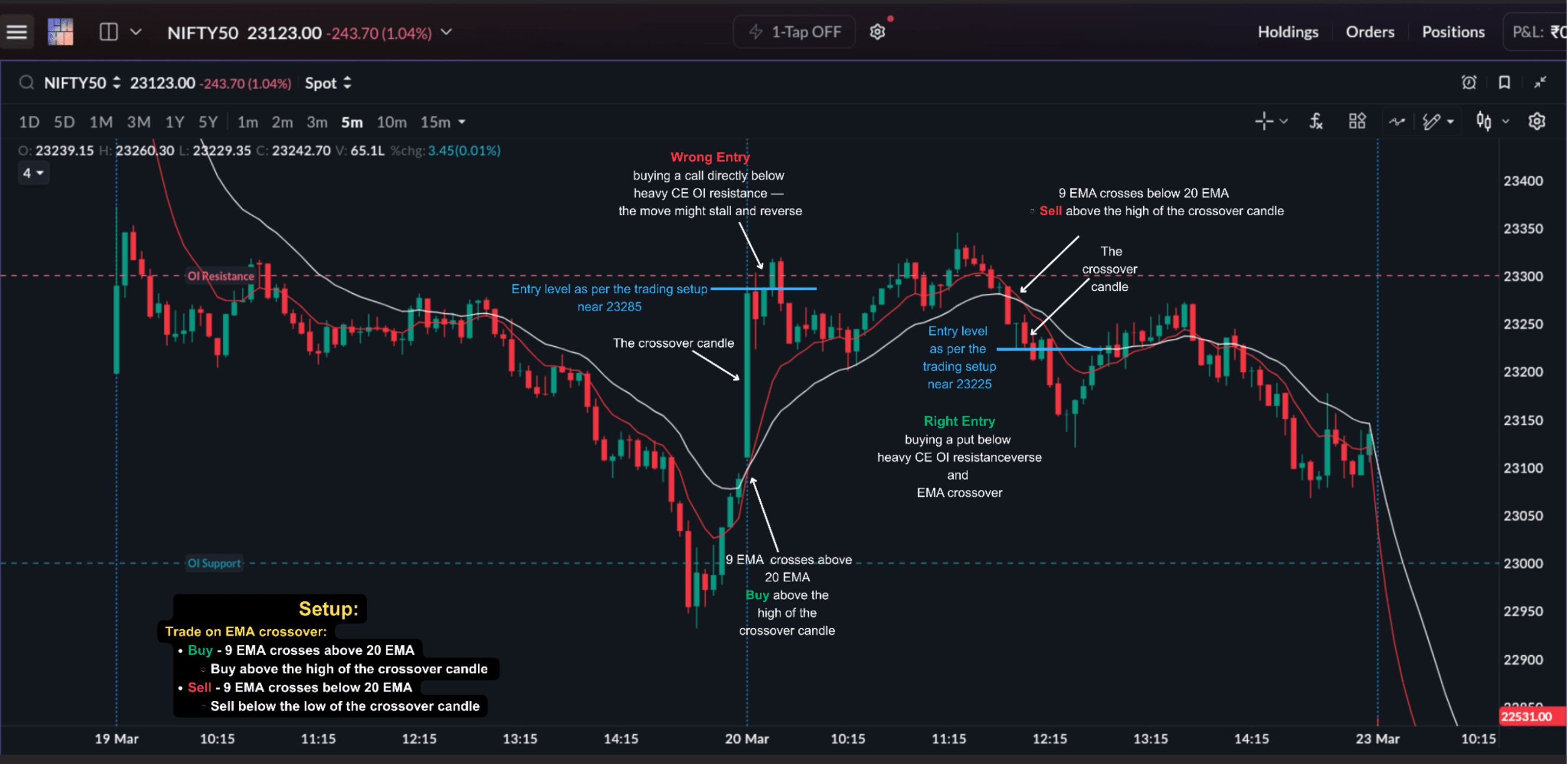
Open Interest (OI) often highlights areas where market participants are heavily positioned. These zones can act as support or resistance because they reflect actual positioning, not just technical levels.
Ignoring OI while entering trades can lead to specific failures:
- buying a call directly below heavy CE OI resistance, where the move may stall or reverse
- shorting into heavy PE OI support, where the expected breakdown may not follow through
The trade may look correct directionally on the chart, but the OI structure may be working against it. Price movement is often absorbed or reversed near such zones.
When that happens:
- momentum may slow
- buying or selling pressure may weaken
- profit booking may emerge
- reversals become more likely
If OI shows a strong wall directly above or below the entry, the risk-reward of the trade is already compressed from the start.
The better approach is to consider OI before the entry, not after the trade has already failed.
Lesson to Learn
- OI provides important context beyond price action
- Strong positioning zones can reduce momentum
- Price movement becomes more reliable when positioning supports the trade
Ignoring Volatility Conditions
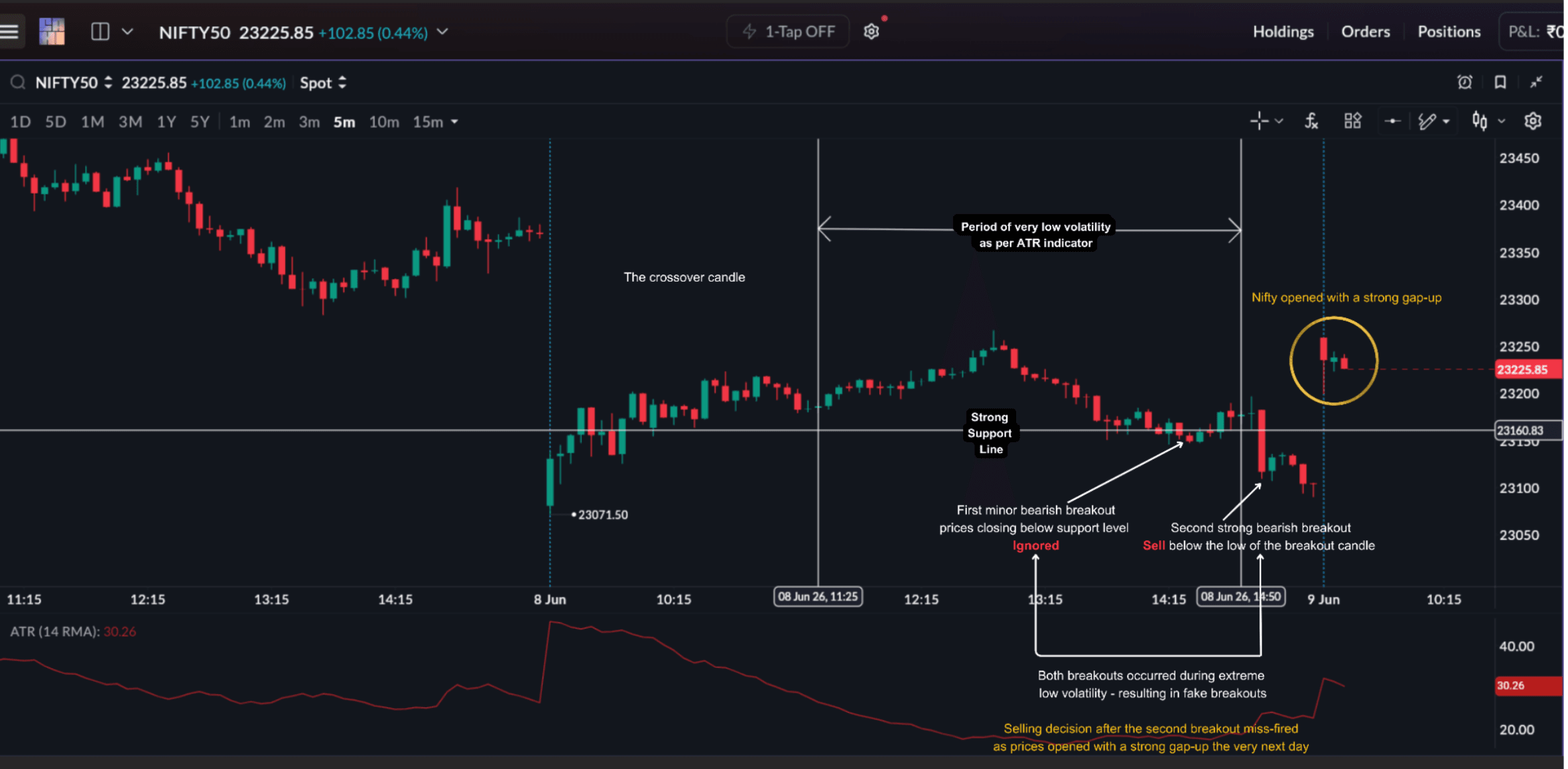
Not every session supports momentum-based scalping. A setup may trigger and the underlying may move in the expected direction, yet the option premium may respond less than expected or sometimes more than expected. This difference is often shaped by volatility.
Volatility plays a major role in deciding whether premiums still have room to expand after a setup triggers.
Two common situations where volatility contributes to trade failure:
1. During low-volatility conditions
- breakouts often struggle to sustain momentum
- ranges become more common
- follow-through becomes limited
A trader may identify a technically correct breakout, but the market may simply lack enough energy to continue the move.
2. Around major events
- before the event, implied volatility (IV) may increase significantly
- after the event, volatility may contract sharply
This can create situations where the directional view looks correct, but premium behaviour still disappoints.
Lesson to Learn
- Setups require supportive volatility conditions
- Premium expansion is not guaranteed simply because price moves
- Market environment matters as much as the setup itself
Poor Strike Selection
A successful scalp trade depends not just on direction, momentum, or volatility but on several factors working together.
The direction may be correct, the price action may support the move, OI positioning may align with the trade, and volatility conditions may be favourable. Yet the trade can still underperform if the wrong option contract is selected.
This is where strike selection becomes important.
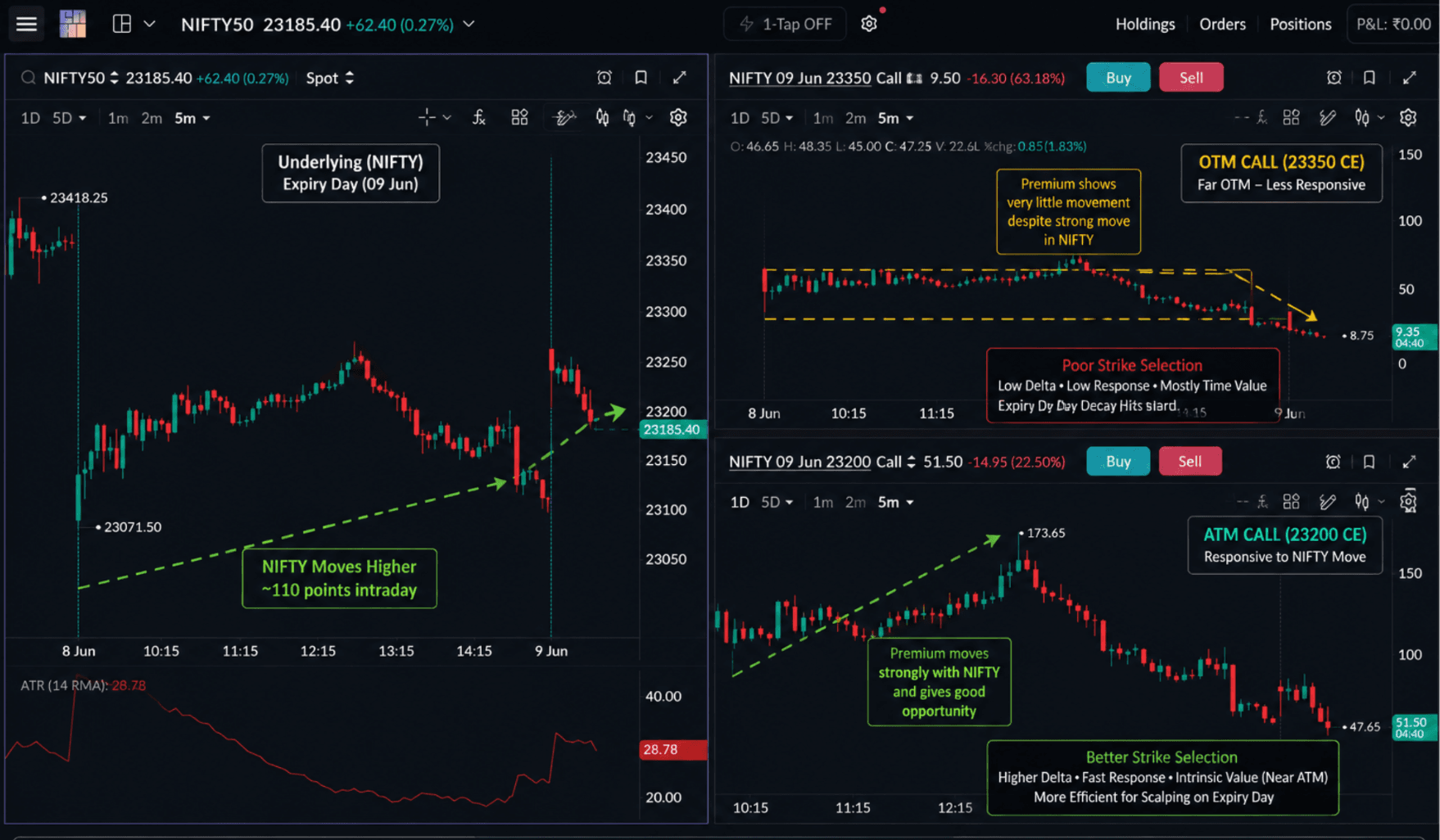
Many new traders choose option contracts mainly based on premium cost. Cheaper premiums may look attractive, but they are cheap for a reason.
OTM options have no intrinsic value, and far OTM contracts usually have:
- lower Delta
- slower responsiveness to price movement
- greater dependence on strong momentum
- higher sensitivity to time decay
As a result, even when the market behaves as expected, the premium may not react in a meaningful way.
Consider a simple example: a trader expects NIFTY to move higher and buys a far OTM Call option because it costs only ₹12. During the next hour, NIFTY rallies 80–100 points, but:
| Contract | Premium at Entry | Premium After the Rally | Move Captured |
|---|---|---|---|
| Far OTM Call | ₹12 | ₹14 | Barely reacts despite the rally |
| ATM Call | ₹100 | ₹125 | Responds meaningfully to the same move |
So in options trading, selecting the correct contract is often just as important as identifying the correct direction.
ATM options are generally preferred for scalping because they offer a balance between premium responsiveness and cost. With Delta near 0.5, the premium usually reacts meaningfully to index movement without requiring a very large move.
Lesson to Learn
- Correct market direction does not guarantee strong premium movement
- Strike selection directly influences how the option responds to price changes
- Cheap premiums can sometimes become expensive mistakes
- Scalping usually benefits from contracts that react efficiently to market movement
Holding Trades Too Long
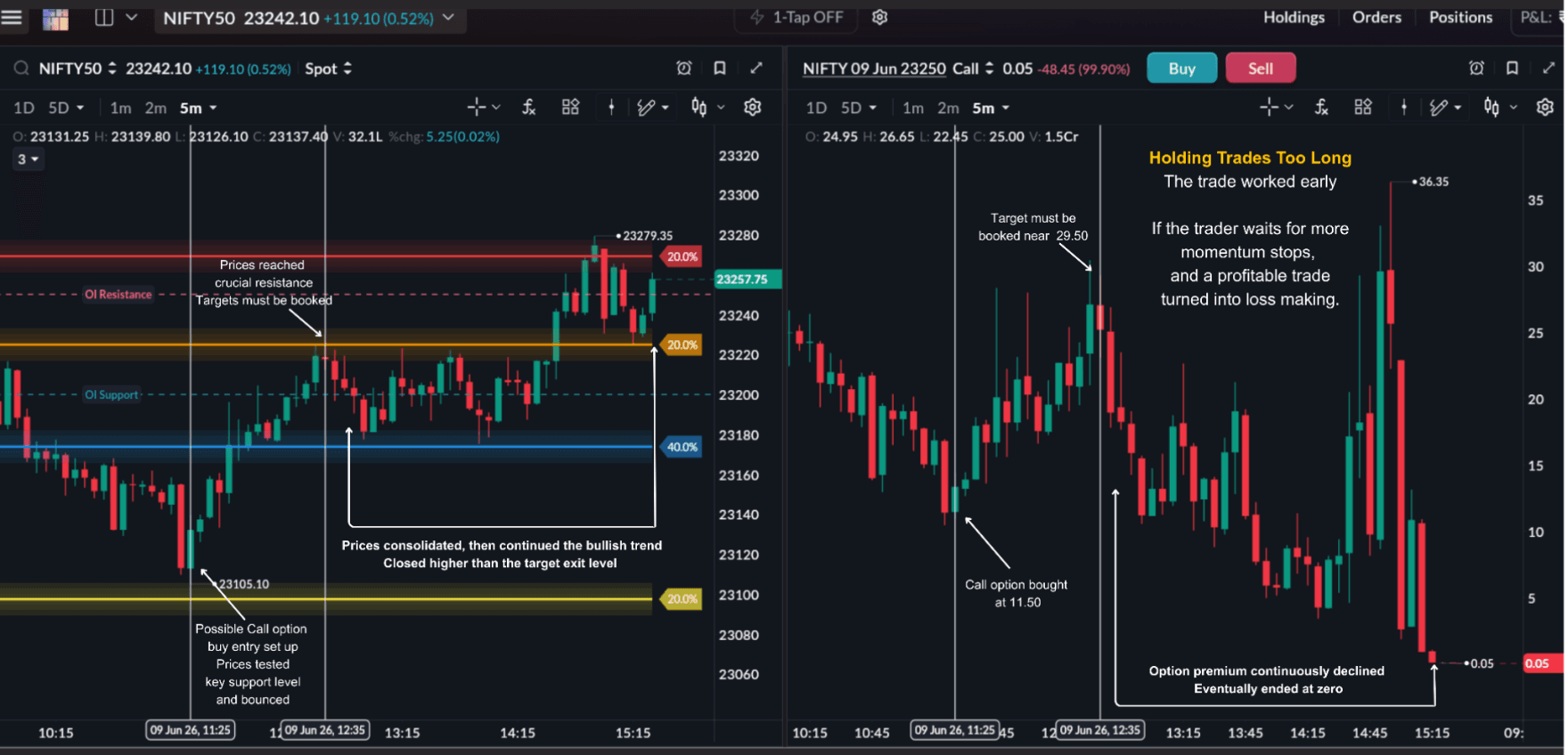
Scalping is designed to capture momentum. Once momentum slows, the nature of the trade starts changing, and that is where many traders begin giving back profits.
Holding a trade beyond its intended duration often turns it into a different trade with a different risk profile.
When momentum fades during an open scalp trade:
- premium value starts reducing gradually because of Theta decay
- the probability of reversal rises as price stabilises
- existing gains begin fading, and the trade can drift toward break-even or loss
This is a common pattern. The trade works early, the trader waits for more, momentum slows, and the premium slowly gives back the gain.
The exit trigger in scalping should be momentum-based, not target-based alone. If the premium is no longer expanding and price is stalling, that is already information. Waiting for the target anyway is not discipline. It is ignoring what the market is showing.

Lesson to Learn
- Scalping rewards momentum, not patience
- Slowing momentum changes premium behaviour
- Holding beyond the original plan often reduces trade quality
Overtrading and Revenge Trading
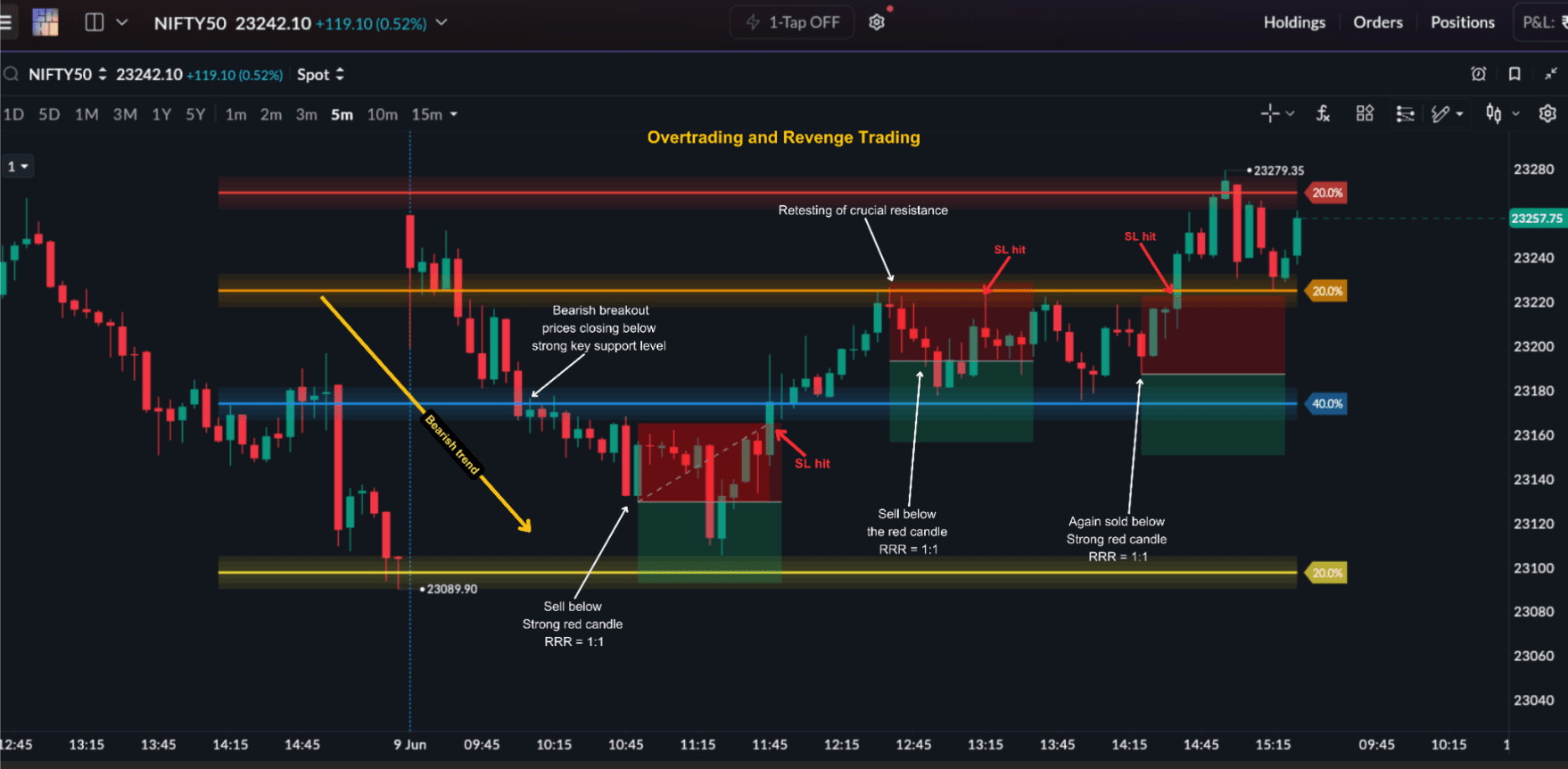
Losses are part of trading. But many traders struggle not with the initial loss, but with what they do immediately after it.
A common behavioural pattern after a losing trade is the urge to recover the loss quickly. This often leads to:
- increased trade frequency
- lower-quality entries
- forcing setups that do not meet the original filters
- ignoring session rules or time-of-day filters
- breaking position-sizing discipline to “make it back”
- reduced patience
This behaviour is known as revenge trading. It rarely recovers losses and usually compounds them.
The original loss was limited. The trades taken in response to it often cause much larger damage because they are no longer based on analysis. They are based on the trader’s emotional state in that moment.
Lesson to Learn
- One losing trade is normal
- Revenge trading often causes more damage than the original loss
- Process discipline matters more than immediate recovery
Indicator Dependence Without Context
As discussed in the previous chapter, indicators are tools for organising information. They are not standalone signals.
When used without broader market context, they often produce false signals that look valid in isolation but fail in practice.
Examples include:
- buying or selling only because RSI appears oversold or overbought
- trading EMA crossovers inside a sideways market
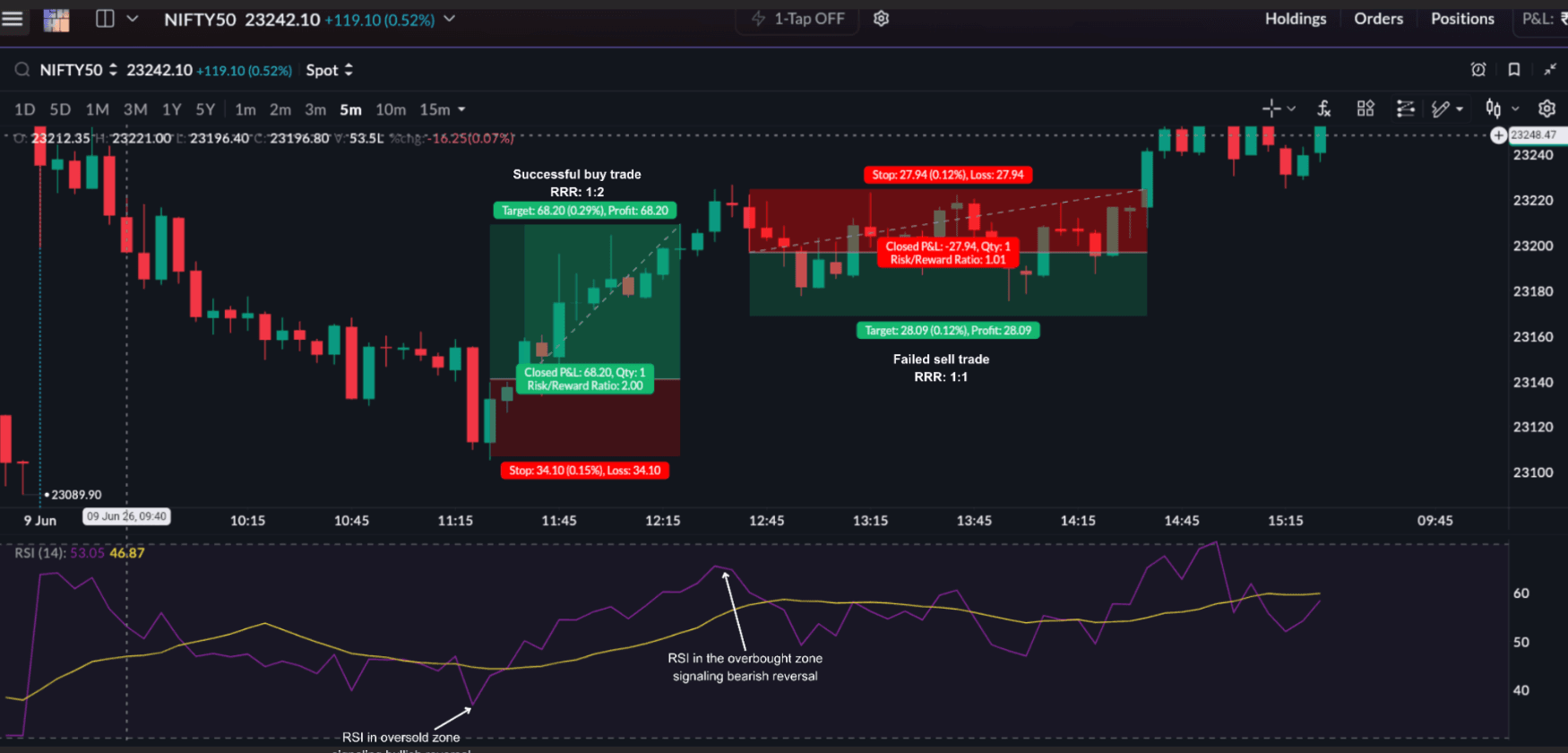
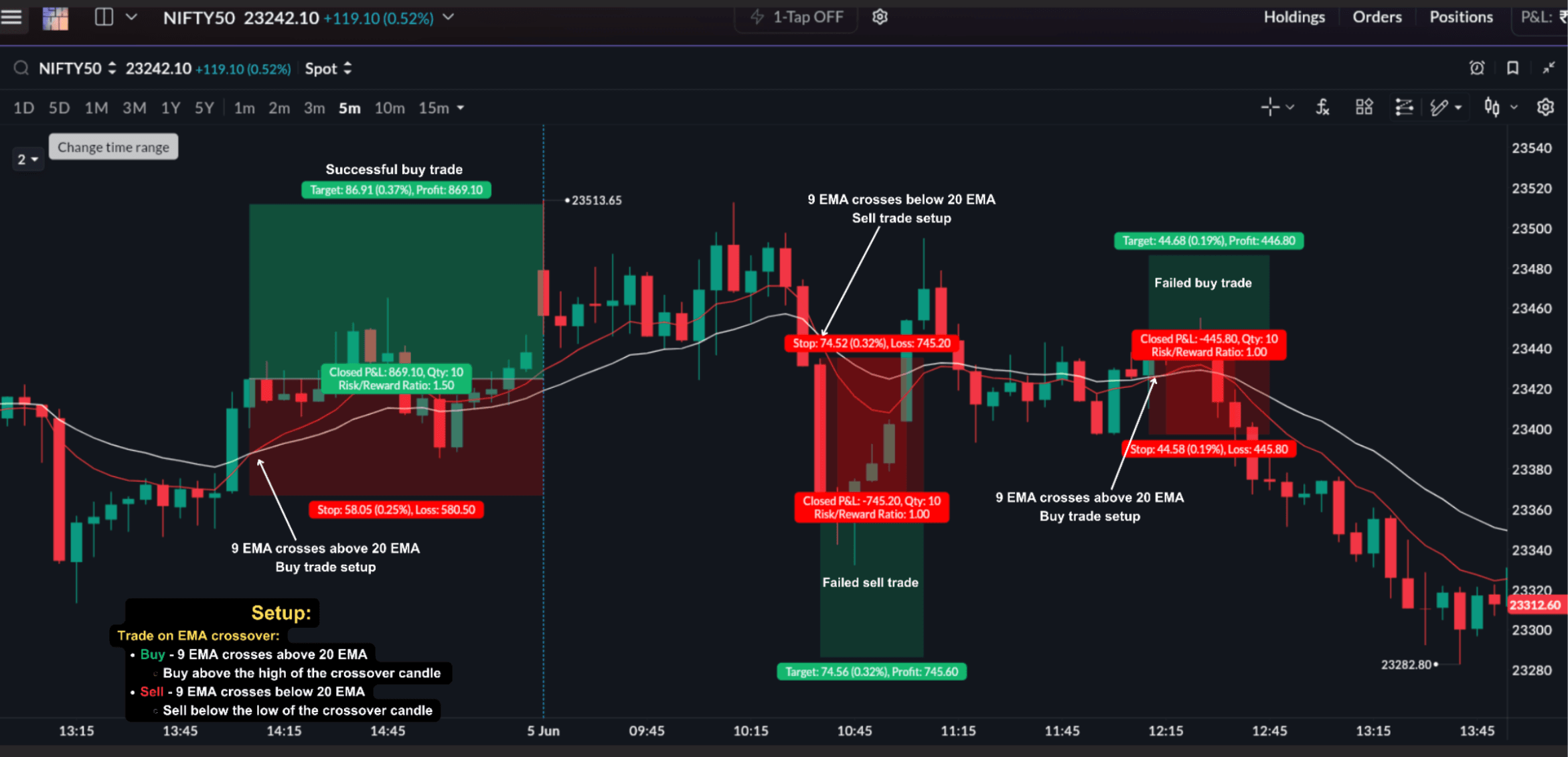
Indicators are most effective when they confirm existing market conditions. They become much less effective when used independently. A strong indicator signal inside poor market structure often produces disappointing results.
Context creates the opportunity. Indicators help validate it.
Lesson to Learn
- Indicators should confirm price action, not replace it
- Context remains more important than any single signal
- High-quality trades usually combine structure, positioning, and confirmation
False Confirmation and Emotional Bias
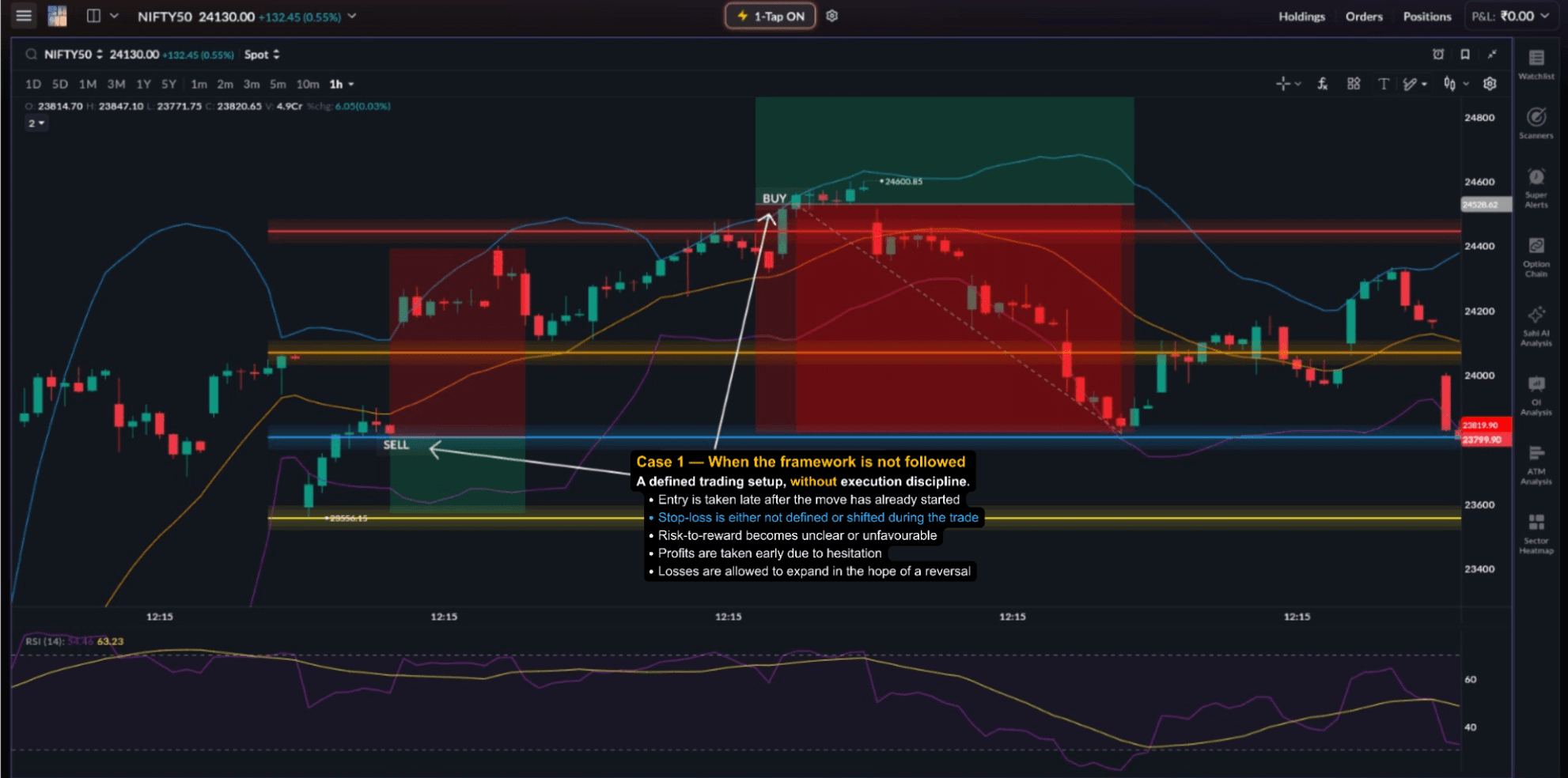
One of the more subtle failure patterns in scalping is confirmation bias, the tendency to see what supports the trade already being planned, while ignoring what contradicts it.
This usually appears in ways such as:
- seeing confirmation where there is only a partial signal
- maintaining a bullish or bearish bias even after price structure changes
- refusing invalidation and keeping the trade open because “the view is still correct”
- moving the stop-loss away from the original level because the trade is under pressure
Moving a stop-loss is often the clearest sign that the original risk structure has been abandoned.
The stop was placed there because beyond that level, the setup was no longer valid. If it is moved under pressure, the trader is no longer executing the original trade. They are reacting emotionally.
Pre-defining invalidation before entry is one of the most effective ways to deal with this. If the trade does not behave as expected within a defined time and price range, it is exited. That decision should be made before the trade starts, not during it.
Lesson to Learn
- Confirmation should come from the market, not expectations
- Invalidation is part of trading
- Strong execution requires flexibility, not attachment
What Good Execution Actually Looks Like
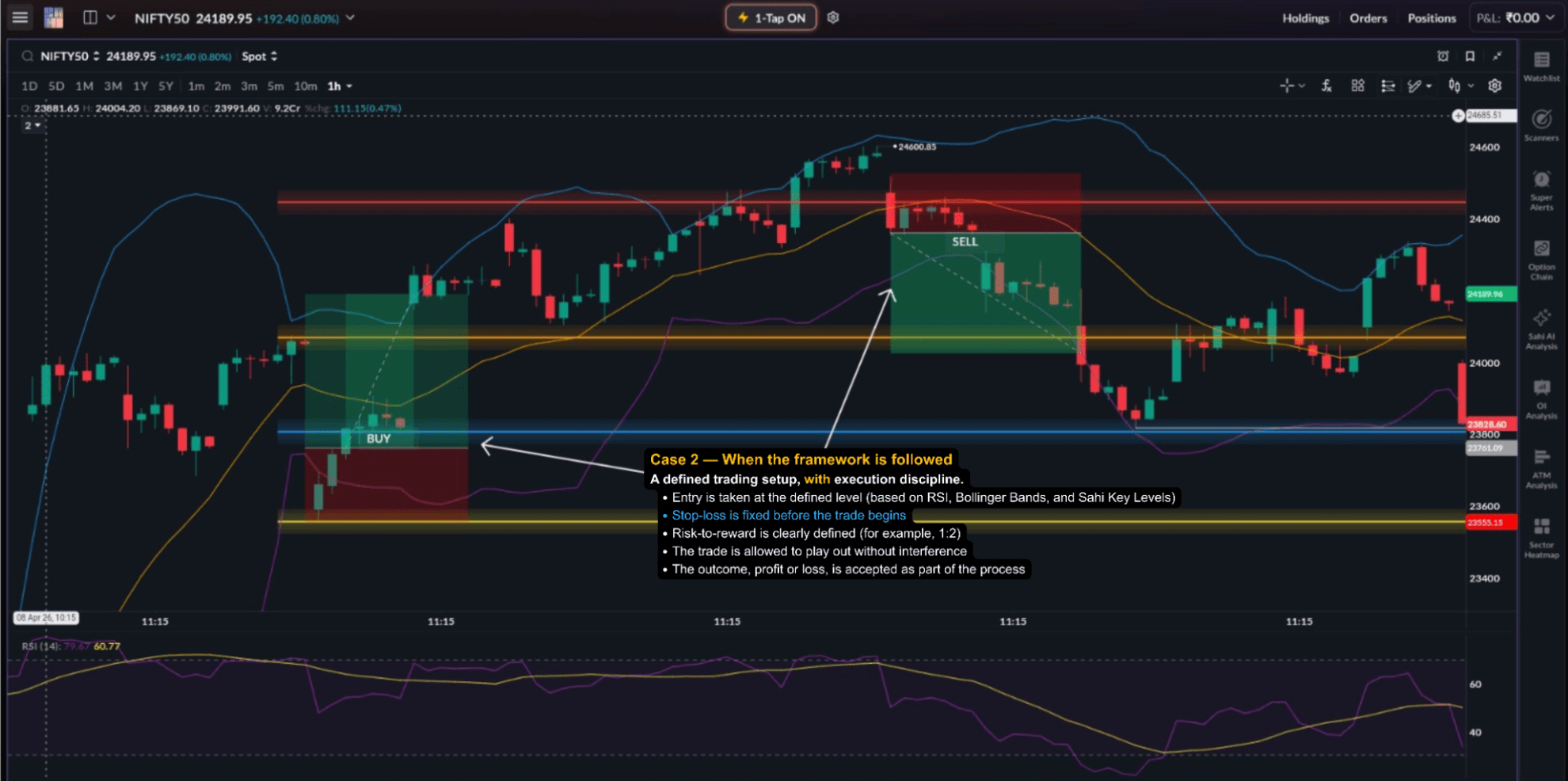
After reviewing common failure patterns, it becomes easier to understand what strong execution actually looks like.
A high-quality scalp trade usually includes:
- context alignment: OI, structure, volatility, and session conditions support the trade
- clean entry: taken at the right stage of the setup, not after the move has already expanded
- controlled risk: stop-loss placed at the structural level before entry, not adjusted during the trade
- disciplined exit: based on momentum behaviour and premium action, not on hope
- quick acceptance of invalidation: if the trade does not behave as expected, it is closed without hesitation
Not every trade will be profitable. That is not the objective. The objective is to keep participating in situations where probability, execution, and risk are aligned.
When these factors come together, trade quality improves regardless of the outcome of any single trade.
Lesson to Learn
- Good execution is a process, not a prediction
- Context, timing, and risk management work together
- Consistency comes from execution quality, not individual wins
Avoiding execution mistakes is only one side of successful scalping. The next step is understanding how traders use Option Chain and Open Interest during live sessions to evaluate positioning, identify possible support and resistance zones, and improve trade selection before execution.
The next chapter focuses on reading Option Chain and OI data to better understand market structure and positioning.
Test yourself
Check how well you understood common scalping mistakes and trade failure scenarios.
Investor knowledge check
How well do you understand the markets?
Five quick questions on the execution mistakes that cause scalp trades to fail.
 5 questionsUnder 3 minutes
 Instant score