
Which Broker Has the Fastest Execution Speed? How to Judge It Yourself
Search for the broker with the fastest execution speed and you will find plenty of brokers happy to claim the title. Very few show you the number behind the claim. Fewer still explain what that number actually measures.
If you trade options or futures actively, this matters more than almost anything else on the pricing page. Execution speed is the gap between the price you meant to get and the price you actually got. That gap is slippage, and on a fast-moving expiry day it compounds across every order you place. A platform that lags by a few hundred milliseconds when volume spikes can quietly cost you more than a full year of brokerage.
The honest answer to "which broker is fastest" is that you usually cannot tell from the marketing alone. So instead of taking anyone's word for it, including ours, here is how to compare execution speed properly, and a checklist you can run against any broker you are considering.
Why "fast" is so hard to compare
Most brokers do not publish a latency figure at all. The ones that do often measure different things, so the numbers are not comparable side by side. "Latency" can mean any of these very different journeys:
- Order placement from a cloud server to the exchange
- The broker's own internal processing time only
- A full round trip from your tap to the confirmation on screen
These are not the same. A small number that measures a short journey can look better than a bigger number that measures the whole path. That is why a headline "fast" claim, with no method attached, tells you almost nothing. There are three more traps to watch for:
- Averages hide the bad days. A broker that quotes a mean is quietly burying its slow orders. The orders that hurt you are the ones in the tail, the slow outliers on a busy session. A percentile like P95 or P99 tells you the real story. A P95 of six milliseconds means 95 out of every 100 orders were at least that fast.
- Sample size and recency matter. A quick figure across a handful of test trades in a calm session is not the same as the same figure across millions of real orders during live market hours. Always ask how many orders the number is based on, and over what dates.
- Lab tests are not live trading. Speed in a quiet market is easy. The real test is the last 90 minutes of an expiry session, when everyone wants to trade at once. A figure measured during real, busy sessions is worth far more than one from a controlled test.
What actually makes a broker fast
Fast execution is not luck, and it is not a single clever optimisation. It comes from architecture. Slow platforms are often slow because an order hops through several systems on its way out: a third-party charting tool, then a separate order manager, then the exchange gateway. Every handoff adds time, and every handoff is a place things can break under load.
The brokers that are genuinely quick tend to share a few traits:
- They run charting and order placement on one integrated stack, not a chain of stitched-together tools.
- Their servers sit physically close to the exchange, which cuts the distance every order has to travel.
- They measure their own latency continuously and are willing to publish it.
- They hold up under peak load, with a clean record of no technical halts on the days that test infrastructure hardest.
- You cannot see architecture from the outside. But you can ask about it, and you can insist on data instead of adjectives.
Where SAHI stands
We built the checklist below around what we would want to know as traders, and then we held ourselves to it.
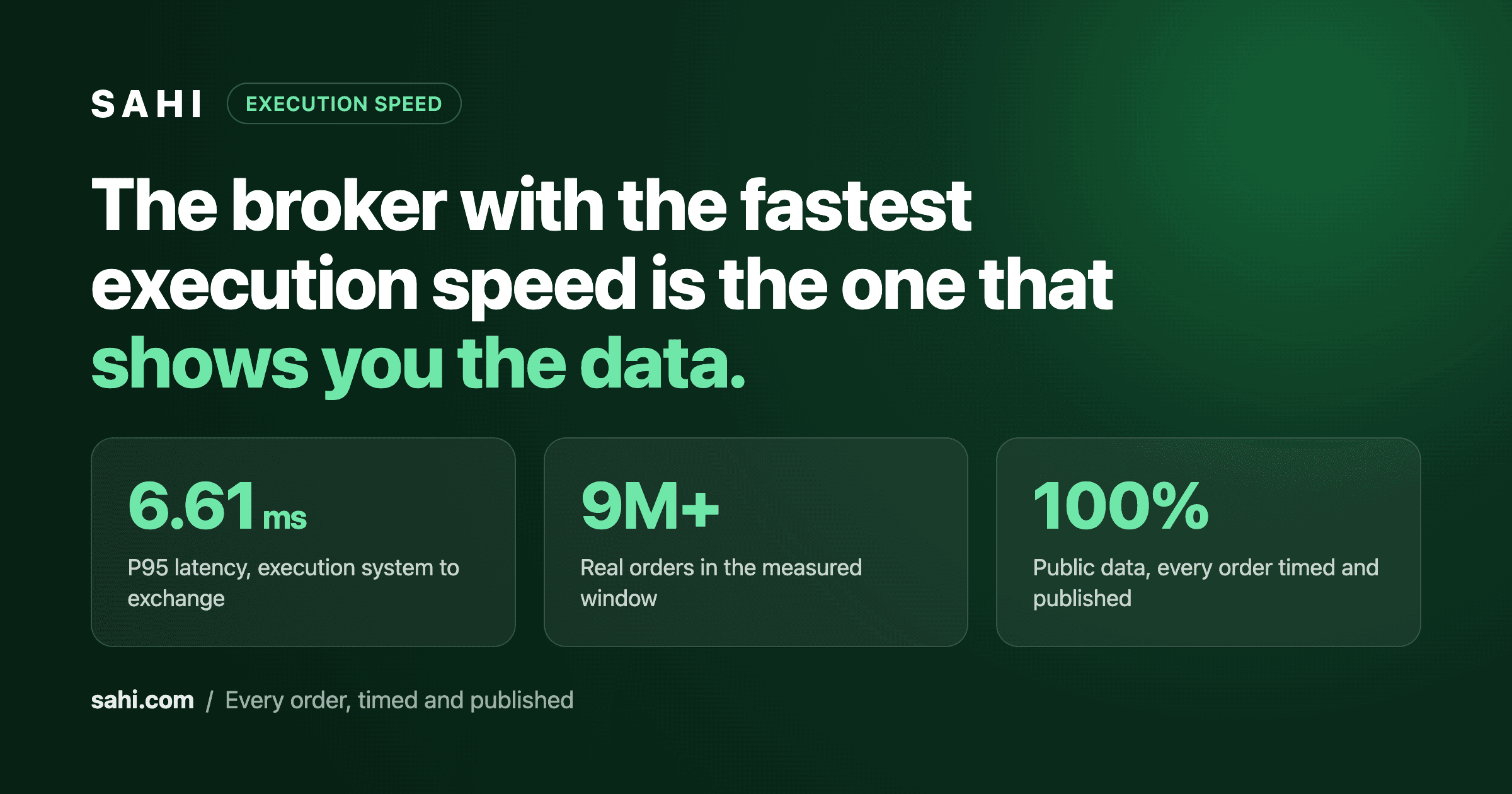
We published a P95 latency of 6.61 milliseconds, measured from our execution system to the exchange, across more than 9 million real orders over a stated window. That is live trading, not a lab test. We showed the full per-hop breakdown so you can see where the time goes, and we made the entire dataset public, every single order, so you can check the number yourself rather than take our word for it.
The reason the number holds is architecture. Our charting engine and order system run on the same in-house stack, sitting close to the exchange, so the handoffs that slow other platforms down simply are not there. You can also see how the platform has performed through recent expiry sessions, the days that stress infrastructure most.
That is the whole point. Do not trust a broker that only gives you a headline. Trust the one that opens its data.
See SAHI's execution-speed numbers for yourselfThe checklist: how to judge any broker's speed
Before you commit to a platform, it should be able to answer yes to every one of these. Run it against your current broker too. The answers can be revealing.
- Does it publish an execution-speed figure at all? Speed you cannot see is speed you cannot trust. Transparency is itself a signal.
- Is it clear about what is being measured, end to end? Ask for the two endpoints. The honest figure covers the full server-side journey, from the moment your order hits the broker's system to the moment it reaches the exchange.
- Is it a percentile, not just an average? Ask for P95 or P99. The average hides the orders that actually cost you money.
- How large and how recent is the sample? Look for millions of real orders over a stated, recent window, not a few test trades.
- Can you see the raw data? The strongest proof is not a headline number. It is the underlying data, made public, so you can verify it order by order.
- Does it hold up under peak load? Look for a latency figure measured during real, busy expiry sessions, plus a clean record of no technical halts when it mattered.
- What is the architecture behind the number? An integrated stack sitting close to the exchange beats a chain of third-party handoffs every time.
If a broker cannot answer these, the speed claim is marketing, not measurement.
Execution figures reflect the published measurement window and can vary with market conditions. Fast execution reduces friction; it does not remove the risks of F&O trading.