
Using Option Greeks for Scalping
Option premiums do not move in a fixed relationship with the index. Their behaviour changes with price movement, time, and momentum, and these changes are explained through Option Greeks. This chapter focuses on how Greeks like Delta, Gamma, and Theta affect option premium movement during scalping.
 10 minutes read|
Why Greeks Matter
In scalping, trades are short and movements are fast. But option premiums do not always move the way traders expect.
A 50-point move in Nifty does not automatically mean a 50-point move in the option premium. Sometimes the premium reacts strongly. Sometimes it barely moves. And near expiry, even a small move in the index can suddenly create a sharp spike in premium.
The premium is not just reacting to direction. It is also reacting to how sensitive the option is to movement, how much time is left until expiry, and how quickly momentum is building or fading.
These relationships are explained through the Greeks.
Greeks mainly explain:
- How much the premium is likely to move when the underlying moves (Delta)
- How quickly that premium movement can accelerate (Gamma)
- How time itself reduces premium value while holding a trade (Theta)
Another important Greek called Vega affects how premiums react to changes in volatility. Since volatility behaves differently during live market conditions and expiry sessions, it will be covered separately in the next chapter.
Without understanding this behaviour, trades can start feeling inconsistent even when the setup looks correct on the chart.
For example:
- The market moves in the expected direction, but the premium barely reacts
- The premium suddenly spikes much faster than expected
- A trade stays flat for too long and time decay starts reducing gains
In scalping, these differences directly affect execution, exits, and profitability.
Delta: Directional Movement
Delta is the starting point for understanding how option premiums react to movement in the underlying asset.
In simple terms, Delta tells us approximately how much the option premium may change if the underlying moves by one point.
The Delta value changes depending on both the strike price and the type of option being traded.
- Call option Delta usually ranges between 0 and 1
- Put option Delta usually ranges between −1 and 0
Put options carry a negative Delta because they generally move in the opposite direction of the underlying asset. When the index falls, put premiums usually rise, and when the index rises, put premiums usually fall.
Instead of thinking about formulas, it becomes much easier to understand Delta through actual price movement.
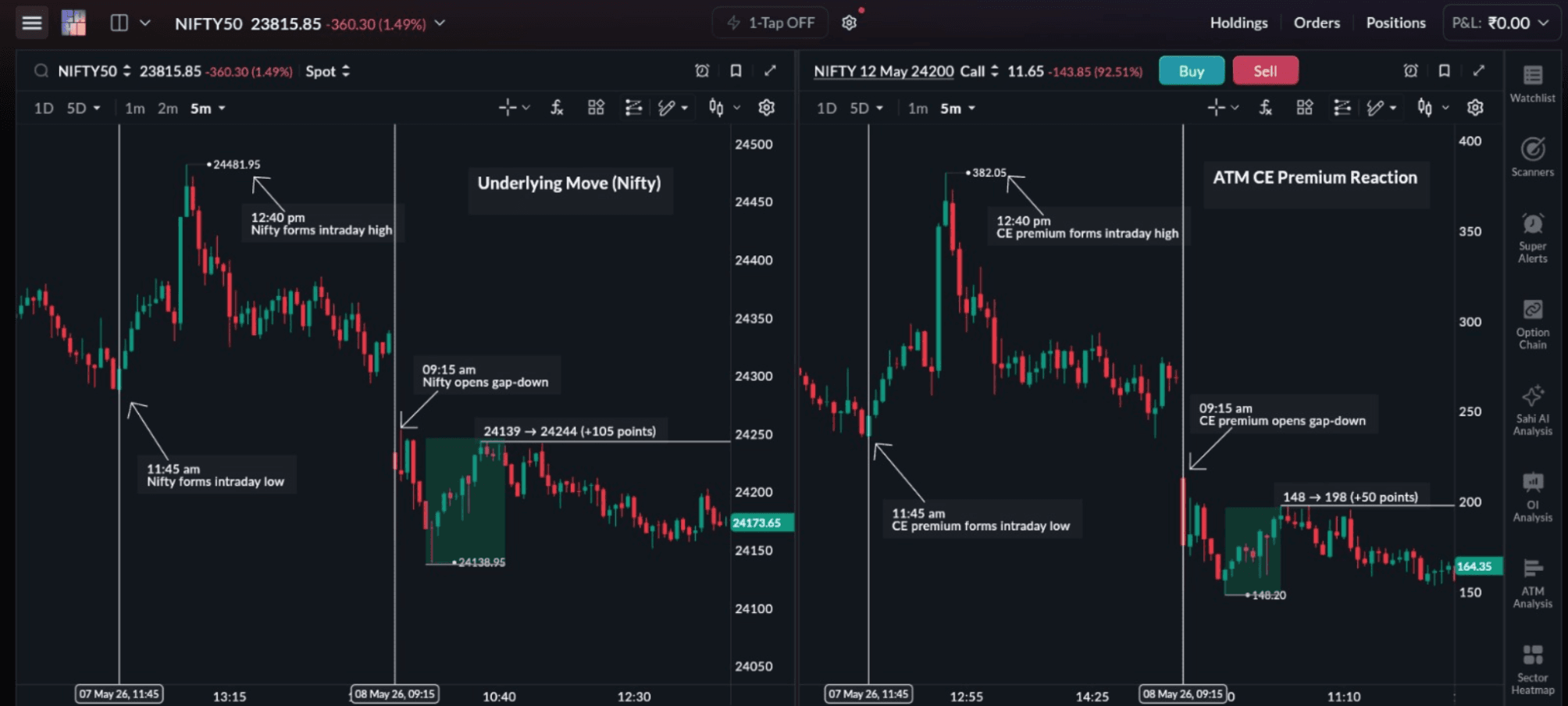
The chart shows Delta in action.
A roughly 105-point move in Nifty leads to an approximately 50-point move in the ATM call option premium. The premium is moving with the index, but not on a one-to-one basis.
This is why two trades with the same directional view can still behave very differently depending on the strike selected.
An ATM (At-The-Money) option generally has a Delta close to 0.5. If Nifty rises 100 points, the ATM premium may rise around 50 points.
Different strikes react differently to the same move in the underlying asset:
| Option Type | Typical Delta Range | Premium Behaviour | Scalping Relevance |
|---|---|---|---|
| ATM (At-The-Money) | Around 0.5 | Balanced premium movement | Commonly preferred |
| ITM (In-The-Money) | Above 0.5 | Premium reacts more aggressively | Faster movement |
| OTM (Out-Of-The-Money) | Below 0.5 | Premium reacts slowly initially | Slower response |
A setup may be correct directionally, but if the option chosen reacts too slowly, the premium movement may still not be enough within the holding window of the trade.
That is why strike selection is not just about choosing a cheaper premium. It directly affects how responsive the trade will feel once the move begins.
What to take away
- Delta helps estimate how responsive the premium will be
- ATM options usually provide balanced movement for scalping
- Strike selection directly affects execution quality and premium behaviour
Gamma: Speed of Movement (Change in Delta)
If Delta explains how much the premium moves, Gamma explains how quickly that premium movement starts accelerating as the underlying price moves.
Gamma becomes strongest:
- Near expiry
- In ATM options
This is where expiry scalping starts feeling very different.
A relatively small move in Nifty can suddenly create a much larger move in the option premium. And when momentum slows or reverses, those gains can disappear just as quickly.
How this usually plays out
During expiry or high-volatility sessions:
- Even a 20–30 point move in Nifty can create a sharp spike in premium
- The premium does not rise gradually — it starts accelerating once momentum builds
So two things start happening at the same time:
- Quick profits when the move works in your favour
- Equally fast drawdowns when the move reverses
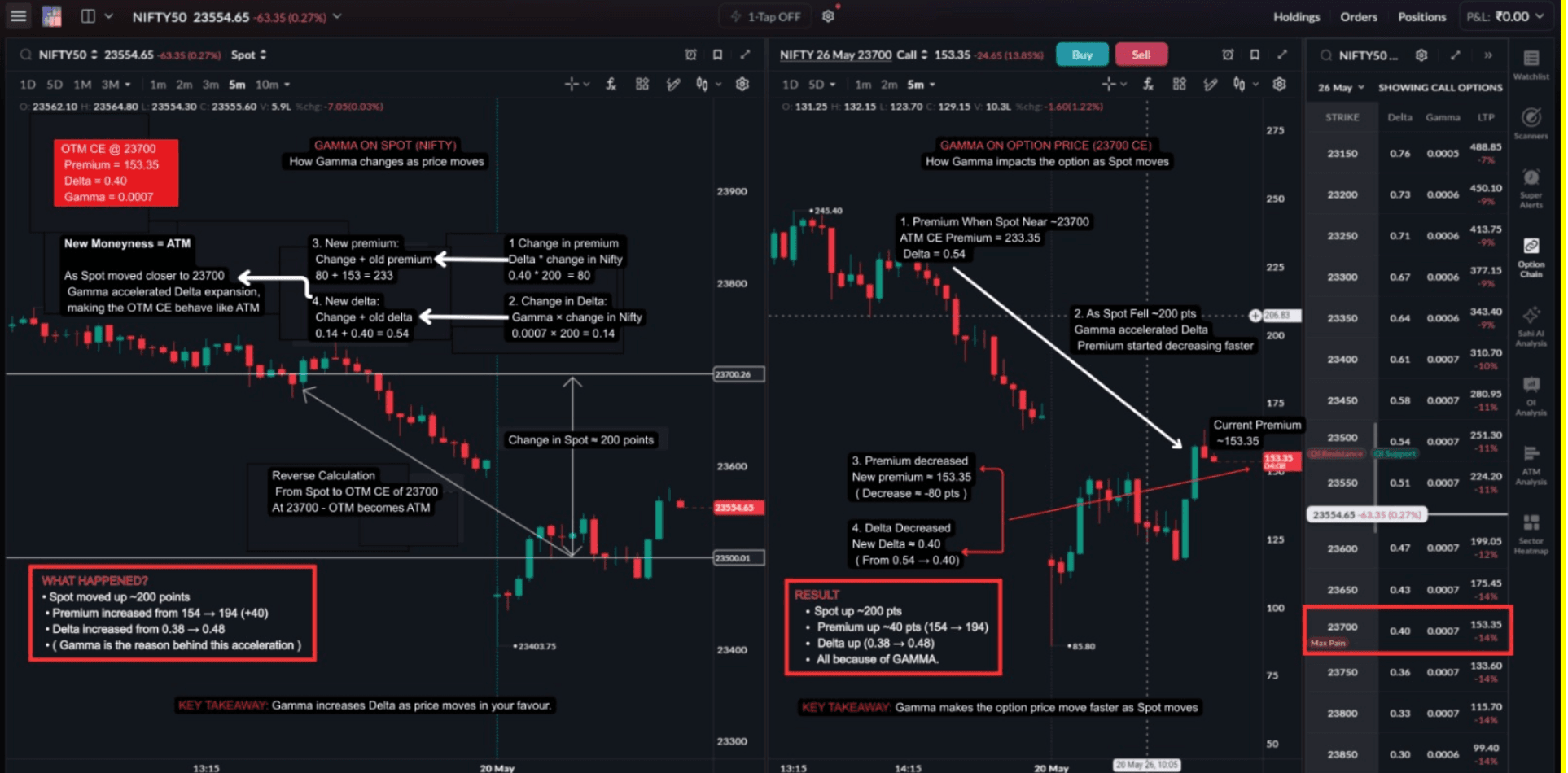
The chart works backward from the market close to show how Gamma increased the option’s responsiveness as it moved from OTM toward ATM.
As Nifty moved closer to the strike price, Delta expanded and the premium began reacting more aggressively to underlying price movement. This is how Gamma becomes visible during live trading, especially near expiry.
A trade may initially look stable, but Gamma can suddenly change how aggressively the premium starts moving.
As momentum increases:
- The premium can suddenly expand very quickly
- Delayed entries start feeling expensive
- Exits need to happen faster because premium swings become sharper
The same effect can also work against the trader.
A trade moves into profit, the underlying pauses slightly, and the premium suddenly drops much faster than expected.
At that stage, the issue is no longer just direction, but the speed of premium movement.
What to take away
- Gamma increases the speed of premium movement
- It becomes strongest near expiry
- Faster premium movement requires quicker decision-making and tighter execution
Theta: Time Decay
Theta measures how option premiums lose value as time passes.
An option premium is made up of two components:
Option Premium = Intrinsic Value + Time Value

- Intrinsic Value → the actual value the option currently holds
- Time Value → the additional value based on the remaining time until expiry
As expiry approaches, the time value gradually reduces. This is known as Theta decay.
In simple terms, even if the market remains stable and does not move much, the option premium can still gradually decline because of time decay.
During strong trending moves, Theta is usually less noticeable. It becomes far more noticeable when price action starts slowing down.
This effect becomes more relevant:
- During sideways or range-bound markets
- When trades are held longer than originally planned
- Near expiry, when time decay becomes faster
For scalpers, this creates a very common problem.
A setup may still look valid on the chart, but if price does not move quickly enough, the premium can slowly start losing value while the trade is being held.
How this usually shows up in scalping
A trade is taken based on a setup:
- Price stabilises instead of moving
- No clear breakout follows
- Momentum starts slowing down
During this time:
- The premium gradually starts fading
- Expected profit begins reducing
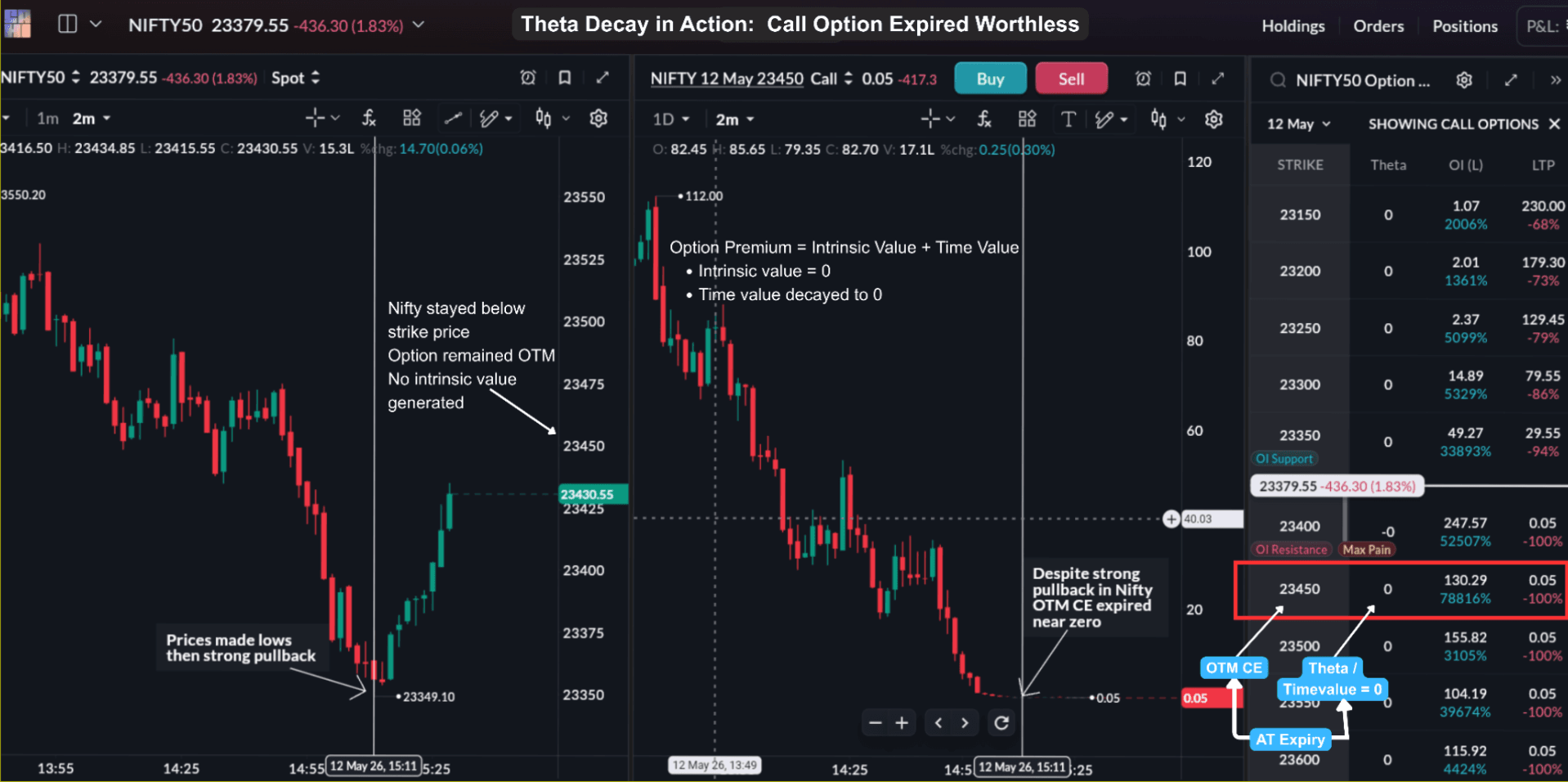
The chart shows a common expiry-day scalping situation.
The underlying made a late pullback but remained below the strike price. Since the option stayed OTM, no intrinsic value was created.
As expiry approached, the remaining time value eroded rapidly through Theta decay, causing the premium to collapse toward zero despite the pullback in Nifty.
This is how Theta becomes visible during live trading, especially when momentum slows down near expiry.
A common situation looks like this:
- The trade moves slightly into profit
- The trader waits for a larger move
- Price stays flat
- The premium gradually starts fading
Eventually, the trade either exits at a much smaller profit or slowly drifts toward break-even or loss.
What to take away
- Theta reduces premium value as time passes
- It becomes more visible when momentum slows down
- In scalping, time itself becomes a risk when trades are held too long without movement
Expiry Day Behaviour
Expiry day combines all three elements together:
- High Gamma
- High Theta
- Rapid changes in premium behaviour
This creates a very different trading environment.
What changes on expiry
Premium behaviour becomes:
- Faster in movement
- More sensitive to small price changes
- Quicker to lose value if price stalls
A relatively small move in Nifty can suddenly create a sharp spike in premium, while a brief pause in momentum can start reducing premium value just as quickly.
Typical expiry-day behaviour includes:
- Sharp spikes and drops in premium
- False breakouts followed by quick reversals
- Rapid shifts between profit and loss
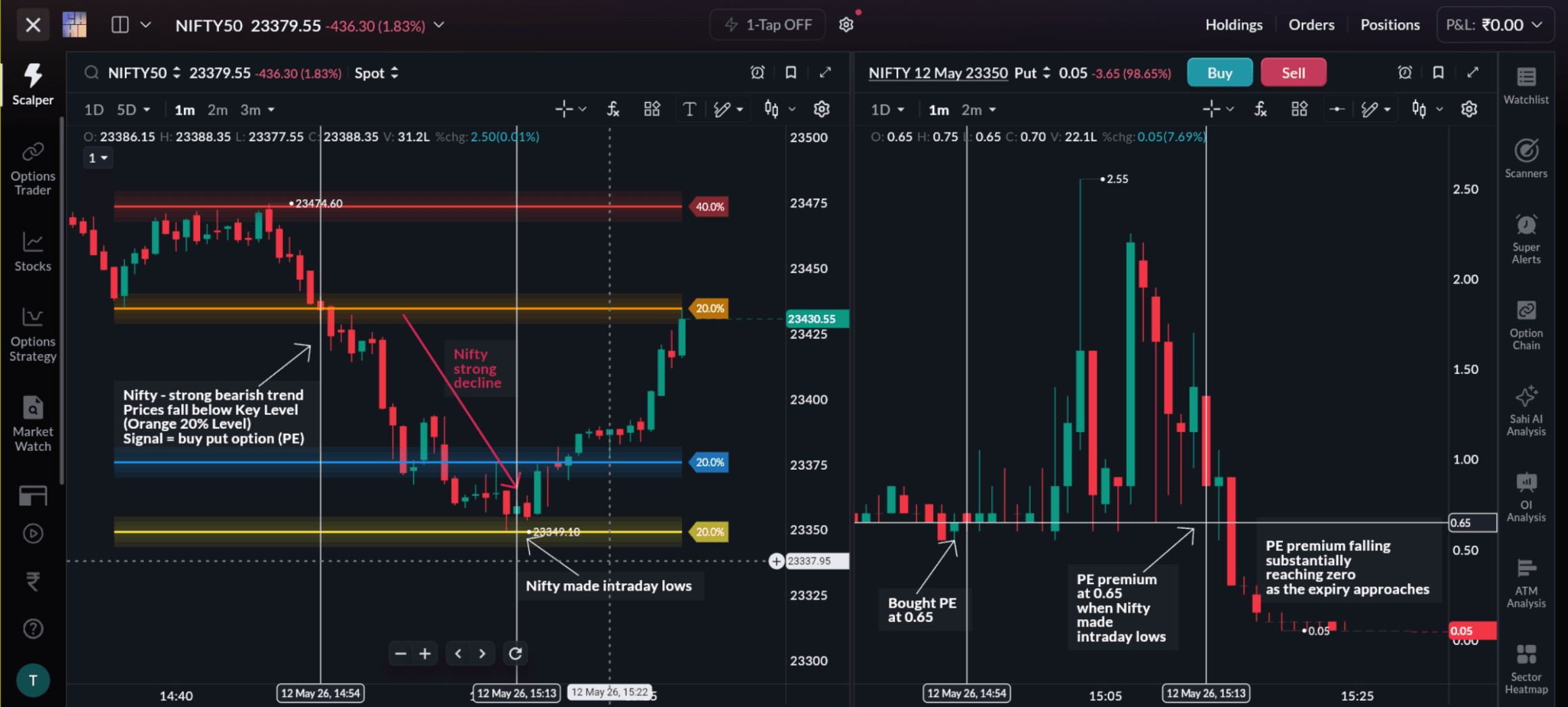
The OTM put premium initially surged as Nifty declined, rewarding the correct bearish view.
But even at the intraday lows, the strike remained OTM, so no intrinsic value was created. The premium was still largely made up of time value, which began eroding rapidly as expiry approached.
Despite the bearish move in Nifty, the premium eventually collapsed toward zero near expiry.
This is why expiry-day scalping becomes less about prediction and more about execution.
Expiry trades usually require:
- Precise entries
- Quicker exits
- Minimal hesitation during decision-making
And the longer a trade is held without momentum, the more dangerous expiry conditions can become because both Gamma and Theta are reacting aggressively at the same time.
What to take away
- Expiry amplifies both opportunity and risk
- Small execution mistakes become more visible
- Timing and execution matter more than direction alone
Practical Application for Scalping
Once the individual Greeks are understood, the next step is observing how they come together during a live trade.
This is less about calculating Greeks in real time and more about understanding how the premium behaves while the trade is active.
Before the trade:
- Delta helps decide which strike to trade
- Responsiveness versus expected movement is considered
During the trade:
- Gamma explains sudden acceleration in premium movement
- Quicker exits may become necessary near expiry
While holding the trade:
- Theta starts affecting trades that are not moving
- Waiting too long can gradually reduce gains
Practical Framework
| Factor | What to Observe | Trading Adjustment |
|---|---|---|
| Delta | How responsive the option is | Choose ATM or ITM for better movement |
| Gamma | Speed of premium movement | Be quicker with exits near expiry |
| Theta | Time impact on premium | Avoid holding trades without momentum |
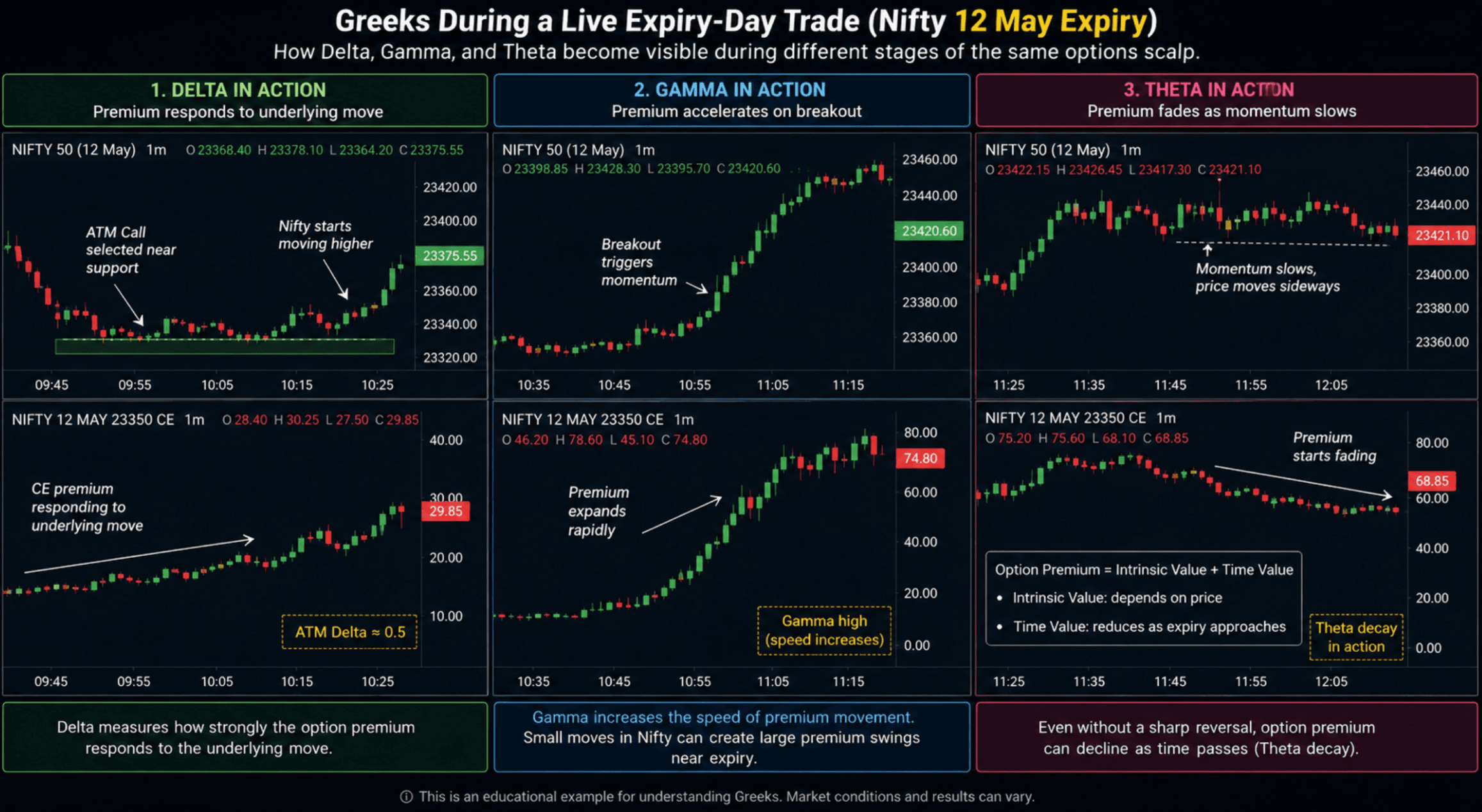
The chart shows how different Greeks become visible at different stages of the same trade using SAHI charts and live option premium movement.
A setup forms near support and an ATM call option is selected because the premium is expected to respond efficiently if momentum builds.
Once the breakout happens, the premium starts accelerating as Gamma becomes more active.
Later, momentum begins slowing down. The underlying is still holding, but the premium stops rising and gradually starts fading as Theta begins affecting the trade.
At this stage, the decision is no longer based only on direction. It is also based on how the premium itself is behaving.
This is where Greeks become useful in practical scalping. They help explain why the same trade can feel very different as market conditions change during the session.
From Greeks to Market Context
Greeks explain how option premiums behave during a trade, but premium movement is also shaped by market context.
Factors like OI, support and resistance, and volatility help explain where price may react and why premiums expand or contract. This is also where Vega becomes important, since it measures how volatility affects option premiums.
The next chapter focuses on using OI, key levels, volatility, and Vega to better read market conditions during scalping.
Test yourself
You have covered how Delta, Gamma, and Theta shape premium behaviour during a scalp. Check how well the Greeks have landed before moving to market context and Vega.
Scalping knowledge check
How well do you read the Greeks?
Five quick questions on Delta, Gamma, Theta, and expiry-day behaviour. See where you stand and pick up an insight along the way.
 5 questionsUnder 5 minutes
 Instant score