
What is Scalping in Trading? Meaning, How It Works & Should You Do It?
Scalping is the fastest form of active trading — in and out within minutes, capturing small but repeatable price moves. This chapter explains what scalping really means, how it works in practice, how it differs from intraday and swing trading, and how to decide if it is right for you.
 10 minutes read|
Most traders want the same thing: consistent profits, controlled risk, and a method that fits their schedule.
Scalping is one answer to that.
It is the fastest form of active trading. Here, you are in and out of a trade in minutes, sometimes seconds, capturing small but repeatable price moves. No overnight positions. No large bets. Just precision, repetition, and discipline.
But scalping is also widely misunderstood. Many beginners confuse it with intraday trading. Some treat it as random buying and selling. Others try it without understanding what separates a scalper from someone just clicking buttons quickly.
This chapter clears that up.
By the end, you will know:
- What scalping in trading actually means
- How it works in practice
- How it differs from intraday trading and swing trading
- The real benefits and risks
- Whether it is right for you
What is Scalping in Trading?
Scalping is a short-term trading strategy where you enter and exit a trade within minutes — targeting small, frequent price movements rather than one large move.
A scalper does not wait for a trend to develop. They do not hold a position for hours hoping for a breakout. They identify a precise setup, enter, take a quick profit, and exit, then repeat the process.
The core philosophy of scalping:
Small gains, taken repeatedly, compound into significant returns.

A scalper targeting 20–30 points on Nifty, executed across 8–10 clean trades in a day, builds a very different P&L than a trader swinging for a 150-point move that may or may not come.
Scalping in numbers (example):
- Target per trade: 20 points on Nifty options premium
- Trades per day: 8
- Win rate: 60% (5 winners, 3 losers)
- Avg win: 20 points | Avg loss: 12 points
- Net per day: (5 × 20) − (3 × 12) = 100 − 36 = 64 points net
That is what a scalping edge looks like — small, consistent, compounding.
How Does Scalping Work?
Every scalp trade follows the same three-step logic:
Step 1 — Identify a setup
Find a key level (support, resistance, or breakout zone) where price is likely to move quickly in one direction. This is your "trigger zone."
Step 2 — Enter with precision
Wait for confirmation. A breakout candle, a rejection wick, and a pattern forming at the level. Enter only when the setup is clear — not before.
Step 3 — Exit fast
Close the trade at your pre-defined target or stop-loss. No adjusting the target mid-trade. No hoping it goes further. Exit, book the result, and move to the next setup.
A practical example on Nifty:
Nifty is trading at 22,400. There is a strong support level at 22,390 (confirmed by Open Interest data). Price dips to 22,392 and forms a hammer candle with a sharp wick rejection. Volume picks up.
A scalper’s trade:
- Entry: 22,412 (after candle confirmation)
- Target: 22,445 (+33 points)
- Stop-loss: 22,388 (−24 points)
- Hold time: 5–7 minutes
- Outcome: Price reaches 22,445. Trade closed. Move on.
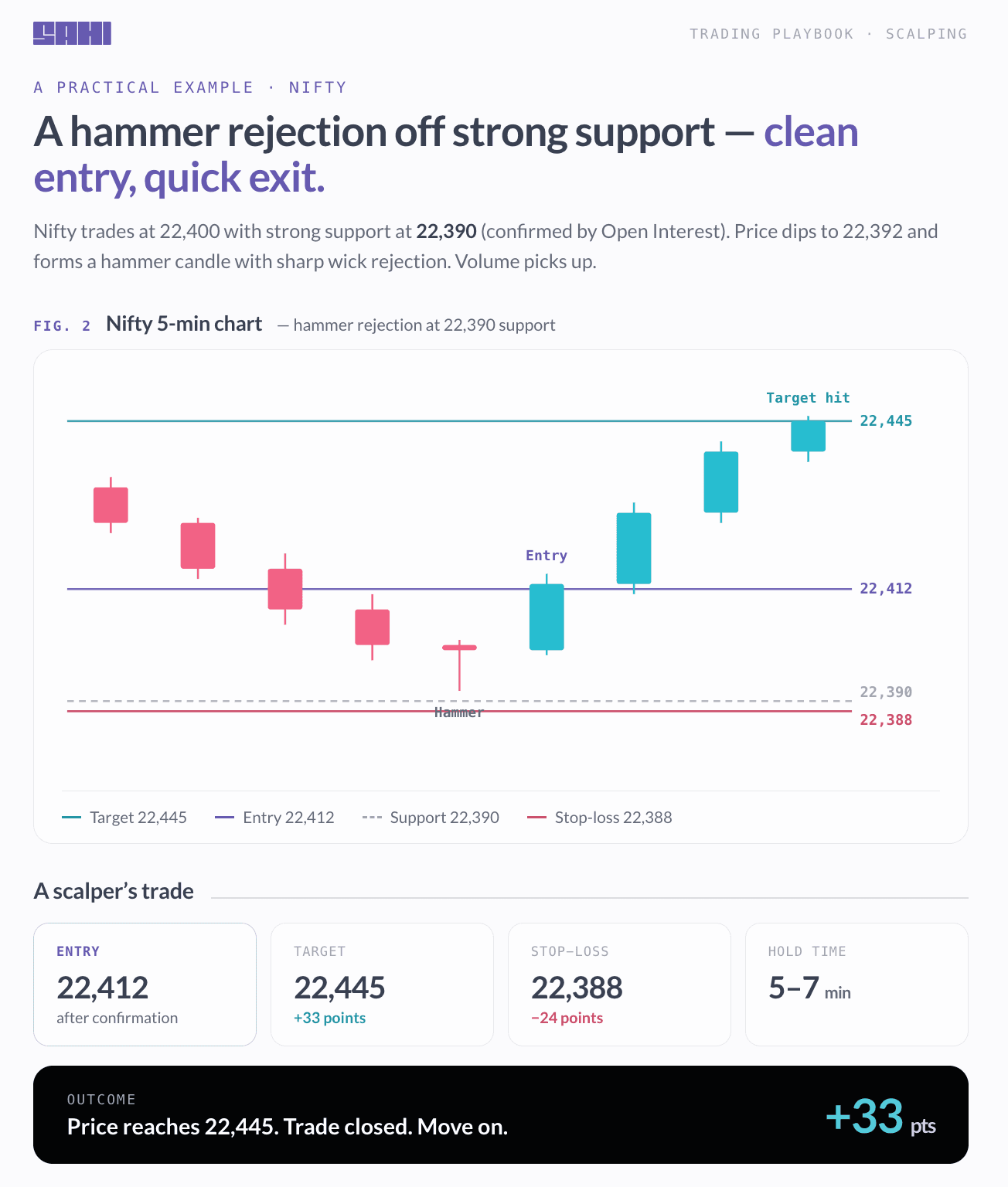
Notice what is not in that example: no guessing, no hoping, no discretionary decisions mid-trade. The setup was defined before entry. The exit was planned before entry. Execution is the only variable.
That discipline is what separates a scalper from a random short-term trader.
Scalping vs Intraday Trading: What is the Difference?
This is one of the most common questions beginners ask, and the confusion is understandable, because both scalping and intraday trading share a fundamental rule: all positions are closed before the market closes at 3:30 PM.
But they are not the same strategy.
What is intraday trading?
Intraday trading (also called day trading) means opening and closing trades within the same trading day. A typical intraday trader identifies a trend or a larger setup, enters a position, and holds it for 30 minutes to several hours, targeting a larger move before squaring off before close.
How to do intraday trading vs scalping
In intraday trading, you read the broader trend, wait for a larger setup, and accept a wider stop-loss in exchange for a bigger target. In scalping, you focus on shorter time windows, tighter setups, and quick execution across multiple trades.
| Factor | Scalping | Intraday (Day Trading) |
|---|---|---|
| Hold time | Very short — 1–15 minutes | Longer — 30 minutes to a few hours |
| Trades per day | Many (5–20+) | Fewer (2–6) |
| Target per trade | Small (5–30 pts on index) | Larger (50–200+ pts on index) |
| Stop-loss | Tight (8–20 pts) | Wider (30–80 pts) |
| Market analysis | Technical focus on key levels | Trend analysis and larger setups |
| Execution speed | Very fast | Moderate |
| Ideal market conditions | High volatility | Stable trends |
| Risk per trade | Lower | Higher |
The key distinction:
Intraday trading is about riding a bigger move. Scalping is about repeated precision — entering and exiting before the move can reverse.
Neither is better. They suit different personalities and different levels of focus.
Scalping vs Swing TradingSwing trading sits at the other end of the spectrum.
A swing trader holds positions for days to weeks, reading higher timeframe charts (daily, weekly) and targeting large moves: 5–15% in a stock, or 300–500+ points on an index.
| Factor | Scalping | Swing Trading |
|---|---|---|
| Hold time | Minutes | Days to weeks |
| Charts used | 1-min, 5-min | Daily, weekly |
| Trades per month | Hundreds | 5–15 |
| Monitoring required | Constant during market hours | Daily check-ins |
| Overnight risk | None | Yes — gaps, news events |
| Capital efficiency | Requires active capital rotation | Capital locked in position |
| Stress level | High (fast decisions) | Lower (longer time horizon) |
Scalping and swing trading are not interchangeable. Choosing between them is not just a strategy decision — it is a lifestyle decision. Scalping demands your full attention during market hours. Swing trading gives you flexibility.
Many experienced traders do both: scalp during high-activity windows and hold swing positions separately. But for beginners, the recommendation is to master one first.
Why Do Traders Choose Scalping?
Three reasons scalping appeals to active traders:
1. No overnight risk
All positions close before 3:30 PM. You never wake up to a gap-down open, wiping out a position. What you make today, you keep, regardless of what happens overnight or over the weekend.
2. Frequent, structured opportunities
Markets move multiple times every day. Scalpers do not need a "big trend." They find opportunities in the normal ebb and flow of price, openings, rejections at key levels, and small breakouts. You do not need a market event to trade.
3. Controlled risk per trade
Every scalp trade has a pre-set stop-loss. Maximum loss is defined before entry. A bad trade costs you 10–20 points. A good discipline means losses stay small and do not compound into large drawdowns.
The Real Risks of Scalping
Scalping looks simple from the outside. Inside, it is demanding. Here are the honest risks:
Execution pressure
You must enter and exit fast. If you hesitate at entry, you miss the move. If you delay the exit, a winning trade becomes a losing one. Speed and decisiveness are non-negotiable.
Transaction costs
Every trade has brokerage, STT (Securities Transaction Tax), exchange charges, and GST. With 10–15 trades a day, these costs add up quickly. Your target per trade must be large enough to absorb costs and still be profitable. Always calculate net-of-cost returns.
Attention demand
You cannot scalp while doing something else. One distraction, a message, a phone call, and you miss an exit. That missed exit can turn a small winner into a loss. Scalping requires undivided focus during active windows.
Emotional control after a losing streak
Three or four losses in a row will happen. The psychological pressure to "make it back" leads to over-trading, wider stops, and revenge trades. All three destroy accounts. Scalpers must be able to lose, close the screen, and return tomorrow with the same discipline.
Should You Do It? Is Scalping Right for You?
Be honest with yourself before you begin.
Scalping may suit you if:
- You can dedicate 2–3 focused, uninterrupted hours to the market (minimum)
- You are comfortable making fast decisions under pressure
- You can follow a rule-based system without improvising mid-trade
- You understand the instruments you are trading — options pricing, time decay (theta), liquidity
- You have already spent time reading charts and identifying levels
Scalping is not suitable if:
- You trade on a phone while doing other things
- You cannot take 3–4 quick losses without going off-plan
- You expect one trade to make your day
- You are new to charts, levels, and market structure — build that foundation first
A practical test before you go live:
Paper trade 20–30 setups. Write down your entry, target, stop-loss, and reasoning before each trade. Review results. If your decision-making is consistent and your simulated results show a positive edge, you are ready to try live scalping with small, defined capital.
Do not skip this step.
Test yourself
You have covered what scalping is, how it works, and how it compares with intraday and swing trading. Run through these questions before moving to the next chapter.
Scalping knowledge check
How well do you understand scalping?
Five quick questions on scalping basics — hold times, trade frequency, costs, and risk. See where you stand and pick up an insight along the way.
 5 questionsUnder 5 minutes
 Instant score