
Scalper Mindset and Discipline
Scalping does not fail because of bad setups. It fails because of poor execution under pressure. This chapter focuses on the behavioural side of scalping, including discipline, decision-making, and emotional control, and how they shape trading performance.
 11 minutes read|
Why Mindset Matters in Scalping
Before getting into setups or tools, it helps to understand what drives outcomes in scalping.
In slower forms of trading, small mistakes often go unnoticed. A slightly late entry or an early exit may still work out because the trade has time to play out. Scalping does not offer that margin. Decisions are taken quickly, and their impact shows up almost immediately, sometimes within a few seconds of entering the trade. A few points missed on entry, or a stop-loss adjusted mid-trade without a clear reason, can change the outcome of the trade within minutes.
This is where many traders misread what is happening. A trade does not work, and the conclusion is that the setup failed. In several cases, the setup was reasonable. The issue was in how the trade was taken or managed.
Over time, this leads to a pattern:
- Strategies keep changing
- Behaviour remains the same
The trader searches for a better setup, while the actual problem sits in execution.
Scalping makes this gap very visible. Decisions are frequent, and mistakes tend to repeat quickly. That is why mindset and discipline directly shape how trades are taken, managed, and exited.
In most scalping approaches, it is normal for 3–5 out of 10 trades to hit the stop-loss. Profitability comes from how the remaining trades are managed, not from avoiding losses altogether.

Scalping as a Business, Not a Bet
Once you start looking at scalping through the lens of behaviour, the next step is how you frame the activity itself.
The traders who last in scalping tend to approach it as a process that plays out over a series of trades, rather than something decided by individual outcomes. In practice, this means they are less concerned with what happens on any single trade and more focused on whether they are following a repeatable way of operating.
A business works in a similar way. It runs on:
- Defined processes
- Known costs
- Performance measured over time
Scalping begins to make more sense when it is approached with that same structure. Over a series of trades, both decisions and costs begin to shape the final outcome.
First, let’s talk about the cost of taking a trade as it is often overlooked.
For a scalper, brokerage is the most visible part of that cost. It scales directly with trading frequency and is one of the few variables that can be controlled.
At the same time, every trade in India also carries a fixed set of statutory charges — STT, exchange transaction fees, GST, and stamp duty — which apply regardless of the broker. When combined, these costs can consume 30–40% of gross profits, especially when targets are small and trades are frequent.
That is where small differences begin to matter.
| Scenario | Cost per trade | 20 trades/day | Monthly impact (20 days) |
|---|---|---|---|
| Lower-cost broker (e.g. SAHI ₹10) | ₹10 | ₹200 | ₹4,000 |
| Typical ₹20 brokerage | ₹20 | ₹400 | ₹8,000 |
In practice, the actual difference is slightly higher than ₹10 per trade, since GST is applied on brokerage. This typically pushes the gap closer to ₹11–₹12 per trade.
At lower trading frequency, that difference is easy to ignore. At scalping frequency, it compounds into a number that directly affects whether the month is profitable.
Costs, however, are only one part of the equation. The other is how decisions are made across a session.
If decisions are not anchored to a system, they tend to drift based on what just happened.
A profitable trade feels like confirmation, and a losing trade creates a strong urge to recover quickly. Without a framework to fall back on, decisions start reacting to recent outcomes, and over time, trading starts to resemble a series of bets rather than a controlled process.
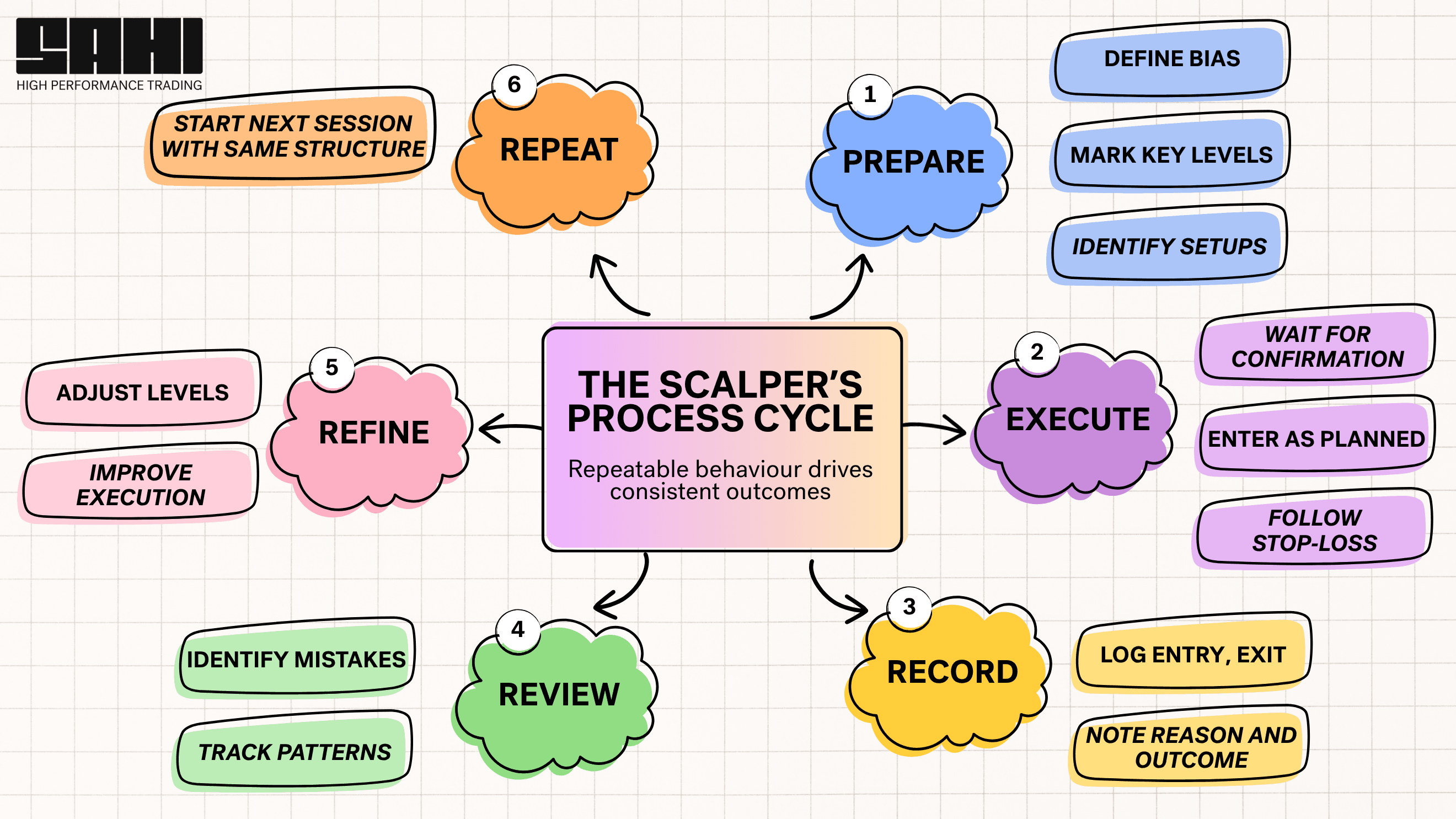
Instead of asking “Did I make money on this trade?”, the better question is “Did I execute this trade the way I planned?”
Across sessions, this shift changes how decisions are taken. Behaviour becomes more stable, and results tend to build on that stability.
Decision Speed and Preparation
That focus on process also carries into how decisions are taken during the session, especially in a style like scalping where timing matters.
Scalping does require quick decisions, but the quality of those decisions depends on what has been done before the market opens.
When the session begins, price is already moving, premiums are reacting, and there is very little time to analyse from scratch. The window to act is often small. In that environment, clarity matters more than speed.
That clarity comes from preparation. If:
- Key levels are already marked
- Setups are clearly defined
- There is a rough sense of bias
Then decisions tend to feel quicker without being rushed. The trade is not being discovered in the moment, it is being recognised.
When that preparation is missing, the same speed starts to work against you. Entries start happening just because price is moving, sometimes within seconds of a candle forming, not because a setup is complete. Trades feel urgent, and there is a tendency to justify them after they are taken rather than before.
During market hours, the role shifts towards execution. If the planned conditions are present, the trade is taken. If they are not, the better decision is to wait.
That also means being comfortable with not trading for stretches of time. In highly active instruments like Nifty or Bank Nifty options, the pressure to stay involved is high, but without a clear setup, activity tends to add noise rather than value.
In these instruments, trades often play out within 30 seconds to 5 minutes, leaving very little room for delayed decisions or rethinking during execution.
Common Psychological Traps
Once decisions begin to get influenced by what is happening in real time, certain behavioural patterns start to repeat across sessions.
The most common ones are:
FOMO
You watch Nifty move 40–50 points in a few minutes without you. Price keeps going, candles keep closing in the same direction, and at some point, the urge to enter builds because the move is already visible.
By the time you enter, the risk-reward has already shifted against you.
Revenge trading
A stop-loss gets hit, and almost immediately, the urge to take another trade comes in to recover it. The previous trade is still on your mind, and the next entry feels urgent rather than planned.
Overtrading
A few good trades create confidence. Activity increases, but the quality of trades drops. Gains from better trades are often given back through unnecessary entries.
Across all three, the underlying issue is similar. Decisions are being shaped by recent outcomes rather than by a predefined structure.
In the moment, these decisions feel reasonable. It is only after the session ends that the pattern becomes clear.
Over a few weeks, this is how accounts start to drift down. Not because of one large loss, but because small, repeated decisions slowly work against you.
In active scalping sessions, traders often take 10–50 trades in a day. At that frequency, even small lapses in discipline or execution can turn a marginally profitable approach into a losing one over a few weeks.
Left unchecked, this does not show up as a sudden drawdown. It shows up as a gradual erosion of capital that becomes visible only after a series of sessions.
Most traders recognise this pattern after the session ends. During the session, it feels justified.
Experienced scalpers handle this differently. They are comfortable stepping aside when conditions are not clear, and they treat waiting as part of the process.
Discipline Framework
These behavioural patterns tend to repeat because decisions are being made in the moment, often under pressure.
Discipline in scalping comes from having a clear set of rules in place before the session begins.
At a basic level, this includes:
- Defined entry conditions
- Stop-loss set before the trade
- A clear exit plan
- Session-level limits
These rules matter most in the moments where there is a strong urge to deviate from them. A trade moves slightly against you, the stop-loss is close, there is a temptation to give it more room, or a loss creates urgency to recover.
That is where discipline shows up in practice.
Look at the two cases below.
Case 1 — When the framework is followed
The setup is identified, and the trade is planned before entry.
- Entry is taken at the defined level (based on RSI, Bollinger Bands, and SAHI Key Levels)
- Stop-loss is fixed before the trade begins
- Risk-to-reward is clearly defined (for example, 1:2)
- The trade is allowed to play out without interference
- The outcome, profit or loss, is accepted as part of the process
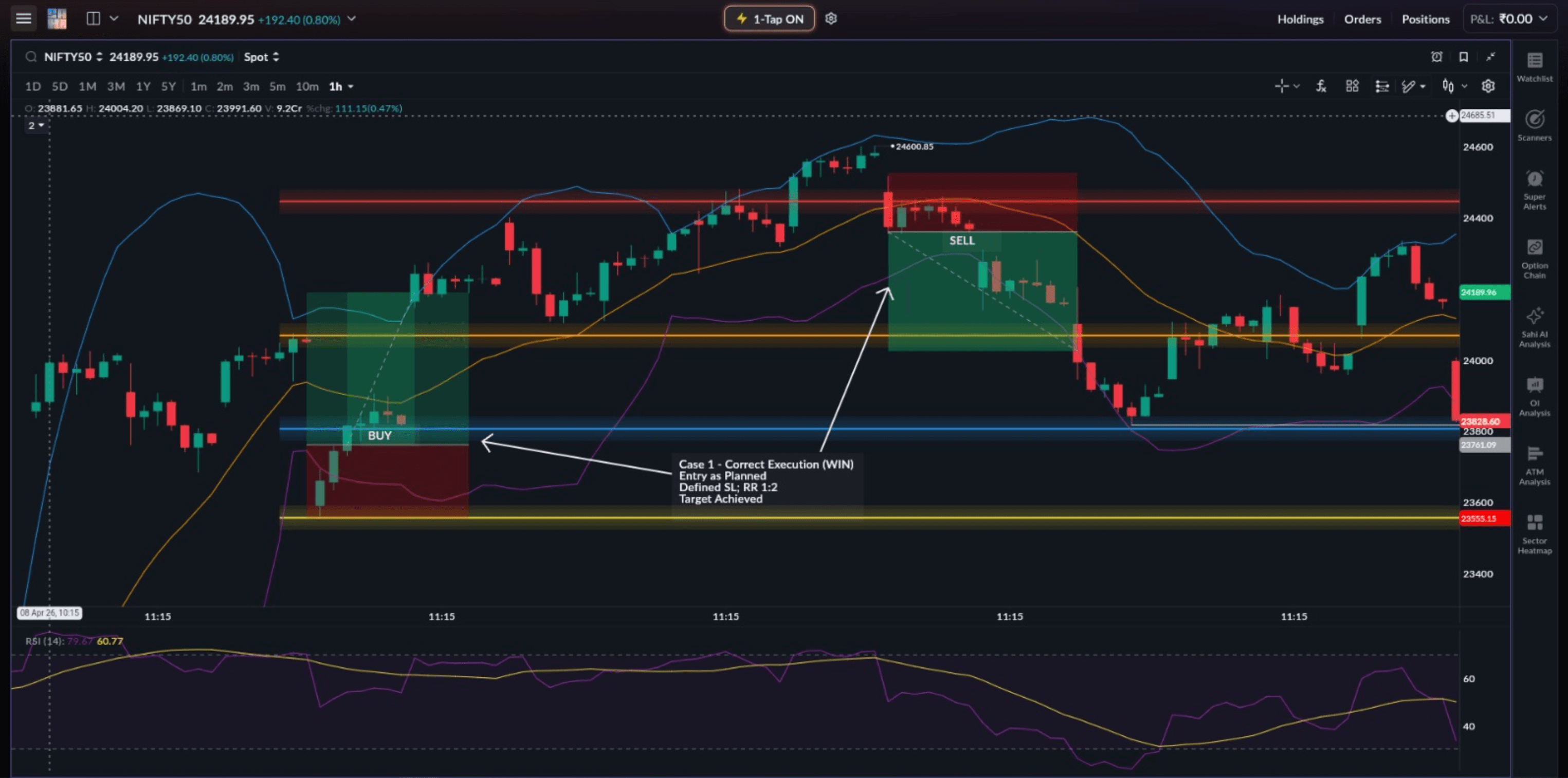
Execution becomes mechanical, not reactive.
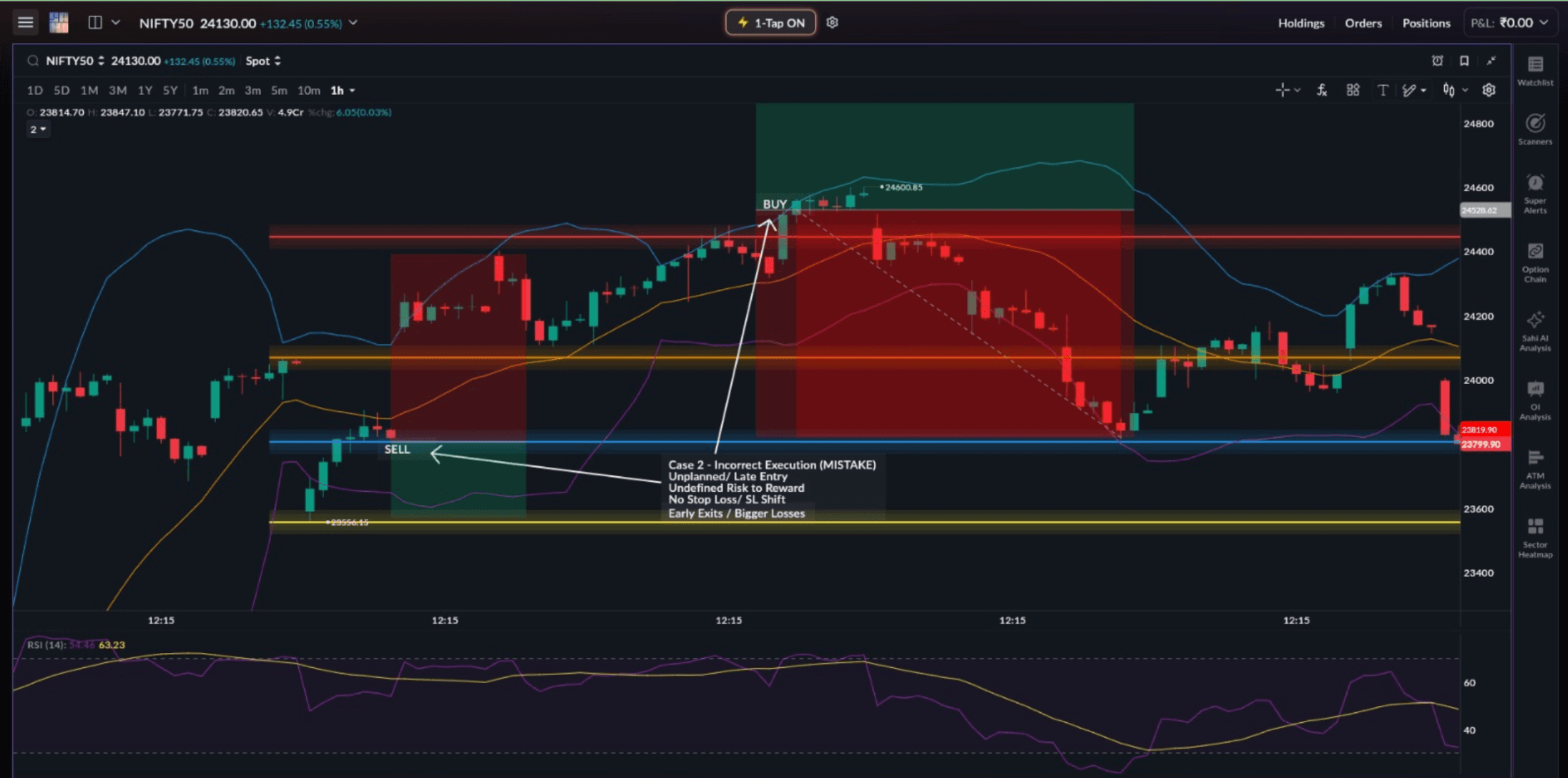
Case 2 — When the framework is not followed
The same type of opportunity is identified, but execution starts to change in the moment.
- Entry is taken late after the move has already started
- Stop-loss is either not defined or shifted during the trade
- Risk-to-reward becomes unclear or unfavourable
- Profits are taken early due to hesitation
- Losses are allowed to expand in the hope of a reversal
The setup may be similar, but the outcome is different because decisions are being made reactively instead of following a predefined plan.
Traits of a Consistent Scalper
Over time, consistent scalpers tend to stand out less by what they trade and more by how they go about it.
- Decisions are taken when the setup is clear, without hesitation
- There is no urgency to act when it is not
- Missed trades are allowed to pass without being chased
- Execution follows a pattern across trades
There is also a difference in how outcomes are handled. A profitable trade does not lead to taking more risk, and a loss does not create pressure to recover immediately. Each trade is treated on its own terms, and the session is evaluated by how closely it followed the plan, not by what the P&L says at the end.
Trading as a Professional
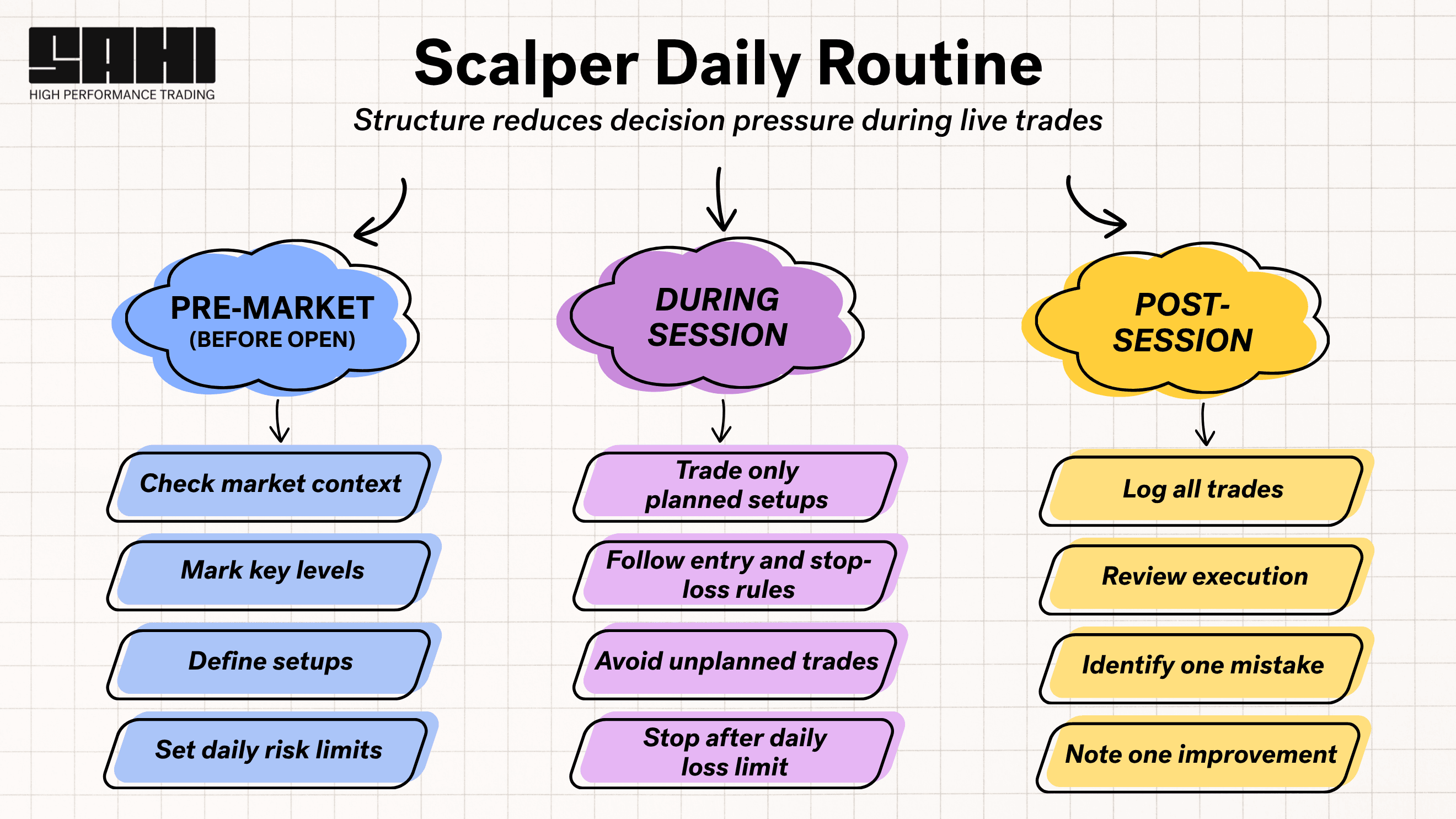
That steadiness in decision-making usually comes from having a simple structure around the trading day.
- Before the market: review context, mark levels, define setups
- During the session: execute only planned trades
- After the session: review trades and behaviour
When this kind of structure is maintained, the impact starts to show up clearly in results.
Why Discipline Beats Strategy
It is easy to assume that better setups lead to better results. In practice, execution tends to play an equally important role.
In scalping, small deviations begin to compound quickly. A slightly late entry, an early exit, or a stop-loss that is not followed may not seem significant on a single trade, but over a session, these decisions start to affect overall performance.
That impact becomes clearer when seen in actual price movement. A ₹2 move in Nifty options translates to around ₹130 per lot (65-unit lot). Across 15–20 trades, this can build into meaningful profits, but only if execution is consistent.
Consider two traders using the same setup. The first follows their plan closely. The second makes small adjustments along the way, entries are slightly delayed, exits are taken early, and stop-losses are moved. Over a few trades, the difference may not be obvious. Over a full session, and then across multiple sessions, the gap becomes clear.
That gap is created by the sequence of small decisions inside each trade. One trade is entered slightly late, reducing the reward. Another is exited early, locking in less profit. A third moves against the position, and the stop-loss is adjusted instead of respected. The setup has not changed. But the outcome has.
Over multiple trades, these small changes accumulate. A strategy that works in theory starts to underperform in practice.
Average setups executed with discipline tend to produce more stable results than strong setups traded without control. This is because outcomes are shaped not just by what is traded, but by how consistently it is executed.
In scalping, discipline is not a support to the strategy. It is a part of the strategy itself.
Are You Built for Scalping
Given how much scalping depends on consistency in decision-making, it helps to step back and look at how you typically operate during a live session.
Self-assessment:
- Can you stay focused on charts for 45 to 90 minutes without distraction?
- Can you consistently be available during active market hours?
- Do you follow predefined rules even when instinct suggests otherwise?
- Can you accept a stop-loss without immediately trying to recover it?
- Are you comfortable waiting when there is no clear setup?
- Do you define risk before entering every trade?
- Can you stop trading once your daily limit is reached?
- Do you avoid entering trades just because the market is active?
- Do you review your trades regularly and identify mistakes?
- Can you stay neutral after both winning and losing trades?
How to read this:
- If most of your answers are “Yes”, it usually means the basic behavioural fit is already in place.
- If the answers are mixed, some parts of your approach are working while others may need more consistency.
- If several answers are “No”, those are typically the areas where decisions tend to drift during a session.
From Mindset to Risk Management
Mindset helps you stay consistent in how decisions are taken. It prevents small mistakes from turning into larger ones during a session. But consistency alone is not enough.
The next layer is risk and money management — how much you trade, how losses are controlled, and how capital is protected over time.
If mindset determines how you behave in a trade, risk management determines how long you can stay in the game.
Test yourself
You have covered why behaviour drives scalping outcomes, the traps that repeat across sessions, and the framework that keeps execution consistent. Check how well it has landed.
Scalping knowledge check
How strong is your scalping discipline?
Five quick questions on mindset, psychological traps, and the discipline framework. See where you stand and pick up an insight along the way.
 5 questionsUnder 5 minutes
 Instant score