
VWAP Scalping Strategy for Nifty & Bank Nifty: 3 Setups That Actually Work (2026)
How institutions benchmark every trade to VWAP and the 3 setups retail scalpers can trade off it on Nifty and Bank Nifty.

VWAP scalping is an intraday strategy where you enter trades only at or near the Volume Weighted Average Price — the average price paid by every market participant since 9:15 AM. On Nifty 50 and Bank Nifty, VWAP functions as a live institutional benchmark: mutual funds and FIIs are evaluated against it, so large money defends and reacts at VWAP with consistency. The three setups scalpers use are VWAP Reclaim (enter when price retakes VWAP after a brief dip), VWAP Rejection (enter in the opposite direction when price fails at VWAP), and VWAP Squeeze Breakout (enter when price breaks out after compressing near VWAP for several candles). This guide covers exact entry rules, stop-loss placement, confirmation filters, and chart settings on SAHI for all three.
VWAP Scalping Strategy for Nifty & Bank Nifty: 3 Setups That Actually Work (2026)
Most retail scalpers treat VWAP like another moving average. It isn't. When a mutual fund or FII executes a large Nifty futures order, its performance is measured against VWAP. This is why VWAP works so consistently as a scalping level: it's the benchmark that controls how trillions of rupees are deployed every single day.
When Nifty approaches VWAP from above, institutional buyers who missed the open step in because they need to average toward their benchmark. When Nifty rallies to VWAP from below on a bearish session, institutions sell to reduce above-VWAP exposure. The flow is predictable because the incentives are predictable. You're not fighting noise; you're reading a system. Watch a video here:
Below are three rules-based setups that trade this institutional flow. If you haven't read SAHI's complete scalping strategy guide and the indicator combinations guide, do that first.
What VWAP is, and why it's different from a moving average
VWAP = cumulative (price x volume) divided by cumulative (volume), calculated from 9:15 AM and reset each trading day.
The difference from a standard moving average: VWAP is weighted by volume. A candle with 5 lakh shares traded moves VWAP more than a candle with 50,000 shares. High-volume prints at key levels shift VWAP and show where institutional orders are executing.
Standard VWAP comes with two additional lines: +1 Standard Deviation (SD1) and -1 SD. Price between these bands is the normal trading range. Outside them signals an extended move. Price above VWAP: buyers are winning. Price below VWAP: sellers are in control.
How to Set Up VWAP on SAHI Charts
- Open any Nifty 50 or Bank Nifty chart in the SAHI app
- Switch to a 3-minute or 5-minute timeframe
- Tap the Indicators icon in the top toolbar
- Search for "VWAP" and add it
- Add RSI (period 9) in a separate panel below the chart
- Ensure Volume bars are visible
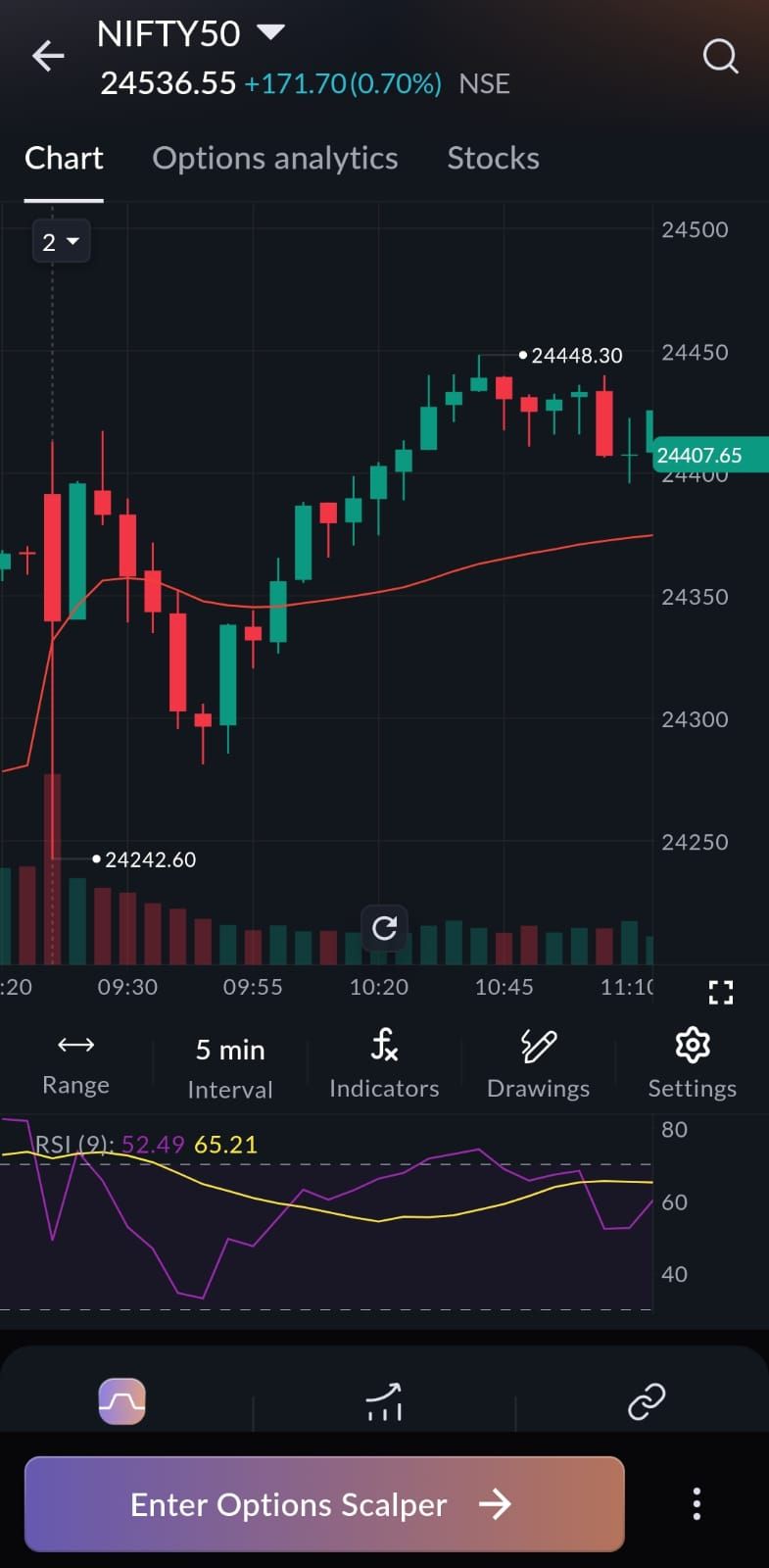
For options scalping, always set up VWAP on the underlying index (Nifty Spot or Nifty Futures), not on the option contract itself.
The 3 Core VWAP Scalping Setups
Setup 1: The VWAP Reclaim
Nifty is in an uptrend, pulls back below VWAP briefly, and then buyers step in and price closes back above VWAP. That reclaimed candle is your entry signal.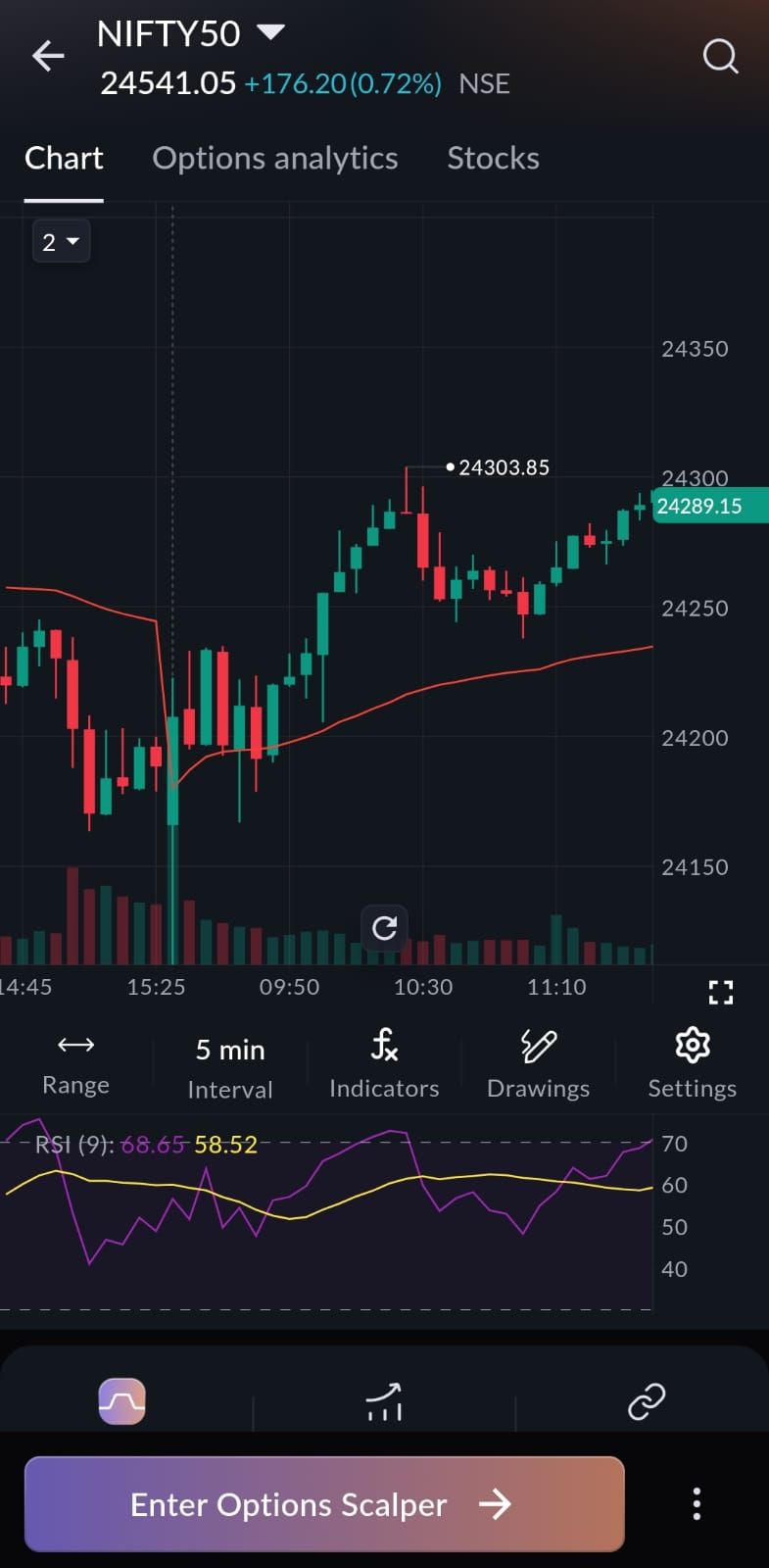
What to look for:
- Nifty above VWAP for at least 45 minutes
- Price dips below VWAP; one to three candles close below it
- A candle closes fully above VWAP with body above the VWAP line
- Volume on the reclaim candle is higher than the prior two candles
- RSI-9 between 40 and 58 at time of dip
Entry: Close of the first full candle above VWAP. Wait for the close.
Stop-loss: Below the low of the deepest dip candle. If the distance is more than 0.5% from the entry, skip it.
Target: First target at twice your stop loss level. Once achieved, you can move the stop to breakeven and let the second half run to 1:3 or even higher.
Setup 2: The VWAP Rejection
The price is below VWAP, rallies up to test it, and fails to break through. That failure is your short signal.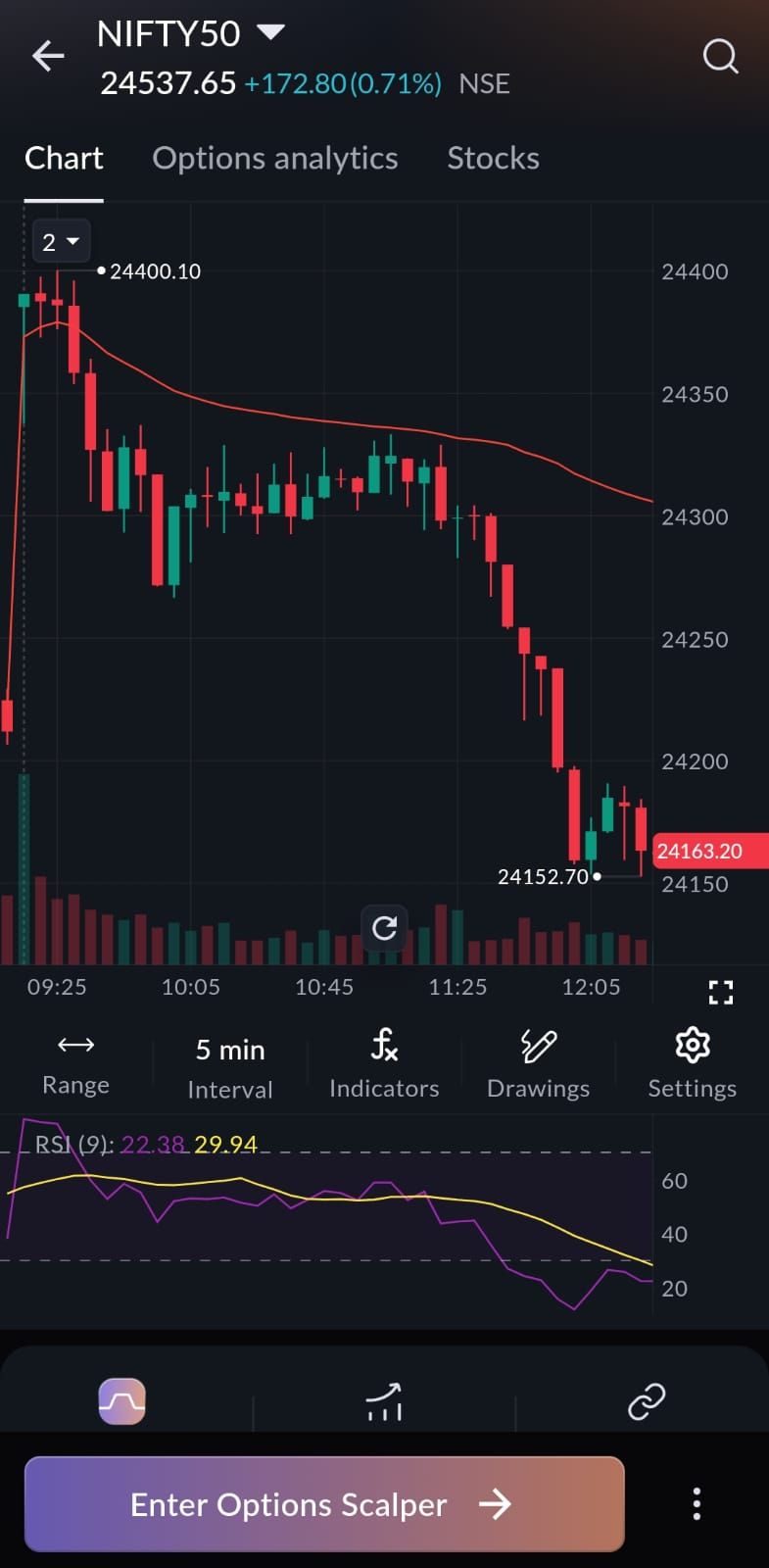
Entry: Close of the rejection candle below VWAP. Buy puts.
Stop-loss: Above the rejection candle wick. If wick extends more than 0.3% above entry, skip it.
Target: Almost the same as the above, but only take when the session is clearly bearish.
Setup 3: The VWAP Squeeze Breakout
Price coils tightly around VWAP for several candles; volume drops progressively. When compression breaks, the move is fast.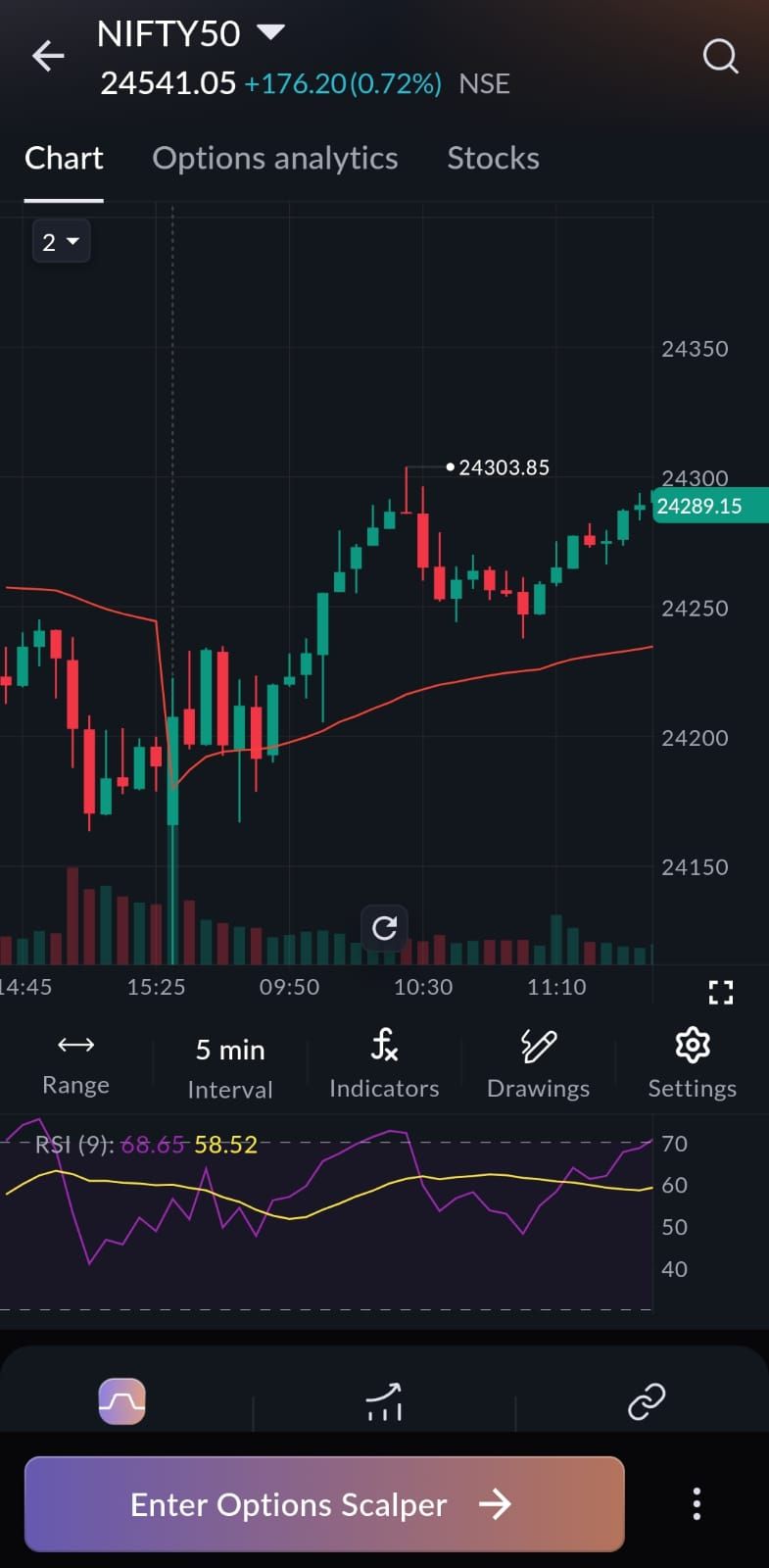
What to look for:
- Minimum 4 consecutive 5-minute candles within 0.15% of VWAP
- Volume declining visibly on each candle
- One candle breaks out closing outside the ±1SD band with volume 2x prior candle
Entry: Close of the breakout candle. Do not anticipate.
Stop-loss: Back inside VWAP. For longs: stop below the VWAP. For shorts: above VWAP.
Target: Project the squeeze zone height from the breakout point. Use a trailing stop.
Timing: When VWAP Setups Work Best on Nifty
| Time Window | VWAP Reliability | Best Setup |
|---|---|---|
| 9:15 AM - 9:45 AM | Low | Avoid. Observe only. |
| 9:50 AM - 11:30 AM | High | Reclaim and Rejection |
| 11:30 AM - 1:30 PM | Medium-High | Squeeze Breakout |
| 1:30 PM - 2:45 PM | Medium | Reclaim and Rejection |
| 2:45 PM - 3:15 PM | Low | Reduce size or avoid |
For expiry day strategy, read SAHI's guide to Nifty expiry day scalping.
The VWAP + RSI Filter
VWAP tells you where price is relative to the day's average. RSI-9 tells you if that position is overextended. Used together, most false signals disappear.
- For Reclaim longs: RSI-9 between 38 and 58 at time of dip
- For Rejection shorts: RSI-9 between 45 and 65 at rejection point
- For Squeeze Breakouts: RSI near 50 during the squeeze phase
If RSI is below 35 or above 65 when you spot a VWAP setup, skip that trade. The setup is too late in the move.
Pre-Trade Checklist: 5 Questions Before Every VWAP Trade
- Is it past 9:50 AM? If not, wait.
- Is price within 0.15% of VWAP? If far from VWAP, the setup has already run.
- Is RSI-9 between 38 and 62? Extreme readings invalidate the setup.
- Is the volume on the signal candle equal to or greater than the prior two candles? No volume = no institutional confirmation.
- Is your stop-loss defined at less than 1% of active capital? No stop = no trade.
The 3 Mistakes That Destroy VWAP Scalping Profits
Trading VWAP Before 9:50 AM
VWAP is still being established in the first 35 minutes. Every large opening order shifts it. The first clean signal rarely appears before 9:50 AM.
Taking VWAP Trades Without Volume
Price can touch VWAP multiple times without any reaction. The institutional VWAP reaction comes with volume. Without a volume spike, the setup is noise.
Ignoring the Day's Broader Context
VWAP is a local level. Check SGX Nifty opening gap, global index futures, and whether Nifty is above or below the previous day's close before your first trade.
Also read how liquidity sweeps affect Nifty scalping to identify when VWAP is being used as a trap.
What to take from this
- VWAP works because institutions benchmark every trade to it. Their flow creates repeatable reactions.
- Three setups: Reclaim (trending), Rejection (rangebound/bearish), and Squeeze Breakout (compressing to explosive).
- Confirm with RSI-9 in the 38-62 range and volume expansion on the signal candle.
- No VWAP trades before 9:50 AM.
- Define the stop-loss before entering.
- Return to SAHI's complete scalping guide for the full framework.
Frequently Asked Questions (FAQs)
All topics
Click the link, confirm the box next to sahi.com is checked — ignore any other results.