
Nifty Expiry Day Scalping: How to Trade Options on Weekly Expiry Days
3 scalping setups built for Nifty's Tuesday expiry — with exact timing windows, strike selection rules, and the theta traps that destroy most buyers.

Nifty expiry day scalping means capturing fast, short-duration moves in Nifty options on weekly expiry day (Thursday). Theta decay accelerates sharply, so ATM options lose value quickly — the edge is in buying directional momentum early in the session or selling premium in the last 30 minutes. Key rules: trade only liquid strikes (ATM ±2), use strict stop-losses (30–50% of premium paid), avoid the 12–2 PM dead zone, and never carry expiry-day positions overnight.
Nifty Expiry Day Scalping: The Complete Playbook
This is a part of the Scalping Trading Strategies: Complete Guide series.
Every Tuesday, Nifty options premiums worth around ₹150 at Monday's close decay to single digits by 3:00 PM, even if Nifty barely moved. Gamma explodes at ATM strikes. The option chain reshuffles as institutions unwind before settlement.
For Nifty scalpers, Tuesday is one of the most opportunity-rich sessions of the week and the most dangerous too. Mainly because the forces that create fast profits also destroy accounts without a framework.
This is the framework. Three setups, specific timing windows, and the rules that keep you afloat.
Why Expiry Day Is Different From Every Other Day
Two forces collide on expiry that don't exist on regular sessions:
Theta acceleration (ideal for option sellers). On a normal day, an ATM Nifty option might lose ₹3–5 in time decay. On Tuesday, that same option loses ₹20–40+ per hour in the afternoon. By 2:30 PM, ATM premiums that started at ₹80–₹100 can be at ₹10–₹15. For buyers, every minute without a directional move is money evaporating (given there isn't much movement in the underlying).
Gamma explosion (ideal for option buyers). Gamma is highest for ATM options near expiration. A 50-point Nifty move can cause a 35–45 point swing in an ATM premium, far more than on a non-expiry day. This amplification is what makes expiry scalping lucrative. But it cuts both ways.
These two forces create three distinct trading windows, each with its own personality:
The Three Expiry Day Windows
Window 1: The Gamma Zone (9:30–10:30 AM)
The scalper's sweet spot. Premiums still have enough time value, but gamma is already elevated, directional moves produce outsized premium swings. The Opening Range forms, and institutional order flow sets the session's tone.
What works here: Buying ATM options on strong directional signals, including ORB breakouts, VWAP breaks, and EMA crossovers.
What doesn't: Holding. Get your 15–25 point premium target and get out. Theta is already ticking.
Window 2: The Theta Zone (10:30 AM–1:30 PM)
Volatility typically compresses. Nifty often drifts into a range. Theta decay accelerates, as ATM options lose 30–40% of their remaining value in this window.
What works here: Selling OTM options (with hedges) and letting time decay work. Range-bound Bollinger Band mean reversion scalps.
What doesn't: Buying OTM options. Even if Nifty moves 30 points your way, the OTM option barely responds, because delta is too low and theta is too fast.
Window 3: The Danger Zone (2:00–3:30 PM)
Premiums are at their lowest. Bid-ask spreads on OTM strikes widen dramatically. But paradoxically, the sharpest moves happen here, with institutional squaring, max pain convergence, and last-hour spikes that can move Nifty 100–200 points in 30 minutes.
What works here: Nothing for most traders, due to the erratic nature of the market. So if you do not want to lose big, try to square off your positions before 2 pm. If needed, trade with very limited quantities and with proper hedges during this time frame.
What doesn't: Holding any long option. An ATM at ₹15 can become ₹2 in 20 minutes of sideways movement.
The Rule: Buy options only in Window 1. Consider selling (with hedges) in Window 2. Be flat by Window 3 — or accept that you're willing to take the risk.
3 Expiry Day Scalping Setups
Setup 1: The Expiry ORB Scalp (Window 1)
When: 9:15–10:00 AM on Tuesday
Logic: The Opening Range on expiry day tends to be tighter than on non-expiry days because overnight positions are already being managed. When it breaks, the move is often fast and clean — driven by institutional flow, not retail guessing.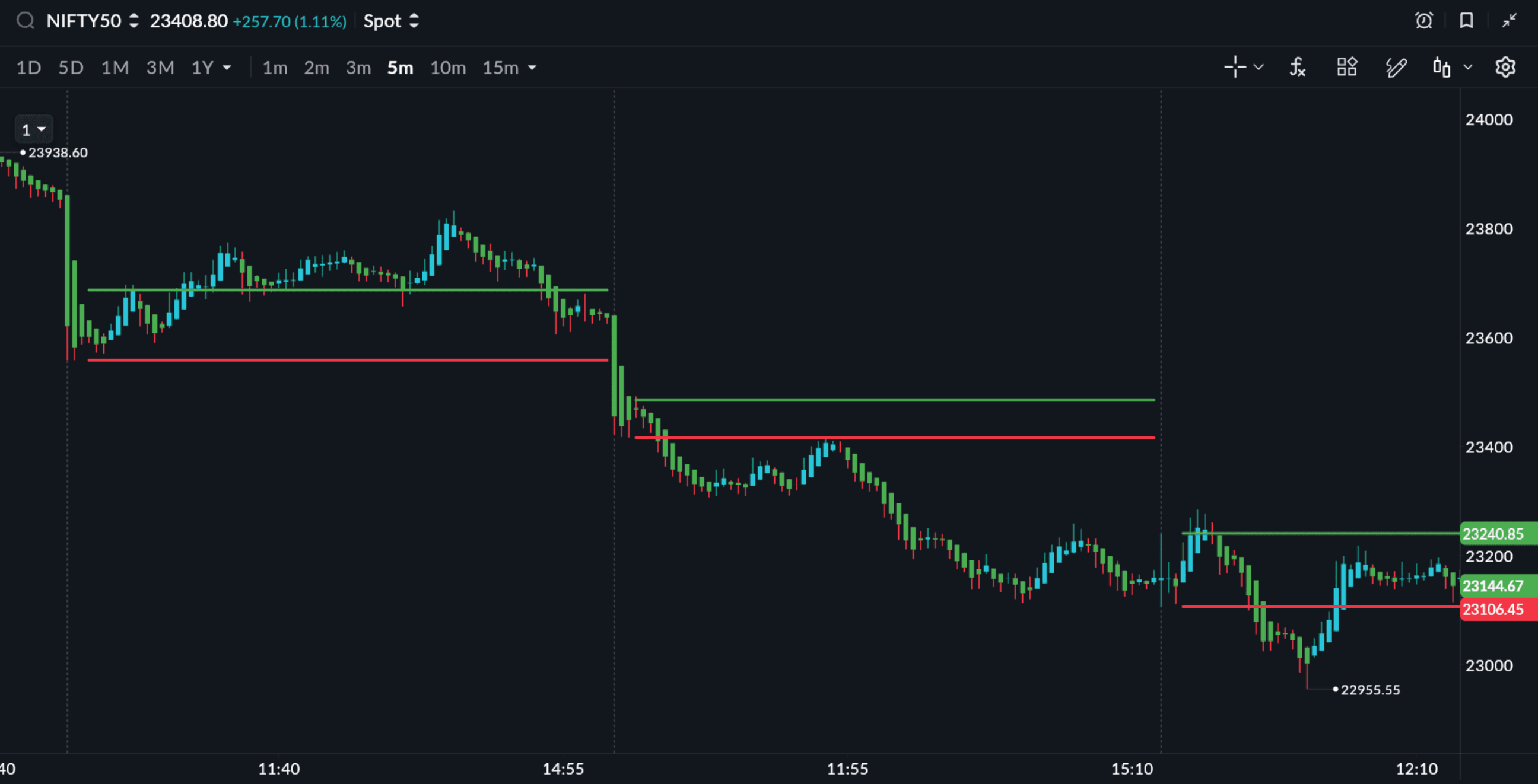
How to execute:
- Let the first 15 minutes print (9:15–9:30 AM). Mark the ORB high and ORB low, auto-plotted on SAHI charts.
- Confirm VWAP bias: price above VWAP = bullish, below = bearish.
- If price breaks above ORB high with a volume spike + price above VWAP → buy the ATM CE.
- If price breaks below ORB low with a volume spike + price below VWAP → buy the ATM PE.
- Stop-loss: 30% of premium paid. If you bought at ₹80, stop at ₹56.
- Target: 20–30 point premium gain (₹1,300–₹1,950 per lot). Take it and exit.
- Time limit: if the target isn't hit within 30 minutes, exit regardless. Theta is eating you.
Strike: ATM only. The nearest strike to the current Nifty level. On expiry day, ATM gamma makes this strike 2–3x more responsive than the strikes 100 points away.
Setup 2: The Theta Decay Scalp (Window 2)
When: 11:00 AM–1:00 PM on Tuesday
Logic: After the morning move resolves, Nifty often enters a range. ATM options still have ₹40–₹60 of time value left, and that time value will decay to near-zero by 3:30 PM. If the market stays flat, selling premium is the highest-probability trade on the board.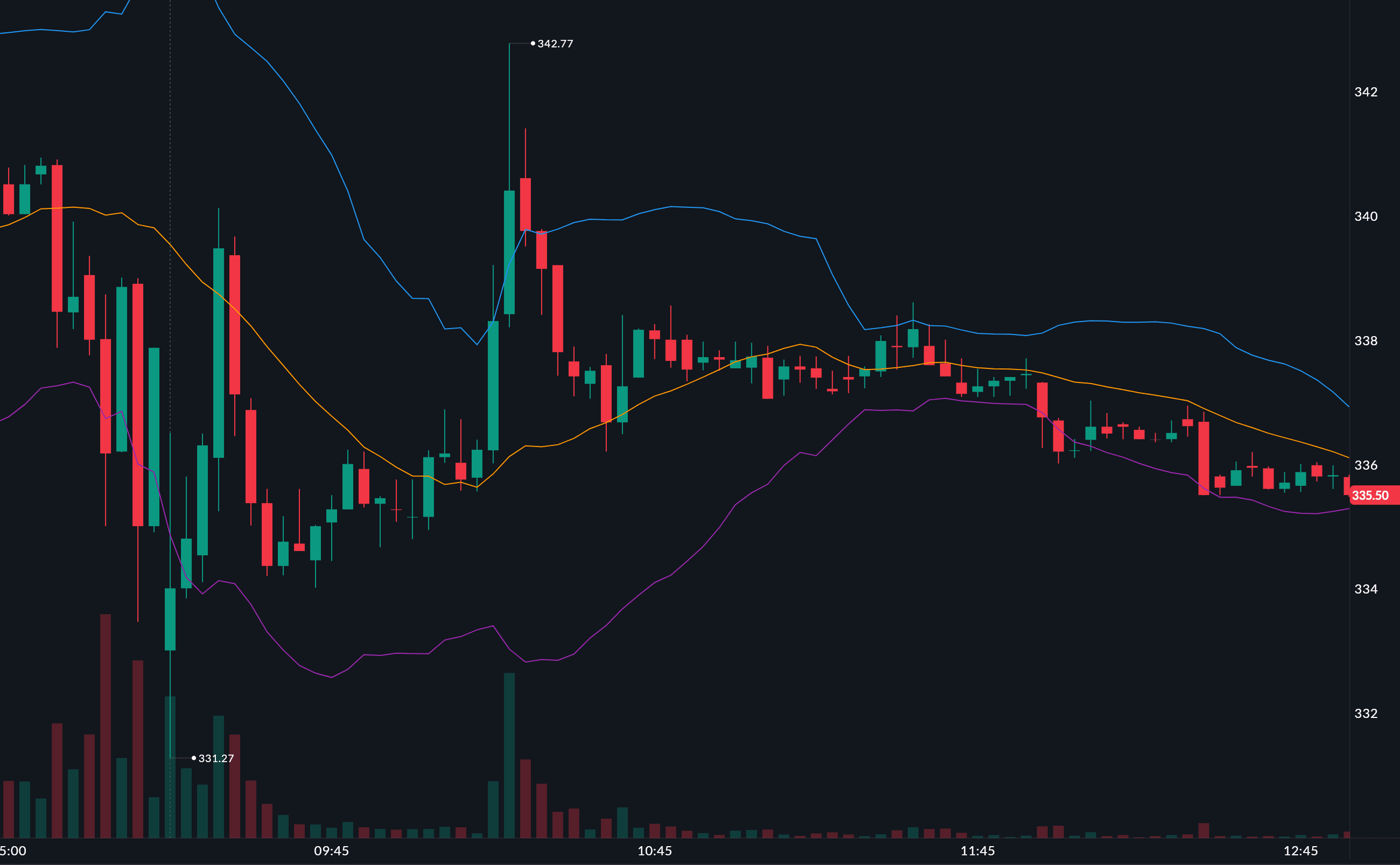
How to execute:
- Confirm Nifty is range-bound: VWAP is flat, Bollinger Bands are horizontal; no clear trend on the 15-minute chart.
- Sell 1 lot of an OTM CE 150–200 points above the current Nifty level.
- Simultaneously buy 1 lot of an OTM CE 50 points above (as a hedge). This creates a credit spread — not a naked sell.
- Maximum profit: the credit received. Maximum loss: the spread width minus credit.
- Exit at 50% of maximum profit or by 1:30 PM — whichever comes first.
Why a spread, not naked selling: Nifty can spike 150 points in 10 minutes during a late-session unwind. A naked short in that scenario means unlimited loss. The hedge caps your risk. Never sell naked options on expiry day.
Critical: This setup requires understanding of option Greeks and spread mechanics. If you don't know what a credit spread is, skip this setup and focus on Setup 1 until you've built that knowledge.
Setup 3: The Max Pain Convergence (Advanced)
When: 12:00–2:00 PM on Tuesday
Logic: Max pain is the strike where option buyers collectively lose the most. On expiry day, Nifty often gravitates toward this level — not always, but frequently enough to be tradeable.
How to execute:
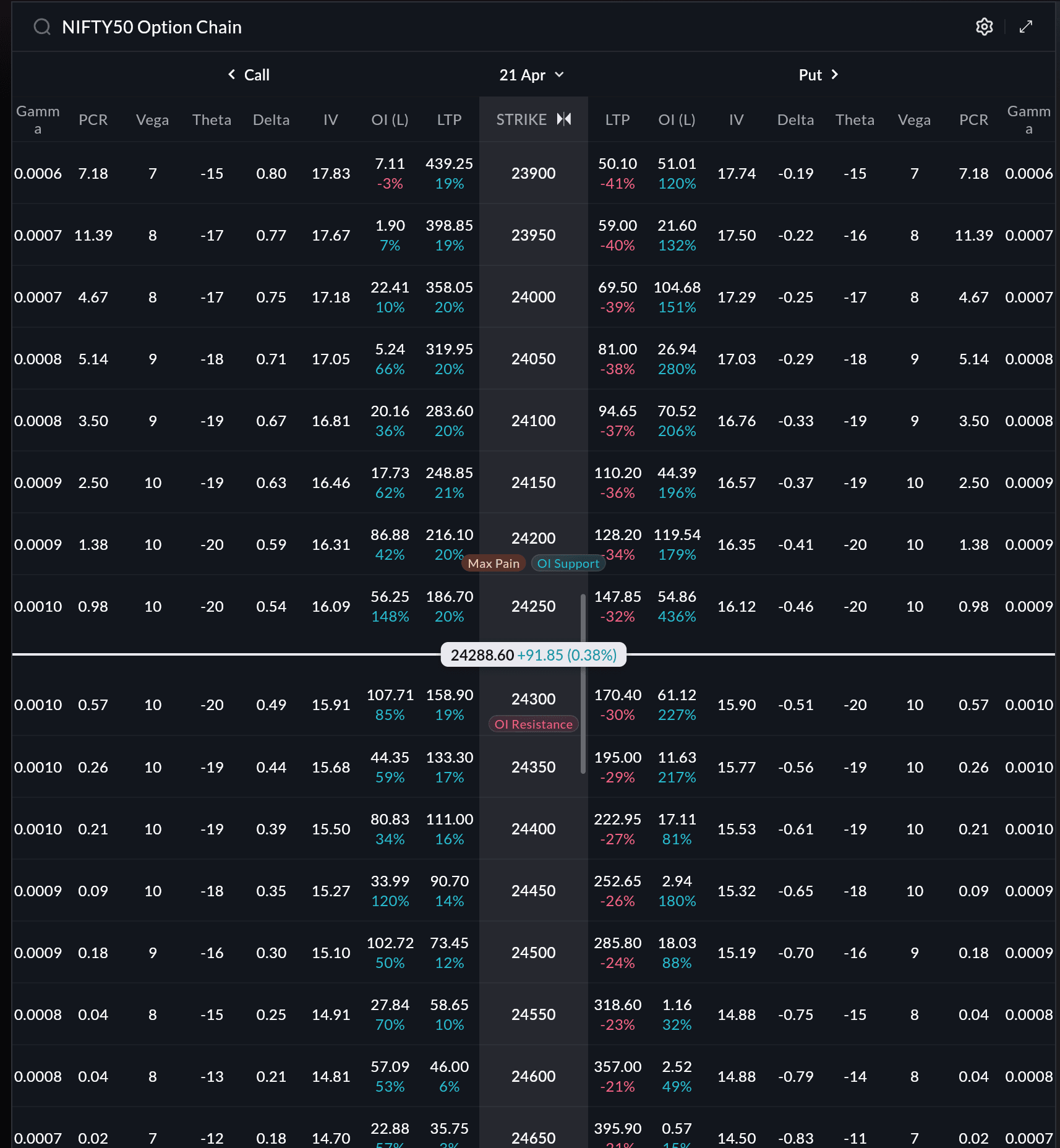
- Identify the max pain strike on SAHI's live Option Chain inside Scalper Mode — the strike with the highest combined CE + PE open interest.
- If Nifty is 100+ points above max pain at noon → buy ATM PE expecting a drift down.
- If Nifty is 100+ points below max pain → buy ATM CE expecting a drift up.
- Confirm: OI should be unwinding (decreasing) at the extreme strikes — visible on SAHI's OI Change column.
- Stop-loss: 30% of premium. Target: max pain level or 50% of the distance. Exit by 1:30 PM.
The live Option Chain inside Scalper Mode shows strike-wise OI, OI change, and Greeks in real time. Combined with auto-plotted ORB levels and VWAP, you get the three data layers expiry scalping requires: where the range is, where the bias is, and where the money is positioned. All on one screen.
Expiry Day Rules (Non-Negotiable)
1. ATM strikes only. OTM on expiry day are lottery tickets. ATM is the only strike where gamma gives you an edge.
2. Maximum 2–3 trades. If none of the setups appear, don't trade.
3. Stop-loss: 30% of premium paid. Tighter than non-expiry because theta is actively working against you.
4. Time-based exit. Target not hit within 30 minutes (Window 1) or 60 minutes (Window 2)? Exit at market.
5. Flat by 2:00 PM. The final 90 minutes is where accounts get destroyed.
Pro Tip: Set Auto SL/TP in SAHI's Scalper 2.0 the moment you enter. On expiry day, the speed of premium collapse means you can't afford to manually place your stop after entry. Pre-set it. Choose limit exits for tighter fills — market exits on wide-spread expiry options can cost you 5–10 points in slippage.
What Expiry Day Scalping Is NOT
It's not buying ₹2 options hoping they become ₹50. That's a lottery, not a strategy. If you don't have a clear signal — ORB breakout, VWAP confirmation, or OI data supporting your bias — don't trade. The best expiry day scalp is often no scalp at all.
Related Articles
- Scalping Trading Strategies: The Complete Guide (2026)
- Nifty, Bank Nifty & Sensex Expiry Day: Weekly F&O Schedule
- Best Scalping Indicators: Which Ones Work (And How to Combine Them)
- Liquidity Sweep Scalping Guide
- Opening Range Breakout (ORB) Strategy
- Moneyness in Options: ITM, ATM & OTM Explained
- Scalper 2.0: The Original, Remastered
- Trading Psychology & Risk Management
- Scalping vs Intraday Trading: Which Style Fits You?
Disclaimer: The content provided is for educational purposes only and does not constitute financial advice. Trading in securities involves significant risk, including the risk of loss. Past performance does not guarantee future results. SEBI data shows that 91% of individual traders in the F&O segment incurred net losses in FY25. Options trading on expiry day carries heightened risk due to accelerated time decay and gamma exposure. Always conduct your own research and consider consulting a SEBI-registered investment adviser before making trading decisions. SAHI is a SEBI-registered stockbroker. For full details, refer to the disclaimer.
Frequently Asked Questions (FAQs)
All topics
Click the link, confirm the box next to sahi.com is checked — ignore any other results.