

Nifty is up around 2,500 points, or 11%, in ten trading sessions – from 22,400 on Oct 23 to 25,030 on Nov 6 – and almost none of it was bought. It was covered.
Going into the November series, the participant-wise index futures data showed the most lopsided positioning of the year. FIIs sat on roughly 2.8 lakh contracts of net short Nifty futures, close to 3 lakh before the start of the series. On the other side, retail (the “Client” bucket) was net long about 2 lakh contracts, with proprietary desks a thin long.
That is a textbook squeeze setup: one large, concentrated seller who has to buy back to exit, facing a counterparty who is already positioned the other way. The only missing ingredient was a trigger.
What the data says
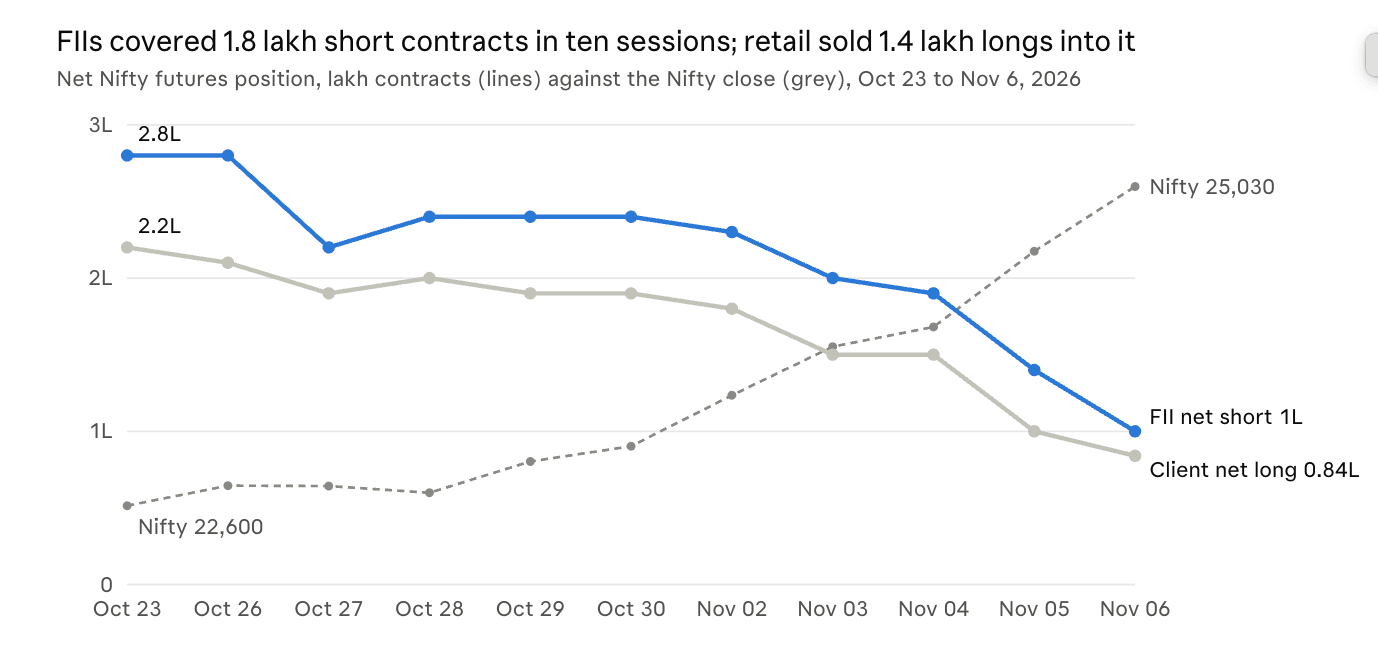
The two lines fall together. FIIs’ net short shrank from 2.8 lakh to 1 lakh contracts, and retail’s net long shrank from 2 lakh to 84,000, while the Nifty climbed every session. Total Nifty futures open interest fell about 22%, from 2.7 lakh to 2.14 lakh contracts, through Nov 6, and Friday’s 2% jump took another 40,000 contracts out of the FII short.
The pace tells the story. The first week of the series was slow: FIIs trimmed from 2.8 lakh to 2.4 lakh and the index barely moved. Then Nov 3 happened. FIIs net bought roughly ₹4,700 crore of Nifty futures in a single session, open interest dropped 7% in a day, and the index added 370 points. Nov 5 and Nov 6 repeated the pattern: 50,000 and 40,000 contracts covered, the index up 2.4% and 2.0%. Three sessions did the work of three weeks.
DIIs and proprietary desks were bystanders. DIIs trimmed their long from about 50,000 to 36,000 contracts; prop desks flipped from a thin long to a thin short. Neither moved the needle.
Why this is covering, not buying
Price up, open interest down is the one combination in futures that cannot be fresh buying. A new long needs a new contract to exist; it adds to open interest. When the index rises and contracts disappear, the buyer is someone closing a short, and the seller is someone closing a long. Both sides are leaving. Nobody is arriving.
That is exactly the shape of the last ten sessions. Roughly 1.8 lakh FII short contracts were bought back, and roughly 1.4 lakh retail long contracts were sold out. The counts almost match, which is what you would expect: the FII bid for exits was met mostly by retail offering its longs, with DIIs and prop desks filling the small gap.
There is a second tell in the stock data. NiftyTrader’s Nov 6 snapshot showed long build-up in 86 stocks against short build-up in 59 – a decent tilt, but the same report notes that a build-up count says nothing about how durable a rally is. Meanwhile the index rally has been narrow: private banks drove most of it, and midcaps and smallcaps kept seeing selling even as the Nifty reclaimed 25,000. A rally that is strongest in the most-shorted, most-liquid names and weakest in the broader market is a rally being forced, not chosen.
Who paid whom
On the futures book alone, FIIs handed roughly ₹3,800 crore to the other side of the trade, and retail collected most of it.
The arithmetic is simple. Hold each participant’s end-of-day net position against the next day’s Nifty move, sum across the ten sessions, and multiply by the 75-share lot. It ignores intraday changes, so treat these as order-of-magnitude figures, not an audit.
| Participant | Net position, Oct 23 → Nov 6 | Approx. mark-to-market on Nifty futures |
|---|---|---|
| FII | Short 2.8L → short 1.0L | Loss of about ₹3,800 crore |
| Client (retail) | Long 2.2L → long 0.84L | Gain of about ₹2,900 crore |
| DII | Long ~0.5L → long 0.36L | Gain of about ₹800 crore |
| Pro | Thin long → thin short | Roughly flat |
A single contract shorted at 22,600 and covered at 25,030 cost its holder ₹1.82 lakh. Retail did not hold the whole way – it sold 1.4 lakh contracts into the rally – but it sold at steadily higher prices, which is why its gain is close to the FII loss rather than a fraction of it. This is the rare series where the positioning data, read correctly at the start, was worth real money to the people who read it.
The caveat: FII index shorts are mostly hedges
The futures loss is real, but it is not the whole FII book. Most FII index futures shorts are hedges against a large cash-equity portfolio, not outright bearish bets. When the index rallies 10%, the hedge loses and the portfolio it protects gains more. The ₹3,800 crore above is the premium they paid for insurance they decided they no longer needed.
The better question is why they stopped needing it. FII cash buying in the first week of November ran at a six-year high, and the rally coincided with a visible rotation out of global AI and technology trades and into Indian financials. An investor who is adding cash exposure and lifting hedges at the same time is not being squeezed out of a view. They are changing their view, and the short covering is what that change looks like on the derivatives tape.
That distinction matters for what comes next. A forced squeeze ends when the shorts are gone, and the market usually gives back part of the move. A hedge unwind backed by cash inflows can run further, because the same buyer keeps showing up in the cash market after the futures covering is done.
Where we stand: even steven
Positioning is now close to neutral, which means the squeeze fuel is largely spent. FIIs are net short 1 lakh contracts against a starting 2.8 lakh; retail is net long 84,000 against 2.2 lakh. Add DIIs at 36,000 long and prop at a thin short, and the whole system is roughly flat. The imbalance that powered the last 2,400 points no longer exists.
The Nifty closed Nov 6 at 25,030, its first close above 25,000 since late February and the strongest week since February 2021. Open interest at 2.14 lakh contracts is the lightest the index futures book has been this series. A light book cuts both ways: there is nobody left who must buy, but there is also nobody left who must sell.
Two more things to hold in mind. Muhurat trading on Nov 8 will be a thin session that tells you little. And the immediate technical resistance sits at 25,150–25,200 – the first place the market has to prove that real buyers, not just exiting sellers, are willing to pay up.
What to watch next
The next leg will be decided by whether open interest starts rising with price. Watch these readings in the daily participant-wise data:
- Long build-up, not short covering. The first session where the Nifty rises and total futures OI rises with it is the signal that fresh money is coming in. Until then, every up-day is still someone leaving.
- FII net short crossing zero. At 1 lakh short, FIIs still have room to cover. If the figure keeps shrinking toward zero and then flips to a net long, the hedge-unwind story is confirmed and the rally has a sponsor. If it stalls near 1 lakh, the covering is done and the index is on its own.
- Breadth. Midcaps and smallcaps did not join this rally. A move that stays confined to private banks and index heavyweights is a positioning move; one that broadens is a market move.
The tell that none of this is working would be price flat-to-down with OI rising - fresh shorts coming back in at higher levels, after the old ones were wrung out. That is the pattern that ends squeezes, and it has not shown up yet.
Bottom line
The November series so far is an ~11% rally built almost entirely on FIIs buying back 1.8 lakh short contracts and retail selling 1.4 lakh longs to them. Retail read the setup right and got paid roughly ₹2,900 crore for it. Now the board is reset: FIIs short 1 lakh, retail long 84,000, OI at a series low, and no one left who is forced to do anything.
From here the market has to be bought, not covered. Rising open interest on up-days is the proof that is happening. Rising open interest on down-days is the proof it is not.