What Happens After You Place the Trade? P&L, Margin, MTM & Expiry
Follow a commodity trade after execution: unrealised and realised P&L, how futures margin and mark-to-market affect your funds, closing a position, exiting a purchased option and what to check before expiry.
 7 minutes read|

Once an order executes, the trade starts affecting more than the price you see on the chart.
The position develops an unrealised profit or loss, Futures margin remains tied to the trade and mark-to-market can affect the funds available in your account. If you close the position, some of those things change again. If you carry it towards expiry, the contract’s settlement rules become increasingly important.
So placing the trade is only one part of its lifecycle. The next step is understanding what happens while it remains open, when it is closed and, if you hold it long enough, when it reaches expiry.
While The Position Is Open
An open position has a P&L, but that number is still moving with the market.
Suppose you sell a Futures contract and the price falls. The position may show a profit because the market has moved in your favour. If the price reverses before you exit, some or all of that profit can disappear.
That changing number is your unrealised P&L.
The same applies when the trade is losing money. As long as the position remains open, the displayed P&L can continue changing.
Once you close some or all of the position, the trading result on the quantity exited becomes realised P&L. Even then, the simple difference between your entry and exit prices is not necessarily the final amount that reaches your account because brokerage, exchange charges, taxes and other applicable costs can affect the net result.
An open profit, a realised trading profit and the final net outcome are therefore related, but they are not exactly the same thing.
What Happens To Futures Margin?
A Futures position does not require you to pay the full contract value upfront. Instead, a portion of your capital is blocked as margin to support the position.
While the trade remains open, that margin reduces the funds available for other positions. When the position is closed, the margin requirement attached to it is generally released or adjusted, subject to any P&L, charges and outstanding settlement obligations.
Margin should not be confused with the amount you can lose. It is the capital required to maintain the position, while the actual gain or loss depends on how far the Futures price moves and the size of the contract.
Futures also introduce another important part of the lifecycle: mark-to-market, or MTM.
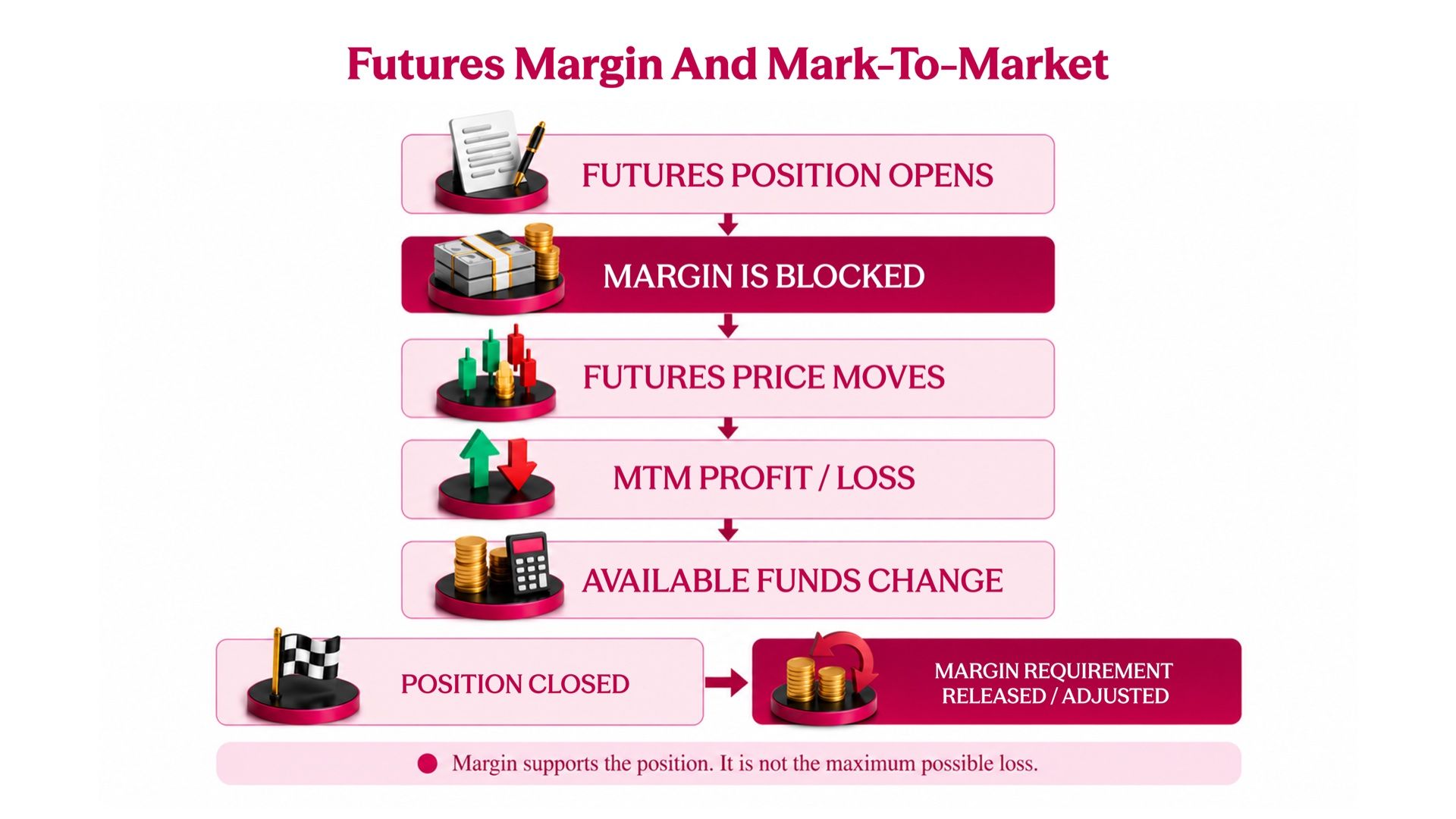
As the settlement price of the Futures contract changes, gains and losses can be credited or debited through the applicable MTM process even while the position remains open.
That means a trade can create funding pressure before you exit. If a Futures position moves sharply against you, the resulting loss can reduce the funds available in the account. If those funds fall too far relative to the margin required, you may need to add funds or reduce the position.
This is why the margin needed to enter the trade should never be treated as the total amount of capital the position may require.

When The Futures Position Is Closed
Closing a Futures position ends the market exposure for the quantity that has been exited.
A long position is closed by selling the corresponding quantity of the same contract, while a short position is closed by buying it back. Once the exit executes, the difference between the entry and exit prices determines the gross trading result on that quantity.
If only part of the position is closed, the trade now has two pieces. The exited quantity has a realised result, while the quantity still open continues to carry market exposure and unrealised P&L.
That is why it is worth checking the open quantity even after pressing Exit. A trade is only completely closed when the intended quantity has actually been exited.
What Changes With A Purchased Option?
A purchased Option follows a different path because the trade is built around the premium.
Suppose you buy a Gold Mini Put at a premium of ₹1,400 per 10 grams and one lot represents 100 grams. Your premium outlay is:
₹1,400 × 10 = ₹14,000
If the premium later rises to ₹1,800 and you sell the Put, the gross trading result becomes:
(₹1,800 − ₹1,400) × 10 = ₹4,000 profit
before applicable charges.
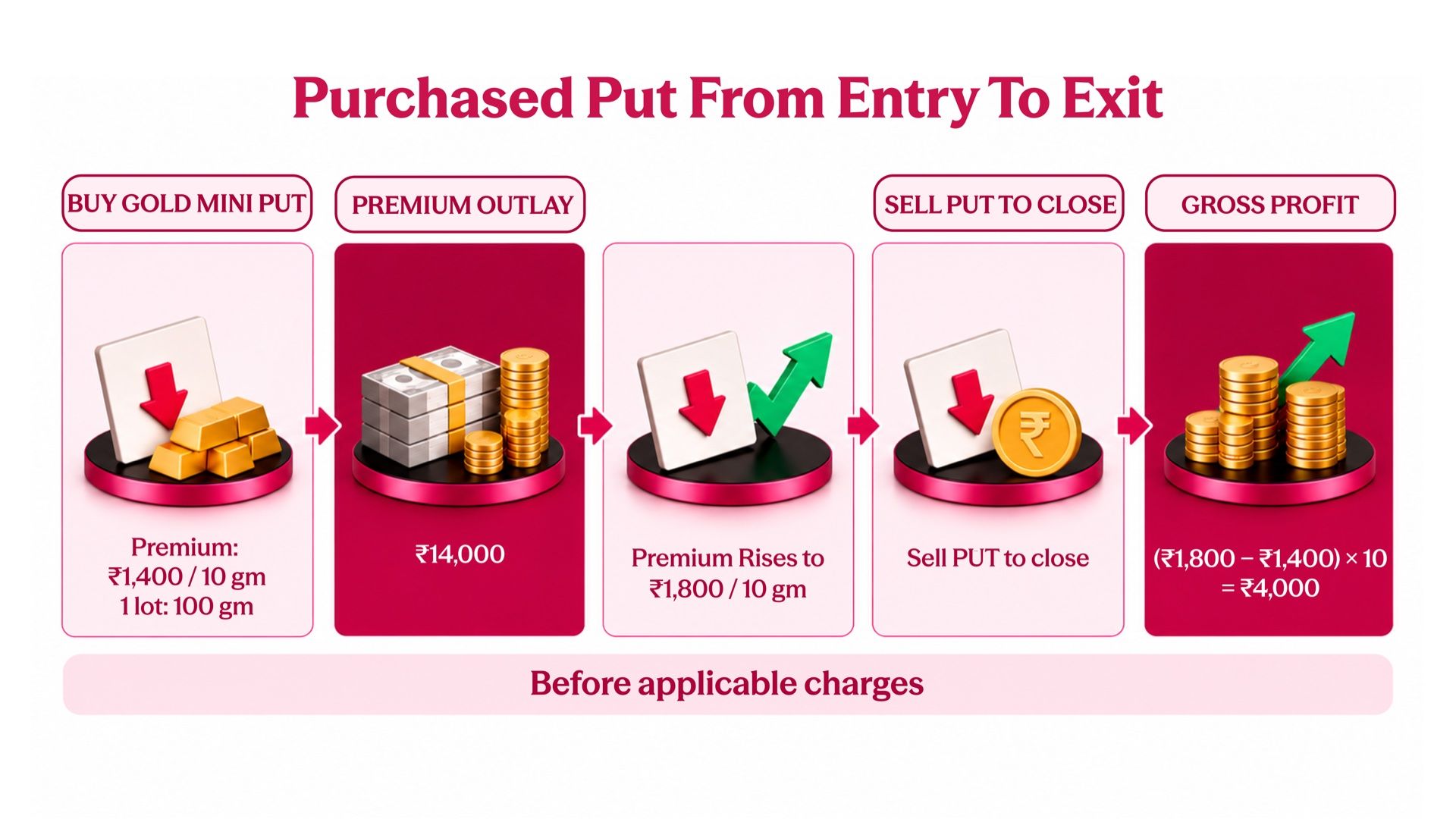
The important number at exit is the price of the Option itself. The underlying Gold price influences that premium, but the two do not move point for point because time remaining and volatility can also affect the Option.
If you sell the Option before expiry, the position ends with that exit. If you continue holding it, expiry introduces a different set of questions.
What Happens At Expiry?
Every Futures and Options contract has a defined expiry, and commodity derivatives need particular attention as that date approaches.
For a trader who simply wants exposure to price movement, closing the position before the relevant expiry and settlement deadlines can avoid obligations they never intended to take on.
Commodity Futures do not all settle in exactly the same way. Depending on the contract, settlement can involve cash settlement or physical delivery under the applicable exchange rules. Physical delivery can bring requirements around funds, delivery obligations, approved locations, quality specifications and other exchange procedures.
On SAHI, positions in deliverable commodity contracts are squared off automatically before the tender period begins, so SAHI traders do not make or take physical delivery.
Options add another layer. If a commodity Option is still open at expiry, the outcome depends on the contract, its moneyness and the applicable exercise and settlement rules. Where relevant, exercise or assignment can result in an underlying Futures position rather than simply ending as a cash profit or loss.
The buyer and seller also sit on different sides of that process. The buyer has paid a premium for the right embedded in the Option, while the seller has accepted the corresponding obligation.
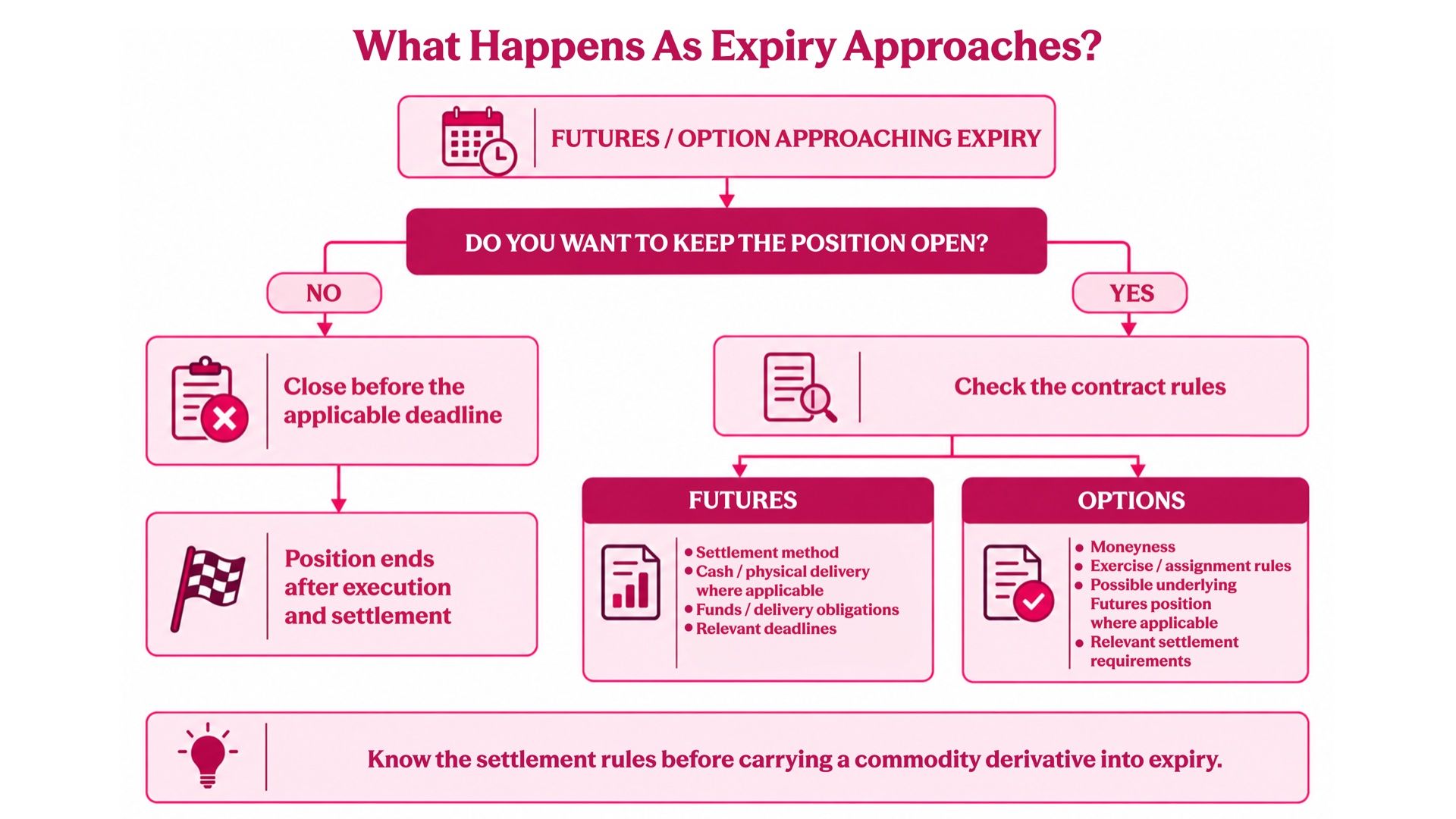
This is why expiry should be checked when the trade is opened, not discovered at the end. Before carrying a commodity derivative towards expiry, know the last trading date, settlement method and any exercise or delivery-related obligations that may apply.
Before You Consider The Trade Finished
A position is not fully understood by looking only at whether the final number is green or red.
If the trade has been closed, check that the entire intended quantity is actually gone and review the realised result rather than relying on the P&L you saw while the position was still open. Charges can affect the final net outcome, while any remaining quantity means the market exposure has not completely disappeared.
If the trade remains open, the questions are different. How much margin is being used? How is MTM affecting available funds? When does the contract expire? What happens if it is carried into settlement?
Those questions are part of the trade too.
With that lifecycle understood, we can now put the entire process together: finding a commodity, analysing it, choosing Futures or Options, structuring the trade, executing it and managing what happens afterwards.
How expiry and settlement are built into a contract is covered in Understanding Commodity Futures & Options.
Key Takeaways
- Unrealised P&L continues changing while a position remains open, while closing the position creates a realised trading result on the quantity exited.
- Futures margin supports an open position and should not be confused with either the full contract value or the maximum possible loss.
- Mark-to-market can affect the funds available in a Futures account even before the position is closed.
- A purchased Option can be closed before expiry by selling it, with the result determined by the change in its premium.
- Futures and Options can create settlement or delivery-related obligations near expiry, so the rules of the specific contract should be checked in advance.
Test yourself
Five quick questions on Chapter 19: What Happens After You Place the Trade?
Commodity knowledge check
How well do you understand commodity markets?
Answer all five questions to check what you have picked up from this chapter. Each answer comes with a short explanation.
 5 questionsUnder 3 minutes
 Instant score