
Top 5 NBFC Stocks in India
From Bajaj Finance and Shriram Finance to Jio Financial Services and Tata Capital, here's a look at five best NBFC stocks, their business strengths, key financial metrics, and growth prospects.

NBFC sector is entering a new growth phase, supported by rising credit demand and digital adoption. While Bajaj Finance and Shriram Finance remain established leaders, Tata Capital, Jio Financial Services, and Cholamandalam are pursuing aggressive expansion across lending segments.
Remember the time when you were able to take a loan for a wedding, buy a new bike, or use gold as collateral during a cash crunch? A Non-Banking Financial Company (NBFC) may have made that possible.
NBFCs allow customers to avail both loans and other financial services for various needs, making credit access easy. Therefore, the NBFC market is slowly emerging as a growing sector and has performed strongly despite continuing economic challenges. According to a report by Wright Research, analysts predict the NBFC sector will cross ₹50 lakh crore in assets under management (AUM) by Q1FY28.
In this blog, we will examine the top 5 NBFC stocks in India based on their market capitalisation, reputation, and potential for future growth.
Overview of Top NBFC Stocks
Below, we have outlined a quick overview of the top 5 NBFC stocks, highlighting their core business and financial performances.
1. Bajaj Finance
Bajaj Finance is a subsidiary of Bajaj Finserv and one of the largest NBFCs in India, known for its diverse lending portfolio, including consumer, commercial, and SME lending, as well as deposits.
The NBFC mostly relies on technology and has been targeting the rural markets through its FinAI initiative to streamline the documentation process and generate customized offers. The company is looking to become a powerhouse in these regions by tapping into specialized segments like gold loans, tractor loans, and commercial vehicle loans.
It is slowly shifting towards AI to lower its operational costs and protect profits from banking competition and surging lending costs. Bajaj Finance also looks to digitize the customer screening process to minimize credit defaults and improve overall asset quality.
In the long run, Bajaj Finance shares have remained in an uptrend, as you can see in the chart below.
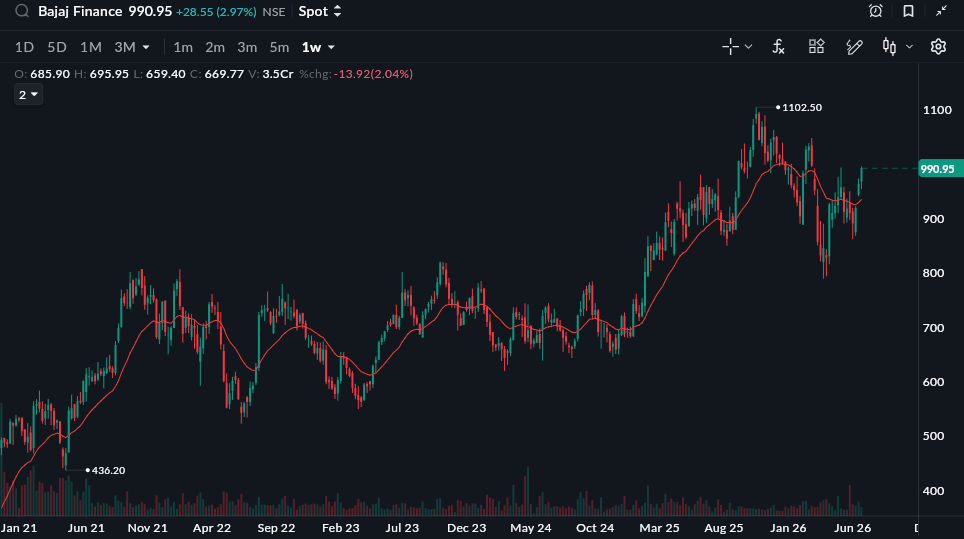
As of 24 June 2026
List of Top 5 NBFC Stocks in India
In the table below, we list the top 5 NBFC stocks listed on Indian stock exchanges by market capitalisation.
|
Company |
Market Capitalization in ₹ |
Gross Non-Performing Assets (GNPA) |
5 Year CAGR % |
ROE June 2026 |
ROCE June 2026 |
|---|---|---|---|---|---|
|
Bajaj Finance |
5,97,069 |
1.01% |
9% |
18.2% |
10.8% |
|
Shriram Finance |
2,36,033 |
4.58% |
29% |
16.4% |
11.5% |
|
Jio Financial Services |
1,60,060 |
0.00% |
NA |
1.19% |
1.86% |
|
Tata Capital |
1,55,702 |
1.5% |
NA |
12.3% |
8.58% |
|
Cholamandalam Investment and Finance Company |
1,43,325 |
4.36% |
27% |
19.3% |
9.70% |
Source: Screener, data as of 16 June 2026. 5-year returns calculated from 16 June 2021 to 16 June 2026.
* Tables marked NA are due to no data present for that particular category on the stated date.
2. Shriram Finance
Shriram Finance offers diverse financial services such as personal loans, home loans, two-wheeler loans, and gold loans.
Shriram Finance has a strong presence in semi-urban and rural areas across India, where it provides diverse financial services to both businesses and individuals, establishing its stronghold in the underbanked and remote regions of the country.
The NBFC in April 2026 sold a 20% stake to the Japanese bank MUFG for ₹39,618 crore, with the latter subscribing to 471.1 million shares issued at ₹840.93 per share. This venture improved Shriram’s tier 1 capital ratio to 36%, up from 20%, following which it is hopeful of showing massive growth in the retail and MSME segments.
In the long run, Shriram Finance shares have delivered strong returns, as shown in the chart below.
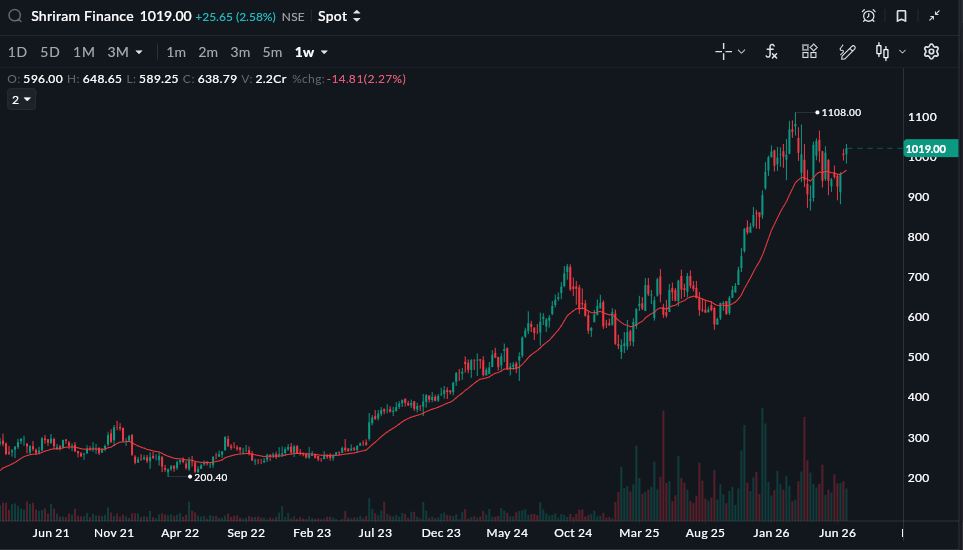
As of 24 June 2026
3. Jio Financial Services
Jio Financial Services is involved in lending, leasing, insurance, and investment segments, and recently entered a joint venture with BlackRock to create JioBlackRock, which offers personalised investment advice to its customers.
The company has positioned itself as an app-based non-banking lender, operating by providing services directly, thereby removing the need for people to visit offline branches. The NBFC is expanding aggressively through several growth initiatives, including personalised merchant loans and asset-based device leasing.
Jio Financial Services is also leveraging AI to ensure credit defaults remain near zero and its profit margins are protected. The NBFC, through the use of predictive intelligence, can easily access the individual’s creditworthiness before loan approval and protect itself from lending risks.
Jio Financial Services was listed in 2023. Since then, the stock has largely traded within a broad range, and as of June 2026, it is trading close to its listing price.
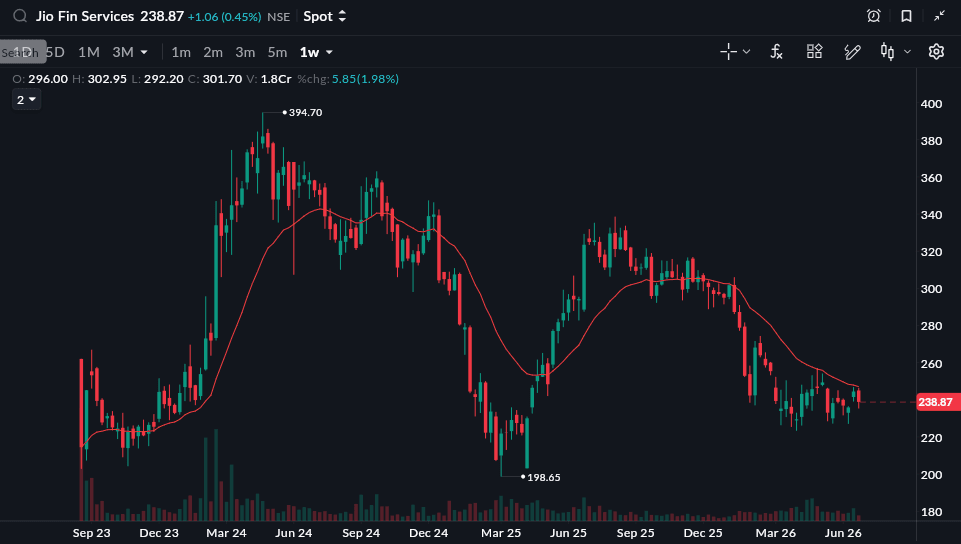
As of 24 June 2026
READ THIS ALSO: Top 5 Fertiliser Stocks in India
4. Tata Capital
Tata Capital provides different loan services, including personal loans, home loans, and vehicle loans, along with credit cards, insurance, and mutual funds to both individuals and businesses. The company went public in October 2025 at a valuation of ₹15,512 crore and became the largest IPO debut by a TATA company since Tata Technologies in 2023.
The company will continue to focus on its retail and SME sections since it constitutes 86% of its business and played important roles in its success in the past. The housing loan segment will be another category that the company will rely on for its growth.
The company has also tightened underwriting standards and maintained strong asset qualities despite the rising borrowing costs. It expects its margins to rise strongly from Q2FY27 and continue steadily, allowing it to meet its Return on Assets (RoA) target of 2.5-2.7%.
Tata Capital was listed in November 2025. In June 2026, the stock is showing signs of recovery and attempting a breakout, as seen in the chart below.
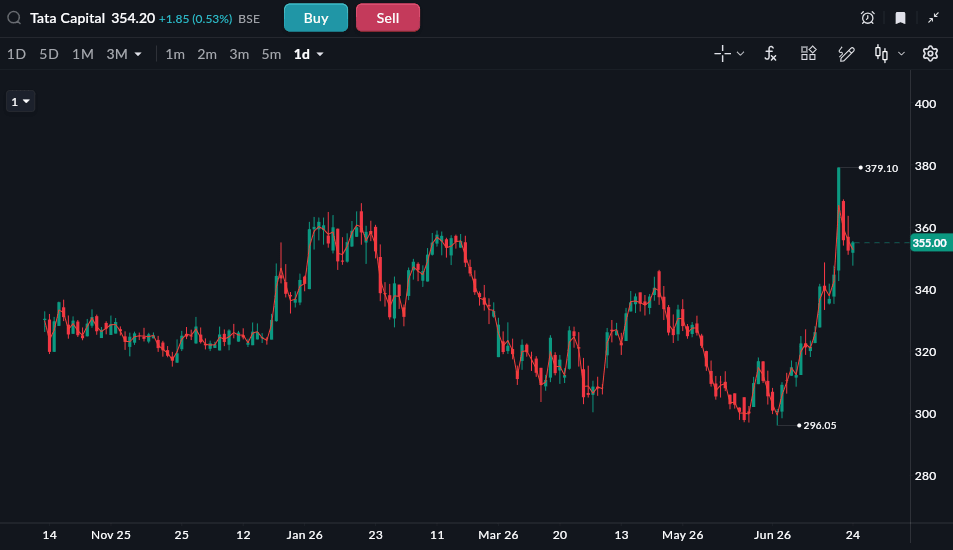
As of 24 June 2026
5. Cholamandalam Investment and Finance Company
Cholamandalam Investment and Finance Company offers diverse financial products like gold loans, loan against property, vehicle loans, SME loans, home loans, and personal loans to its customers. The company, with its strong branch network, manages assets worth ₹2.27 lakh crore.
It has a strong footing in semi-urban, tier 3, and tier 4 towns, where it has streamlined operations like onboarding and loan disbursal by introducing the ‘Chola One’ app, making it easier for customers to access credit.
Cholamandalam has projected its AUM to rise between 20% and 23% in FY27, driven by growth in vehicle finance and more people applying for gold loans. However, Cholamandalam is maintaining a conservative outlook and has set aside a financial buffer of ₹200 crore.
CHOLAFIN has been a true wealth creator for long-term investors. The chart below shows a strong long-term uptrend despite market corrections.
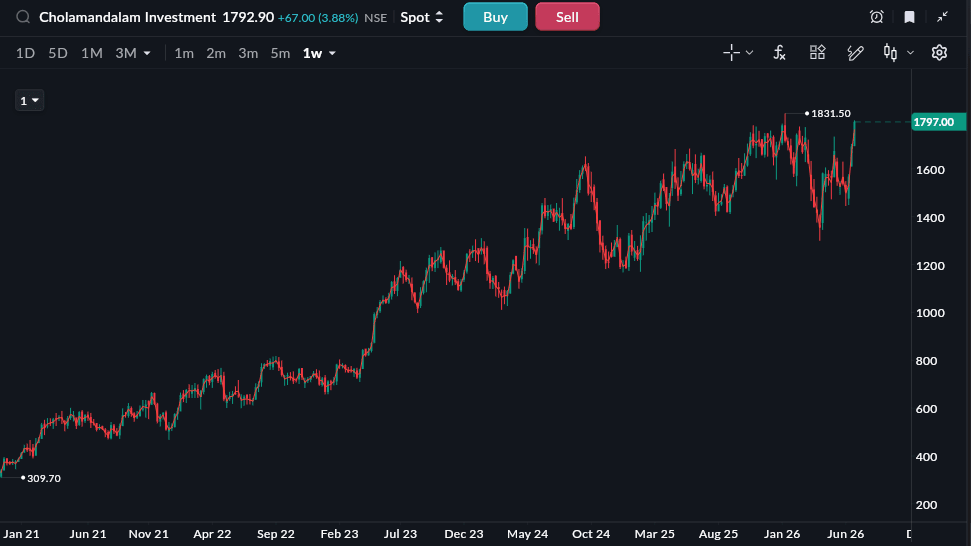
As of 24 June 2026
READ THIS ALSO: Top 5 Tourism Stocks in India
India’s NBFC Sector Outlook
Given below is an overview of how the NBFC sector is likely to perform in the future:
-
According to a report by Wright Research, NBFC AUM is projected to touch ₹50 lakh crore by March 2027 as credit growth is estimated to grow between 16-18% yoy.
-
Segments like vehicle loans, housing loans under ₹25 lakh, and gold loans are likely to aid the NBFC sector’s growth.
-
Gold loans will emerge as the fastest-growing segment, with Compound Annual Growth Rate (CAGR) rising at around 40% for the period between FY25 and FY27.
-
According to CRISIL Ratings, bank credits will include 44-45% of NBFC’s total borrowing by FY27 due to cheaper bank lending rates, compared to a more expensive and risky option of raising funds through costly corporate bonds and foreign borrowing options, respectively.
-
MSME loans-focused and small NBFCs will attract new customers through bank partnerships, the use of GST data, and digital credit tools. However, higher borrowing costs will challenge them in maintaining a strong position. Investors must be careful when investing in small NBFC stocks.
Conclusion
Investors must refrain from blindly investing in any of the best NBFCs and instead focus on proven players with high market capitalisation and low borrowing costs. Categories like gold loans, vehicle loans, and home loans are expected to do well due to lower interest rates. It is advisable to exercise caution with microfinance and unsecured loans, currently touted to be risky and highly volatile due to a surge in defaults.
All topics
Click the link, confirm the box next to sahi.com is checked — ignore any other results.