
PSU Bank Stocks Rise: What Is Driving the Rally in SBI, PNB and Bank of Maharashtra?
The Nifty PSU Bank index is up 4.22% in a month against 2.16% for the Nifty 50. Q1 FY27 earnings, multi-decade-low NPAs and below-book valuations explain the move.

PSU bank stocks are rising on the back of Q1 FY27 earnings, not hope. The Nifty PSU Bank index is up 4.22% over the past month against 2.16% for the Nifty 50. SBI posted a record ₹21,121 crore quarterly profit with its best asset quality in over 20 years. PNB's profit jumped 214%. System-wide gross NPAs are at a multi-decade low of 1.8%, and bank credit grew 15.9% in FY26. Yet Bank of India still trades at 0.73 times book value.
PSU bank stocks are back in focus. On Wednesday, August 26, 2026, public sector lenders drew steady buying even as the broader market slipped.
The Nifty PSU Bank index touched an intraday high of 8,762.45, a gain of 1.85%. By 12:45 PM it held 8,697.95, up 1.10%. The Nifty 50, in contrast, was down 0.22% at 24,281.50.
Bank of Maharashtra led the pack. The stock traded at ₹86.07 on the BSE, up 5.39% from its previous close of ₹81.67, after hitting ₹86.99 intraday. Bank of India rose 1.56%, Indian Bank 1.41% and Canara Bank 1.21%. SBI added 0.89% and Punjab National Bank 0.43%.
How far have PSU bank stocks actually run?
The single-day move is the smaller part of the story.
Over the past month, the Nifty PSU Bank index has gained 4.22%. The Nifty 50 managed 2.16% and the Nifty Private Bank index 1.89%. So public sector lenders have delivered roughly twice the return of their private peers over that stretch.
Zoom out further and the gap widens. The Nifty PSU Bank index is up 26.97% over one year. The Nifty 50 is down 1.74% in the same period.
One caveat matters. On August 26 itself, the Nifty Private Bank index rose 1.26% and beat the PSU Bank index. So this is not a clean daily rotation out of private banks. It is a one-month and one-year trend, not a single session.
Q1 FY27 earnings did the heavy lifting
The clearest driver is the June 2026 quarter.
SBI reported a standalone net profit of ₹21,121 crore, up 10.23% year-on-year. Net interest income rose 14.88% to ₹46,992 crore. Gross NPAs fell to 1.47% from 1.83%, and net NPAs to 0.38%. Both are the lowest in more than two decades. Domestic advances grew 18.15%, and return on equity came in at 17.87%. The full breakdown is in the SBI Q1 FY27 results report.
PNB was the bigger surprise. Net profit hit ₹5,253 crore, up 213.6% from ₹1,675 crore a year earlier. That base quarter was unusually weak, so the percentage flatters the print. Still, the underlying numbers were strong: gross NPAs down to 2.78% from 3.78%, net NPAs at 0.28%, provision coverage at 97.23% and credit cost at just 0.25%. Recoveries alone brought in ₹2,789 crore. See the PNB Q1 FY27 results for detail.
The strength was broad, not narrow:
- Bank of India: net profit up 36.2% to ₹3,068 crore
- Indian Bank: net profit up 10% to ₹3,273 crore; the stock jumped 10% on results day
- Punjab and Sind Bank: net profit up 23%
- Canara Bank: net profit up 2.2% to ₹4,856 crore, with global advances up 17.97%

(As of 12:15 PM on August 26, 2026)
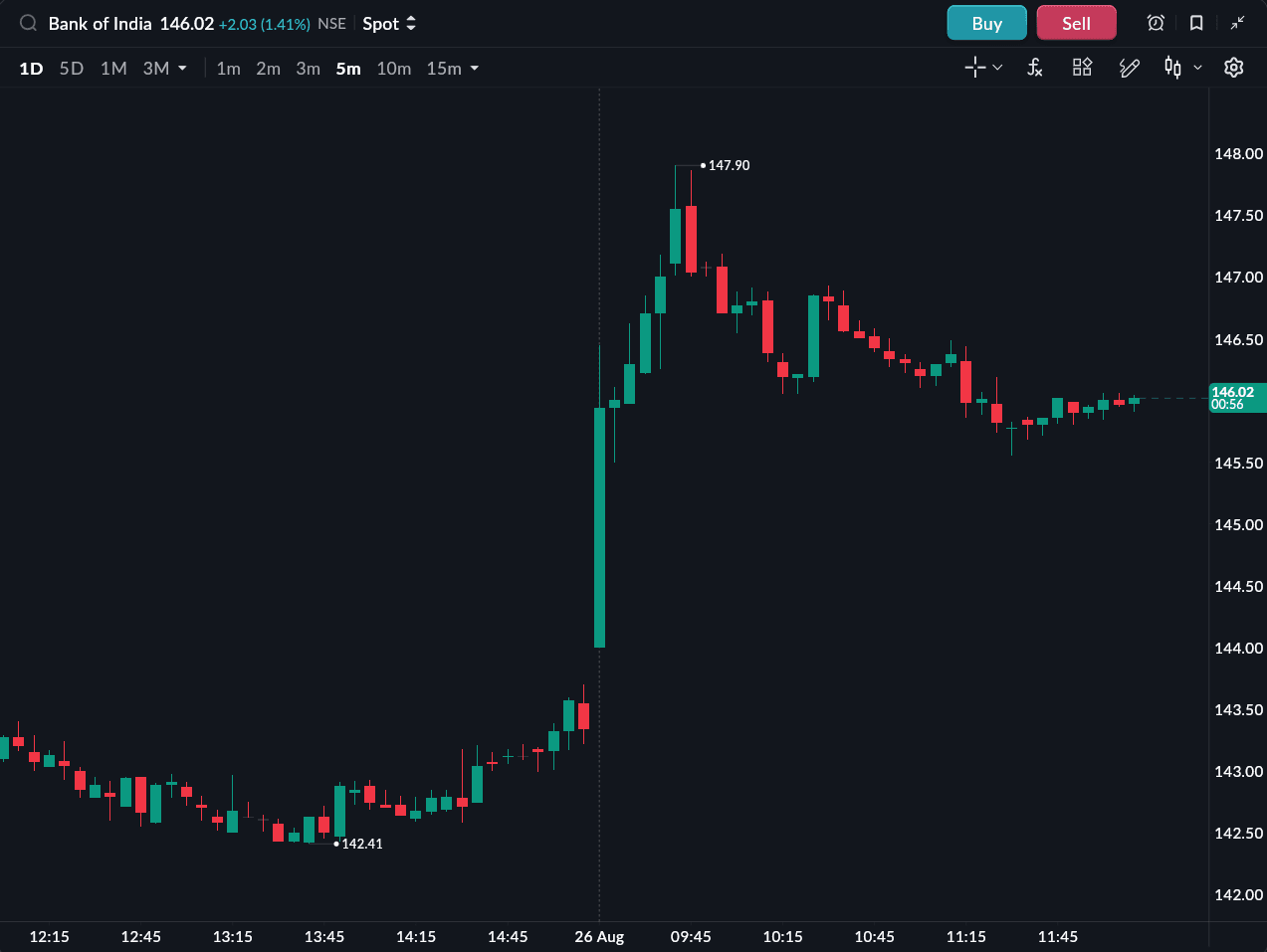
(As of 12:15 PM on August 26, 2026)
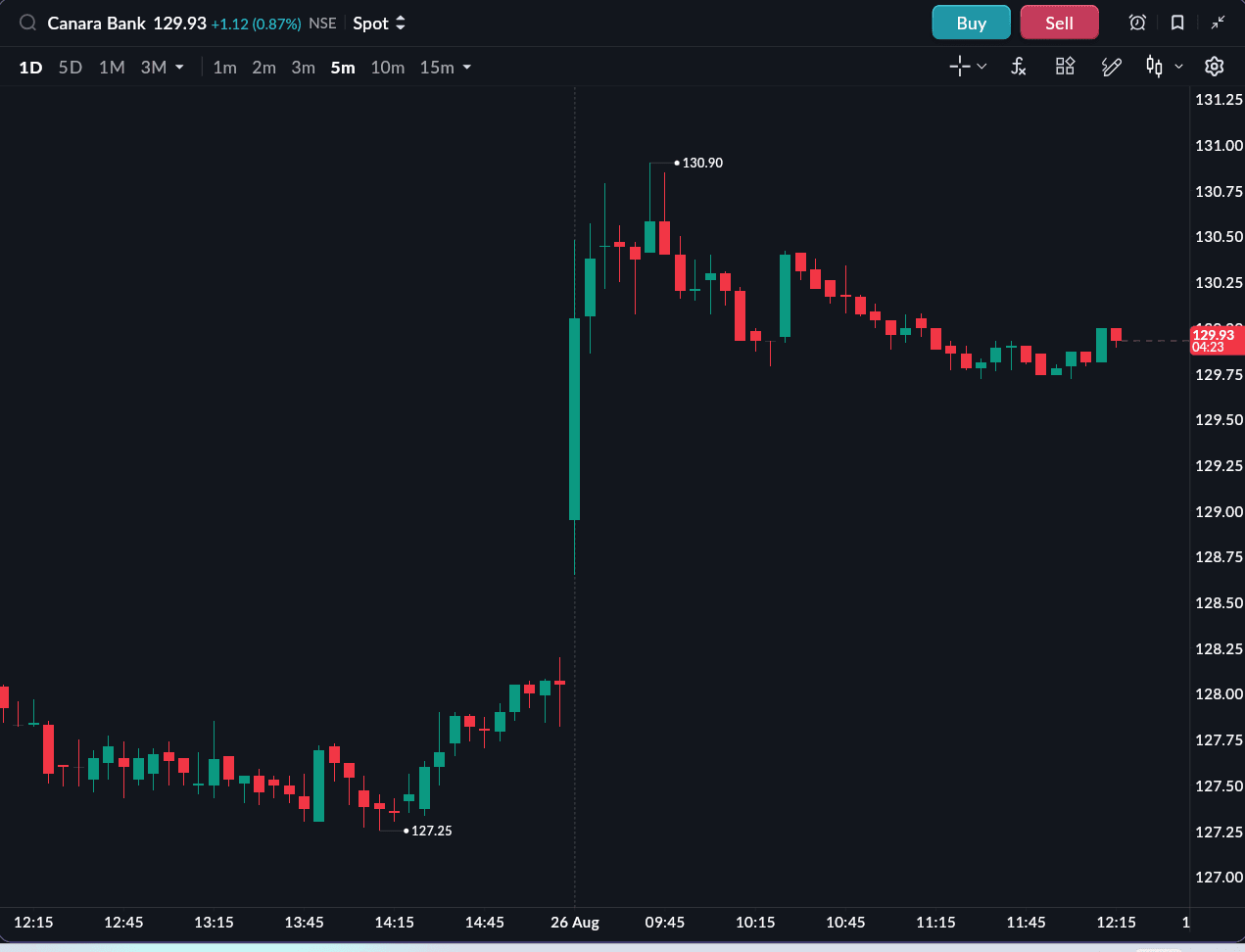
(As of 12:15 PM on August 26, 2026)
Indian Bank's slippage ratio tells the real story. It fell to 0.77% from 0.96% in the previous quarter. Fresh slippages dropped to ₹1,250 crore. NPA provisions fell nearly 49% sequentially. Lower provisions flow straight to profit.
Which PSU bank reported the largest percentage jump in net profit in Q1 FY27?
Asset quality is at a multi-decade best
For years PSU banks carried a risk premium. Investors assumed the next bad-loan cycle was always around the corner.
That assumption is getting harder to defend. The RBI's Financial Stability Report of June 2026 put the gross NPA ratio of scheduled commercial banks at 1.8% as of March 2026, a multi-decade low. The RBI's own baseline projection sees it edging up only to 1.9% by March 2028.
Individual PSU banks are now reporting net NPAs below half a percent. SBI is at 0.38%, Canara Bank at 0.36% and PNB at 0.28%. Those were unthinkable numbers a decade ago.
The margin story is more nuanced than it looks
Here is where a lot of commentary gets it wrong.
The common claim is that PSU banks are shielded from margin pressure because their loans reprice slowly. The opposite is closer to the truth. PSU banks carry a higher share of loans linked to the external benchmark and to treasury bill yields, both of which reprice within days of a rate move. Private banks hold more MCLR-linked credit, which resets only every six or twelve months.
So PSU banks felt the rate cuts first, and harder. Analysts expect private banks to show a margin bottom before public sector lenders do.
What actually helped the stocks is that the damage came in milder than feared. SBI's domestic net interest margin held at 3.00%, down just 1 basis point year-on-year and 7 basis points sequentially. PNB's domestic margin improved to 2.64% from 2.47% in the previous quarter. Margins were expected to be the weak link. They were not.
Valuations: below book, but not everywhere
The valuation argument is real, and it is also uneven. Here is where the large lenders stand as of August 26, 2026.
| Bank | Price (₹) | Book value (₹) | Price to book | P/E | ROE (%) |
|---|---|---|---|---|---|
| Bank of India | 146 | 200 | 0.73x | 5.67 | 12.4 |
| Bank of Baroda | 244 | 326 | 0.75x | 5.73 | 12.7 |
| Punjab National Bank | 117 | 136 | 0.86x | 6.03 | 13.0 |
| Canara Bank | 130 | 136 | 0.96x | 5.96 | 16.1 |
| Union Bank of India | 188 | 183 | 1.03x | 6.95 | 15.7 |
| Indian Bank | 890 | 623 | 1.43x | 9.28 | 15.4 |
| State Bank of India | 1,056 | 674 | 1.57x | 11.6 | 15.4 |
| Bank of Maharashtra | 86 | 46.4 | 1.85x | 8.71 | 22.6 |
| HDFC Bank | 729 | 390 | 1.87x | 14.2 | 13.6 |
| ICICI Bank | 1,438 | 527 | 2.73x | 18.4 | 15.9 |
Four of the large PSU banks still trade below book value. ICICI Bank trades at 2.73 times book. That gap is the discount investors are trying to close.
But note the last two rows carefully. Bank of Maharashtra, the day's biggest gainer, trades at 1.85 times book. That is almost exactly HDFC Bank's multiple. It is no longer a cheap stock. What it does have is a 22.6% return on equity, the highest in the group. Buying it on a "PSU banks are cheap" thesis would be buying the wrong reason.
As of August 26, 2026, which of these PSU banks trades at the LOWEST price-to-book multiple?
Credit growth is running well ahead of deposits
Loan demand is the other support. Bank credit grew 15.9% in FY26 to ₹212.9 lakh crore, an addition of ₹29.2 lakh crore in one year. That is a sharp pickup from 10.9% in FY25.
Growth was broad based. Services led at 19%, personal loans grew 16.2%, agriculture 15.7% and industry 15%.
Deposits grew 11.5% in the same period, up from 10.6% a year earlier. Credit outpacing deposits by more than four percentage points keeps the loan-to-deposit ratio elevated. That is the pressure point to watch, because deposits raised at higher rates will show up in funding costs through FY27.
What PSU bank rallies have historically got wrong
This rally rests on measurable things: earnings, slippages, credit growth and valuation gaps. That is a firmer base than the merger-and-privatisation talk that drove earlier runs.
It is still worth remembering how these stocks behave. PSU bank shares tend to move in sharp bursts and correct just as sharply. The same index that has gained 27% in a year fell hard in earlier episodes covered in why PSU bank stocks fall.
Three things separate a rerating from a bounce. Slippages need to stay low through a full cycle, not one quarter. Margins need to bottom out and turn. And deposit growth needs to catch up with credit growth. The first is happening. The second and third are still open questions.
What has changed is the lens. PSU banks are now being judged on earnings, asset quality and return on equity rather than on their history. That is why SBI, PNB, Bank of Maharashtra, Bank of India and Canara Bank are back on watchlists. For a wider view of the space, see PSU stocks to watch in 2026.
Sources: NSE index data and BSE quotes as of 12:45 PM, August 26, 2026; RBI Financial Stability Report, June 2026; RBI Basic Statistical Return (BSR-2), March 2026; Ministry of Finance data on bank credit growth for FY26; Q1 FY27 investor presentations and exchange filings of SBI, PNB, Bank of India, Indian Bank, Canara Bank and Punjab and Sind Bank; screener.in for book value and valuation ratios. This article is for information only and is not investment advice.
Frequently Asked Questions (FAQs)
All topics
Click the link, confirm the box next to sahi.com is checked — ignore any other results.