What Are Commodities? Meaning, Types & How They Are Traded
Start here. Learn what a commodity actually is, how the commodity universe splits into agricultural and non-agricultural markets, and why trading a commodity contract is different from buying the physical good.
 7 minutes read|
Before a packet of biscuits reaches a supermarket shelf, a piece of jewellery reaches a showroom, or a smartphone lands in your hand, there are raw materials somewhere behind it.
Wheat and sugar go into food, gold and silver become jewellery and investment assets, copper and aluminium go into electrical equipment and electronics, while crude oil is refined into petrol, diesel and aviation fuel.
Many of these raw materials are commodities.
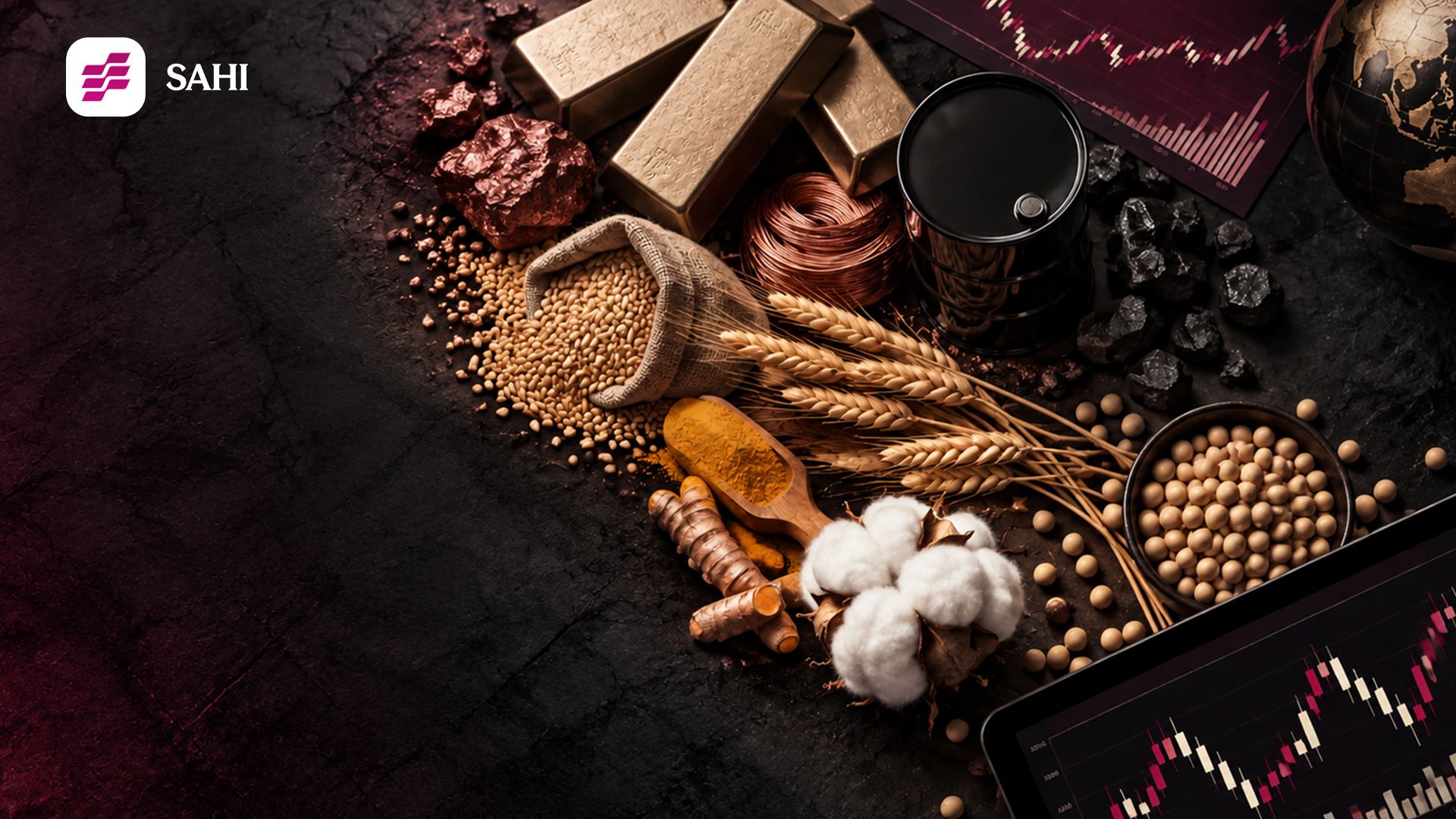
Gold, silver, copper, natural gas, crude oil, cotton, wheat, turmeric and guar may look like completely different products, but they have one thing in common: they are physical goods that are produced, bought and sold across large markets.
Some are mined, some are drilled and some are grown, but all of them move through real supply chains before they reach businesses or consumers.
For a trader, the interesting part is that you can participate in the price of a commodity without physically owning it.
You can take a view on gold without storing gold, on crude oil without owning a barrel, or on copper without finding somewhere to keep tonnes of metal. In financial markets, that exposure can come through contracts linked to the price of the underlying commodity.
For an organised market to work, though, everyone needs to know exactly what is being traded. Gold has purity standards, cotton has grades, and other commodities have their own specifications around quality, quantity and delivery.
So at its simplest, a commodity is a physical good that can be bought and sold. Organised commodity trading becomes possible when that good can be defined clearly enough for a large market to form around it.

And that universe extends far beyond the few commodities most traders hear about regularly.
The Commodity Universe
For an Indian trader, the easiest way to first map the commodity universe is to divide it into two broad groups: agricultural and non-agricultural commodities.
Agricultural commodities come from farming and related activity. This includes food grains and cereals, oilseeds, spices, cotton and several other crops.
Non-agricultural commodities include metals and energy products. Within this group are precious metals such as gold and silver, base metals such as copper and aluminium, and energy commodities such as crude oil and natural gas.
This distinction becomes useful because the forces affecting these markets can be very different.
An agricultural commodity may be particularly sensitive to crop output, weather, monsoons, domestic supply conditions and government policy. Crude oil, gold or copper may respond much more directly to global demand, international prices, geopolitics, currencies or industrial activity.
We will explore these markets properly in Chapter 3: The Commodity Universe. For now, what is worth noticing is that every one of them is tied to something being produced, moved or consumed in the real economy.
Commodities And The Real Economy
Behind the crude oil price on a trading terminal is a physical chain of extraction, transportation and refining. The resulting products eventually become petrol, diesel, aviation fuel and other industrial inputs.
Cotton follows a completely different journey. It is grown, harvested, processed and eventually used by textile manufacturers.
That physical journey is important because behind every price on your screen is a real product that somebody, somewhere, produces, transports, stores, processes or consumes.
If production changes, consumption changes or there is a disruption somewhere along that chain, the balance between buyers and sellers can change as well.
We will break down the forces that move commodity prices properly in Chapter 9: What Moves Commodity Prices? At this stage, what matters is that a commodity price is not simply a number moving on a chart. It represents a market for an actual good being produced and used somewhere in the world.
That connection with the physical economy is one of the defining features of commodity markets. But participating in that market does not necessarily mean buying the physical commodity itself.
Buying A Commodity vs Trading A Commodity Contract
Suppose you walk into a dealer and buy 10 grams of physical gold. You now own the actual commodity. But a trader can also take exposure to movements in the price of gold without physically purchasing those 10 grams.
This is where commodity derivatives come in. A derivative is a financial contract whose value is linked to an underlying asset. In this case, that underlying asset is a commodity.
Two instruments you will encounter throughout this course are commodity futures and commodity options.
We will understand exactly how both work in Chapter 7: Understanding Commodity Futures & Options. For now, the important distinction is simpler.
When you purchase the physical commodity, you are dealing in the actual asset. When you trade a commodity derivative, you are trading a financial contract linked to that commodity.
The difference becomes important because the two can involve very different practical considerations.
Buying the physical asset may involve ownership, payment for the commodity itself and issues such as storage or custody. A derivative comes with its own contract terms, including factors such as contract size, capital requirements, expiry and its own risk profile.
So even if two people have exactly the same view on gold, the way they choose to express that view can create very different trades. We will get into the mechanics of futures and options later in the course.
Where Do Commodities Fit In Financial Markets?
Commodity markets sit alongside equities, debt and currencies, but the underlying asset is different. An equity represents ownership in a business, while a commodity market is linked to a physical economic good such as gold, crude oil, natural gas or copper.
That difference is important because commodities can be produced, transported, stored and consumed, and changes in their availability in the physical world can affect their market price.
We will compare commodities and equities much more closely in Chapter 4: Commodities vs Stocks: What Changes?
When you search for Gold, Crude Oil, Natural Gas or Copper on your trading screen, there is a real commodity behind that price and a real market operating around it.
Once that is clear, the next question becomes much more useful: Why did organised commodity markets and commodity contracts come into existence in the first place?
That is where we go next.
Key Takeaways
- A commodity is a physical good that can be bought and sold, usually against an accepted specification or grade.
- Commodities can broadly be divided into agricultural and non-agricultural commodities.
- Agricultural commodities include grains, oilseeds, spices and crops such as cotton, while non-agricultural commodities include precious metals, base metals and energy products.
- Commodity markets are connected to the real economy. Changes in production, availability, storage or consumption can ultimately affect the market price.
- Buying a physical commodity and trading a commodity derivative are different things. One involves the actual asset, while the other involves a financial contract linked to it.
- Futures and options are two important commodity derivatives. Their mechanics, risks and use cases will be covered later in the course.
Test yourself
Five quick questions on Chapter 1: What Are Commodities?
Commodity knowledge check
How well do you understand commodity markets?
Answer all five questions to check what you have picked up from this chapter. Each answer comes with a short explanation.
 5 questionsUnder 3 minutes
 Instant score