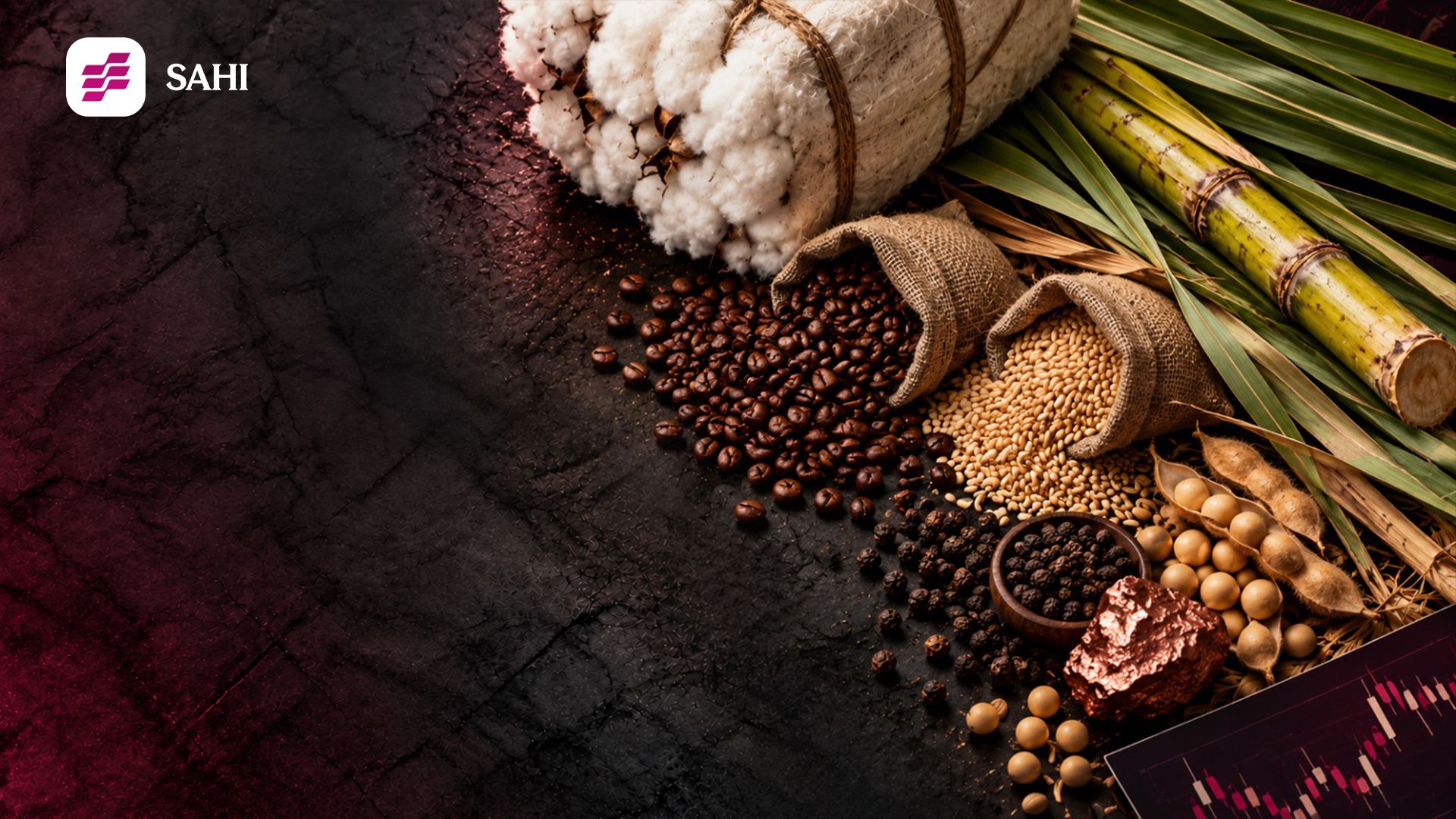
The Commodity Universe: Agri vs Non-Agri Commodities Explained
Gold, crude oil, copper and turmeric sit side by side on a screen but live in very different markets. Map the commodity universe by family and learn what sits behind precious metals, energy, base metals and agri commodities.
 6 minutes read|
Gold, crude oil, copper and turmeric can all sit next to each other on a trading screen, but the markets behind those prices have very little in common.
Gold can react to interest rates and currency moves, while crude oil sits inside a global energy market where production decisions and geopolitics matter. Copper is closely tied to industry and construction, while turmeric is affected by an entirely different physical market involving weather, crop output, stocks and demand.
So before worrying about charts, contracts or price drivers, it helps to know what kind of market you are actually looking at.
In India, that distinction can sometimes get blurred because traders often encounter commodities through the exchanges on which they trade. Gold, Crude Oil and Copper are commonly associated with MCX, while commodities such as Jeera, Turmeric and Guar are more closely associated with NCDEX. But MCX and NCDEX tell you where a commodity contract trades, not what kind of commodity it is.
To understand the commodity universe itself, we will therefore divide it into two broad groups: non-agricultural and agricultural commodities. Non-agri includes precious metals, energy and base metals, while agri includes grains, oilseeds, spices, fibres and guar.
You do not need to memorise a catalogue of commodities. The point is to recognise the families, understand what sits behind them and start seeing why information that matters enormously to one market may barely register in another.

Non-Agricultural Commodities
The non-agricultural side of the market can broadly be divided into precious metals, energy and base metals. Gold and Silver sit under precious metals, Crude Oil and Natural Gas under energy, while Copper, Aluminium and Zinc are among the major base metals.
Precious Metals
Gold and Silver sit together under precious metals, but the markets around them are not identical.
Gold is used in jewellery, bought as an investment and held by central banks. That gives it a strong financial side, so currencies, interest rates and investor demand can matter alongside what is happening in the physical market.
Silver shares some of those characteristics, but industrial demand plays a larger role in its market. As a result, the two metals can respond to some of the same developments without necessarily moving together.
Energy
Crude Oil and Natural Gas are the two main energy commodities we will deal with in this course.
Crude oil is refined into petrol, diesel, aviation fuel and several other petroleum products, linking its market directly with transport, industry and economic activity. Since crude is traded globally, changes in production, demand or supply from major producing regions can quickly feed into prices in India.
Natural Gas sits in the same energy bucket, but its production, transportation, storage and consumption chain is different. So a view on Crude Oil does not automatically translate into the same view on Natural Gas.
Base Metals
Copper, Aluminium and Zinc are among the major base metals.
Their demand comes heavily from construction, infrastructure, manufacturing and electrical equipment, which ties these markets closely to industrial activity.
If factories are producing more or infrastructure activity is picking up, demand for these metals can change. Supply disruptions matter too, especially when mining or production problems affect how much metal reaches the market.
Agricultural commodities work through a different physical cycle because their supply begins with planting, growing and harvesting rather than mining or extraction.
Agricultural Commodities
Agricultural commodities move through planting, growing and harvesting cycles, so supply can change with weather, acreage, crop health and harvest conditions.
Many of these markets also have a stronger domestic layer. Stocks, imports, exports, government policy and demand from processors can all affect the balance between what is available and what is needed.
The main groups an Indian trader will come across include grains and pulses, oilseeds, spices, fibres and the Guar complex.
Grains And Pulses
Wheat, Chana and Maize are examples of grains and pulses.
Their markets are closely tied to food demand and crop supply, which means production conditions and domestic availability can matter a great deal.
Oilseeds And Oils
Soybean and Mustard Seed sit within the oilseed market.
Oilseeds are processed into products such as edible oils and meals, so the market connects crop output with demand from processors and consumers.
Spices
Jeera, Turmeric and Coriander are among the better-known spice commodities.
Production, stocks, domestic consumption and export demand can all matter here, which gives these markets a very different character from something like Gold or Crude Oil.
Fibres
Cotton and Kapas connect agriculture with the textile industry.
Supply begins with the crop, while demand comes further down the chain from processors and textile manufacturers.
The Guar Complex
The Guar complex includes Guar Seed and Guar Gum.
Guar Seed is the crop, while Guar Gum is the processed product used in commercial and industrial applications. So the market links agricultural supply with downstream industrial demand.
Why The Commodity Itself Matters
A monsoon forecast may matter to an agricultural trader because it can affect crop conditions. A disruption in a major oil-producing region can matter to Crude Oil, while a slowdown in manufacturing can change the demand picture for Copper.
Broadly, agricultural markets are more exposed to weather, seasonality, crop output, domestic policy and import-export conditions, while many non-agricultural markets have stronger links with global prices, currencies, geopolitics and industrial activity.
None of these relationships works mechanically. A weak crop does not automatically mean prices will rise, just as geopolitical tension does not guarantee Crude Oil will rally. We will get into price drivers properly in Chapter 9.
For now, it is enough to know what the commodity is, who uses it and what sits behind its supply. That context helps explain why different commodity markets can behave very differently even when they appear next to each other on the same trading platform.
The next step is to compare commodities with the market most traders already know: equities.
That takes us to Chapter 4: Commodities vs Stocks: What Changes?
Key Takeaways
- The commodity universe can broadly be divided into agricultural and non-agricultural commodities.
- Non-agricultural commodities include precious metals such as Gold and Silver, energy products such as Crude Oil and Natural Gas, and base metals such as Copper, Aluminium and Zinc.
- Agricultural commodities include grains and pulses, oilseeds, spices, fibres and the Guar complex.
- Different commodity families are connected to different physical markets, which means the developments that matter to them can vary considerably.
- Before analysing a commodity, a trader should understand what it is, who uses it and what kind of supply chain sits behind the price.
Test yourself
Five quick questions on Chapter 3: The Commodity Universe
Commodity knowledge check
How well do you understand commodity markets?
Answer all five questions to check what you have picked up from this chapter. Each answer comes with a short explanation.
 5 questionsUnder 3 minutes
 Instant score