
DDPI on Sahi: Sell Shares Without Entering TPIN and OTP Every Time
A one-time Aadhaar e-Sign lets Sahi debit shares for sale, pledge, mutual fund and open-offer instructions, so the CDSL TPIN and OTP step disappears from every delivery sell order.

DDPI stands for Demat Debit and Pledge Instruction. It is a one-time authorisation that lets SAHI debit shares from a demat account for four specific purposes only: settling sell trades, pledging shares for margin, mutual fund transactions on exchange platforms, and tendering shares in open offers. Once DDPI is active, the CDSL TPIN and OTP step disappears from every delivery sell order. Activation is fully online through Aadhaar e-Sign, costs a one-time ₹100 + 18% GST (₹118), and can be revoked at any time. It is optional, not mandatory.
The two minutes that cost traders money
A stock gaps up 6% at open. A trader opens their trading platform, taps "sell" on the same holding, and instead of an order confirmation, the screen asks for CDSL verification. Generate TPIN. Wait for the SMS. Enter the OTP on the CDSL page. Come back. Place the order again.
Most of the time, the move has faded by then. This is not a rare edge case. Every delivery sell order from a demat account needs authorisation. The default authorisation method is eDIS with TPIN and OTP, which expires at the end of each trading day.
A trader who sells holdings on twelve different days in a month goes through that loop twelve times.
DDPI removes the loop permanently. Here is what it is, what it can and cannot do, what it costs, and exactly how to switch it on.
What is DDPI?
DDPI is short for Demat Debit and Pledge Instruction. It is a standardised document, signed once by the account holder, which authorises the broker and depository participant to debit securities from the demat account for a fixed, closed list of purposes.
SEBI created it through circular SEBI/HO/MIRSD/DoP/P/CIR/2022/44 dated April 4, 2022, and widened its scope through a clarification circular, SEBI/HO/MIRSD/MIRSD-PoD-1/P/CIR/2022/137 dated October 6, 2022. The purpose was to retire the open-ended Power of Attorney that brokers had used for two decades and replace it with something far narrower.
The important word is limited. A power of attorney was a broad legal instrument. DDPI is a fixed-scope instruction. It cannot be stretched.
The four things DDPI covers, and nothing else
SEBI permits DDPI to be used for exactly four purposes:
- Transfer of securities for settlement obligations. When a trader sells shares held in demat, those shares must reach the clearing corporation. DDPI authorises that debit.
- Pledging and re-pledging for margin. Shares can be pledged in favour of the trading or clearing member to get collateral margin for F&O and intraday positions.
- Mutual fund transactions on stock exchange order entry platforms. Redemptions routed through the exchange platform.
- Tendering shares in open offers through exchange platforms. This includes buybacks, delisting offers and acquisition open offers.
Anything outside those four is not permitted. That matters more than most people realise, so it deserves its own section.
What DDPI cannot do
| Concern | Reality under DDPI |
|---|---|
| Can the broker sell shares on its own? | No. DDPI only authorises the debit leg of an instruction the client has already placed. No sell order, no debit. |
| Can shares be transferred to a third party's demat account? | No. The debit can only go to the clearing corporation for settlement or into a pledge in favour of the trading/clearing member. |
| Can it be used for off-market transfers or gifting shares? | No. Those still need a separate Delivery Instruction Slip. |
| Does it touch the bank account or funds? | No. DDPI applies to securities in the demat account only. |
| Does it affect buying shares? | No. Buying credits the demat account. DDPI concerns debits. |
| Is it mandatory? | No. SEBI made it explicitly optional. A client can decline DDPI and continue with eDIS TPIN, or use a physical DIS. |
DDPI vs POA vs TPIN: which is which
| Parameter | Power of Attorney (old) | DDPI | CDSL TPIN / eDIS |
|---|---|---|---|
| Scope | Broad, loosely worded | Four defined purposes | Per-transaction, per-day |
| Effort per sell order | None | None | TPIN + OTP each day |
| Validity | Until revoked | Until revoked | Expires end of day |
| Misuse risk | Higher | Low, by design | Lowest |
| Status | Being phased out | Current standard | Always available as fallback |
| Cost on SAHI | Not offered | ₹100 + 18% GST, one-time | Free |
Existing POAs signed before the change remain valid until the client revokes them. New clients are onboarded on DDPI.
What DDPI costs on SAHI
A one-time charge of ₹100 + 18% GST, or ₹118 in total. It is debited from the trading account ledger once activation is processed. There is no annual fee, no renewal charge and no per-transaction cost after that.
Perspective on the number: a trader who sells holdings even twice a month spends roughly 24 TPIN-OTP cycles a year. ₹118 is a one-time payment to delete all of them permanently.
How to activate DDPI on SAHI: step by step
SAHI is a SEBI-registered broker with its own depository participant membership with CDSL (IN-DP-12100100), and it supports resident individual accounts. That combination matters here. At most brokers, joint accounts, HUFs, NRIs and corporate accounts have to print a DDPI form, sign it, and courier it to a head office. On SAHI, every eligible account can complete DDPI online. Nothing is printed, signed physically or posted.
The whole process takes about two minutes.
Step 1: Open the SAHI app and navigate to Profile
Log in to the SAHI app. Tap the profile icon and open DDPI under account settings. The screen shows the current status as not activated.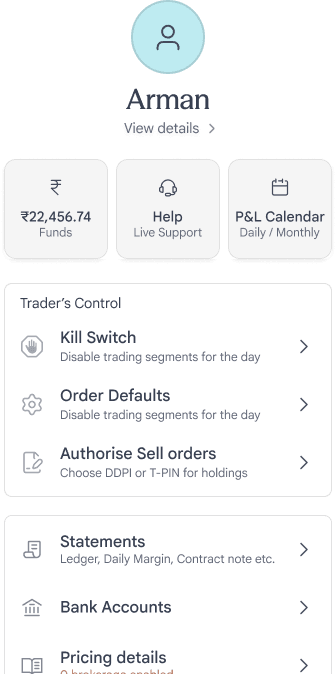
Step 2: Read what is being authorised
The next screen lists the four permitted purposes. This is worth reading rather than scrolling past. It is the actual legal scope of the authorisation being given.
Step 3: Proceed to e-Sign
Tap Proceed to e-Sign. SAHI generates the DDPI document and redirects to the Aadhaar e-Sign page operated by a licensed e-Sign service provider.
Step 4: Enter the Aadhaar number and verify with OTP
Enter the 12-digit Aadhaar number, tick the consent box, and request the OTP. The OTP goes to the mobile number linked to Aadhaar, not necessarily the one registered with SAHI. If the Aadhaar-linked mobile is not active, the OTP will not arrive, and that is the single most common reason activation fails.
Step 5: Submission and activation
Once the OTP is verified, the signed DDPI is submitted to the depository. The status moves to Under process. Activation is typically completed within one working day, and confirmation arrives by email and SMS.
What actually changes day to day
Before DDPI, selling a holding looked like this: place sell order → eDIS prompt appears → tap verify → CDSL page opens → enter TPIN → receive OTP → enter OTP → return to app → order goes through. Repeat the next day, because the authorisation expires.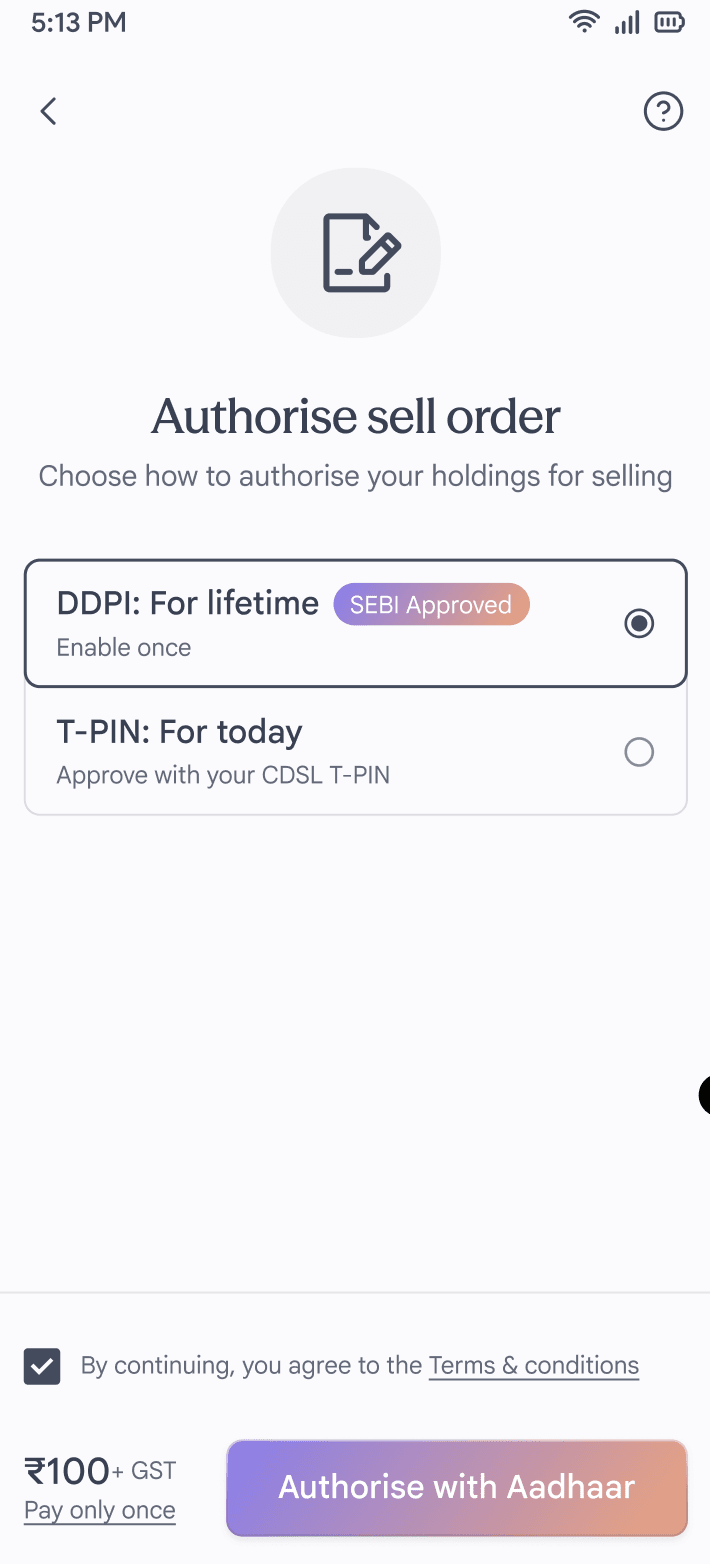
After DDPI: place sell order → order goes through.
Four situations where the difference is felt most:
1. Exiting on a gap or a news spike. Fast moves reward a trader who can hit sell immediately. This is the main reason DDPI exists.
2. Selling more than one stock in a session. A single day's TPIN pre-authorisation covers the day, but only after it has been done. DDPI removes the setup step entirely.
3. Pledging holdings for margin. DDPI covers the pledge leg, which makes it faster to convert an existing portfolio into F&O collateral. The mechanics of that are covered in SAHI's guide on using a portfolio as trading capital.
4. Buybacks and open offers. Tendering shares into a buyback or open offer is a debit from demat, and it is covered by DDPI. Missing the tender window because of a failed authorisation is an expensive mistake to make once.
Common questions traders have about selling shares
Shares are visible in holdings but the sell order was rejected. Under T+1 settlement, shares bought on Monday are credited to demat by Tuesday. Before credit, they show in holdings as a receivable, not as a demat balance. Selling them on Tuesday is a BTST trade, which is settled by the broker and does not go through the TPIN or DDPI path at all.
Is TPIN still needed after DDPI is active? No, for the covered transactions. The TPIN itself remains valid and works as a fallback if a DDPI-based debit ever fails. There is no need to delete it.
Does DDPI apply to intraday and F&O? Intraday equity positions are squared off the same day and never touch demat, so no authorisation is needed. F&O contracts are not held in demat either. DDPI only matters for delivery holdings and for pledging.
What about shares lying with another broker? DDPI signed with SAHI covers the SAHI demat account only. Holdings in another demat account follow that broker's own authorisation.
What happens if shares are sold but not delivered? That becomes a short delivery and goes to the exchange auction, with penalties. DDPI does not change this. It authorises a debit, it does not create shares.
The bottom line
DDPI is a small, one-time piece of paperwork that removes a recurring source of friction from every delivery sell order. It costs ₹118 once, takes two minutes over Aadhaar e-Sign, is limited by regulation to four specific uses, and can be revoked whenever the account holder chooses. For anyone who sells holdings more than occasionally, it pays for itself the first time a stock moves fast.
Sources: SEBI circular SEBI/HO/MIRSD/DoP/P/CIR/2022/44 dated April 4, 2022; SEBI circular SEBI/HO/MIRSD/DoP/P/CIR/2022/91 dated June 30, 2022; SEBI clarification circular SEBI/HO/MIRSD/MIRSD-PoD-1/P/CIR/2022/137 dated October 6, 2022; CDSL eDIS and TPIN documentation. Charges and process details as applicable on SAHI as of August 2026.
Disclaimer: This article is for educational purposes and does not constitute investment advice. Securities market investments are subject to market risks. Read all related documents carefully before investing.
Frequently Asked Questions (FAQs)
All topics
Click the link, confirm the box next to sahi.com is checked — ignore any other results.