
Option Buying vs Selling: When to Switch Based on Market Conditions
Understand how market trend, India VIX, volatility and expiry timing decide whether option buying or option selling can work better in Nifty trading.

Quick Summary
Option Buying vs Selling depends on market conditions, volatility, and expiry timing. Option buying works better in trending and high-momentum markets, while option selling performs well in range-bound conditions due to time decay. Understanding IV, trend strength, and risk management can help traders choose the right options trading strategy and avoid common trading mistakes.
Option Buying vs Selling depends on market conditions, volatility, and expiry timing. Option buying works better in trending and high-momentum markets, while option selling performs well in range-bound conditions due to time decay. Understanding IV, trend strength, and risk management can help traders choose the right options trading strategy and avoid common trading mistakes.
Option Buying vs Selling is one of the biggest debates among traders. Many traders buy call options expecting a strong move in Nifty or Bank Nifty, but even after the market moves in their favour, profits remain limited because of time decay and volatility changes.
On the other hand, option sellers may earn steady premiums in calm markets, but one sharp move can wipe out weeks of gains.
The truth is, neither option buying nor option selling works all the time. The best option strategy depends on market conditions.
In this blog, we’ll understand when option buying works better, when option selling makes more sense, and how traders can adapt to changing markets.
Difference Between Option Buying and Option Selling
Here are the key differences between Option Buying and Option Selling. Understanding both strategies can help you choose the right one based on your risk appetite, capital and market view.
|
Criteria |
Option Buying |
Option Selling |
|---|---|---|
|
What you pay/receive |
Pay premium for each lot |
Receive premium upfront |
|
Max loss |
Limited to premium paid |
Unlimited (if uncovered) |
|
Max profit |
Unlimited |
Capped at premium received |
|
Time works against you |
Yes - Theta eats your premium |
No - Theta works for you |
|
Volatility preference |
Rising volatility (high IV) |
Falling volatility (low IV) |
|
Ideal trader profile |
Directional conviction, event plays |
Range-bound view, income strategy |
|
Win Rate |
Usually lower |
Usually higher |
|
Capital Required |
Lower |
Higher margin needed |
|
Best For |
Volatile markets |
Stable or range-bound markets |
When Should You Switch Between Option Buying and Option Selling?
Choosing between option buying and option selling should not be based on emotions or gut feeling. Traders should look at 3 important factors like, market trend, Volatility, and time remaining until expiry
Among these, Implied Volatility (IV) is one of the most important indicators.
Let's understand each in detail.
1. Implied Volatility (IV)
Implied Volatility, or IV, shows how much movement the market expects in the near future. It directly affects option premiums. Traders use IV to decide whether buying or selling options may be more suitable.
When IV is High, Option Selling Favors
When volatility is high, option premiums rise. In such situations, experienced traders prefer option selling because they receive higher premiums upfront. If volatility cools down later, option premiums may fall, helping sellers make profits even if market moves slowly.
When IV is Low, Option Buying Favors
When IV is low, option premiums are relatively cheaper. This makes option buying more attractive and traders can enter positions at lower cost. If the market makes a strong move afterward, option premiums can rise quickly and can generate good returns.
How Traders Track IV
For Nifty traders, IV is commonly tracked through India VIX, also known as the market fear index. As a general benchmark:
-
India VIX below 12 (calm market): Option Selling can be good
-
India VIX below 13–20 (moderate volatility): Mixed approach may be good
-
India VIX above 20–22 (High volatility zone): Option selling may offer better opportunities
-
India VIX above 30 ( Very high volatility): Option premiums become expensive, but risk management becomes extremely important
2. Trend Strength
Different market conditions favour different option strategies. The table below explains the best option strategy that works in trending, sideways, and choppy market conditions.
|
Market Type |
What It Looks Like |
Best Options Strategy |
|---|---|---|
|
Strong trend (up or down) |
Consistent higher highs/lows or vice versa, breakout from range |
Buy directional options (calls in uptrend, puts in downtrend) |
|
Sideways / range-bound |
Nifty stuck between two levels for days/weeks |
Sell options — straddles, strangles, iron condors |
|
Choppy/indecisive |
Big swings but no clear direction |
Avoid buying; wait or use spreads |
A simple way to judge a trend is to check whether Nifty or your underlying is trending above/below its 20-day EMA with strong momentum. If it's bouncing around EMA, it's choppy, and buying options can't be a good strategy.
For better understanding, look at the chart. When Nifty was moving around the 20 EMA without a clear trend, option premiums kept falling. If you had taken an option-buying position during this phase, you could have ended up booking a loss.
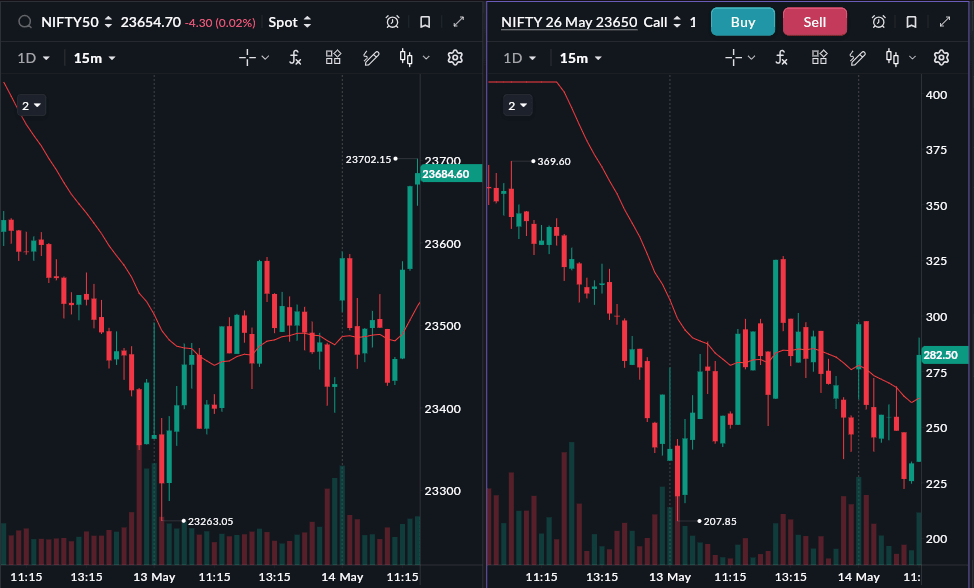
In the above screenshot, you can see Nifty was falling earlier, but suddenly bounced back more than 200 points. Because of this sharp recovery, option premiums also moved very fast.
This is quite common in the market. Prices can change suddenly within minutes, on volatile days. These fast moves can create big opportunities as well as big risks for both option buyers and option sellers.
If you are an option buyer and market moves in your direction, option premiums can rise very fast and give quick profits. But if the move is against your trade, premiums can also lose value quickly.
For option sellers, falling premiums work in their favour, but sudden market spikes or reversals can create losses if positions are not managed carefully.
3. Time to Expiry
Time remaining until expiry plays a major role in option trading, but many beginners ignore it. In options, the closer the expiry date comes, the faster the premium starts losing value due to time decay (Theta).
When Expiry is Far Away
If there are 15 or more days left for expiry, time decay works slowly. This gives option buyers more time for the market move to play out. Traders with a strong directional view prefer option buying during this phase because premiums do not lose value very quickly.
When Expiry is Near
3–5 days before expiry, time decay becomes much faster. Out-of-the-money (OTM) options can lose premium rapidly, even if the market moves slightly in the expected direction. This is where option sellers get an advantage, as premiums keep declining with every passing day.
When Does Option Buying Work Best?
Option buying works best when the market is expected to make a strong directional move within a short period. Since option buyers benefit from momentum and expanding premiums, choosing the right setup becomes very important.
Here are some situations where option buying may offer better opportunities:
-
Upcoming events - Events like Union Budget, RBI policy decisions, or company earnings increase market movement and volatility. Traders may look at directional options or even straddles during such periods.
-
Breakout after long consolidation -When Nifty or a stock trades within a narrow range for several days or weeks and breaks out, momentum can build quickly. Traders may consider Call Options during upside breakouts and Put Options during downside breakdowns.
-
India VIX below 14–15 -Lower volatility usually means option premiums are relatively cheaper, reducing the overall cost of option buying.
-
More time left before expiry - Having 15 or more days before expiry gives the trade more time to work and reduces the impact of rapid theta decay.
When Does Option Selling Work Best?
Option selling works best when the market is expected to remain stable, move within a range, or have less volatility. Many traders believe option selling is only for large capital traders, success in option selling strategy depends more on discipline and proper risk management.
Here are some situations where option selling may offer better opportunities:
-
Post-event volatility decline - After major events like Budget, RBI or Fed meetings, and earnings announcements, implied volatility falls quickly. Traders who sell options before this volatility drop can benefit even if the market does not move much afterward.
-
Strong resistance or support zones - If Nifty repeatedly fails to cross a major resistance or holds a strong support level, traders may consider selling options slightly away from these levels during the final days before expiry.
-
India VIX above 20 - Higher volatility leads to expensive option premiums. This gives option sellers a larger premium cushion and better income potential.
-
Final week before expiry - Time decay happens fastest during the last few days of expiry. Even moderate market moves may not impact out-of-the-money (OTM) short options.
-
Range-bound market conditions - When market lacks strong news flow or breakout momentum and continues trading within a range, option selling strategies perform better.
How Much Capital is Required for Options Trading
The capital required for an options trading strategy depends on the strategy. Option buying needs lower capital, while option selling requires higher margin due to higher risk.
|
Strategy |
Approx. Capital Needed (Nifty) |
Max Risk |
|---|---|---|
|
Buy 1 lot Nifty ATM Call/Put |
₹3,000–₹10,000 (just premium) |
Limited to premium paid |
|
Sell 1 lot Nifty OTM Call/Put (naked) |
₹80,000–₹1,20,000 (margin) |
Unlimited |
|
Short Strangle (sell 1 CE + 1 PE) |
₹1,50,000–₹2,00,000 |
Losses beyond breakevens |
|
Bull Call Spread (defined risk buy) |
₹5,000–₹15,000 |
Limited to net debit paid |
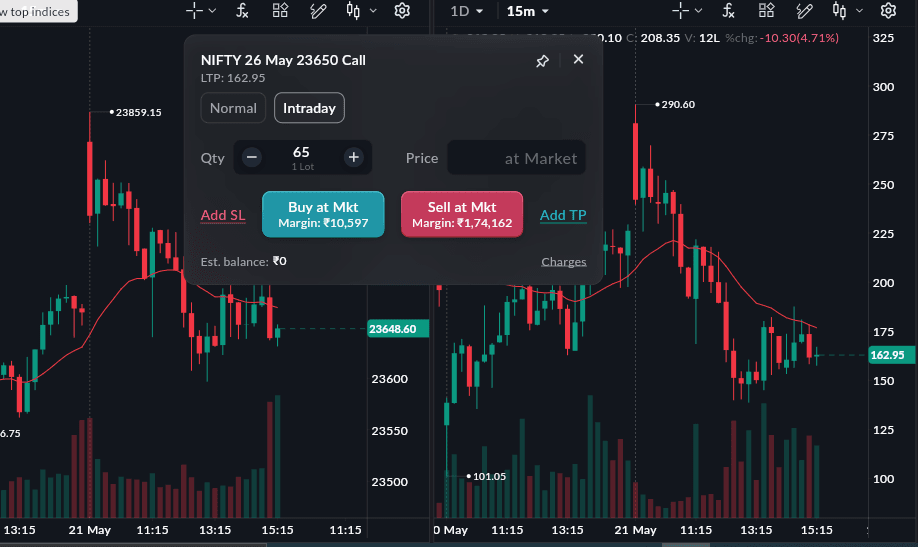
Margins change periodically based on SEBI/exchange updates. Always check your broker's live margin calculator before placing trades.
In the attached screenshot, you can clearly see the margin required for option buying and option selling on SAHI platform.
Common Mistakes to Avoid in Options Trading
Here are some common mistakes traders make every week while trading expiry options.
Option Buyers often:
-
Buy deep OTM options because they're cheap without a clear price target or stop
-
Ignore IV and end up buying when options are already expensive
-
Hold losing positions too long, hoping for a recovery
-
Buy options in the last 3–4 days of expiry without very strong directional conviction
Option Sellers often:
-
Sell naked (uncovered) without stop-losses, one sharp gap-up or gap-down can wipe weeks of gains in a single session
-
Don't adjust when the market breaks out of its range
-
Selling too many lots relative to the capital available
-
Ignore upcoming events and sit with short options in a high-risk announcement
Read This Also: Bank Nifty Expiry Day: What Happens If You Don't Square Off?
Final Words
Top options trading strategy is not about sticking to one strategy forever. Markets keep changing, and traders need to adapt. Option buying works better in trending and high-volatility markets, while option selling performs well in range-bound conditions due to time decay.
Successful option traders are not permanent buyers or sellers. They understand market conditions and adjust their strategy accordingly. Once you understand this, options trading feels more like a skill than a gamble.
All topics
Click the link, confirm the box next to sahi.com is checked — ignore any other results.