
0DTE Options Explained: How to Trade NSE Expiry Day Like a Pro
Learn how 0DTE options trading works on NSE, the best expiry day strategies for Nifty 50, theta decay impact, open interest analysis and SEBI rules traders must know.

Quick Summary
0DTE options trading on NSE offers quick profit opportunities but carries high risk due to rapid premium decay and volatility. Success depends on disciplined risk management, choosing the right strategy, and protecting capital while trading Nifty 50 expiry day options.
What Does 0DTE Mean in Options Trading on NSE?
0DTE stands for zero days to expiration. It refers to an options contract that expires on the same day you open it. On NSE, you can trade 0DTE options every Tuesday when Nifty 50 weekly expiry takes place.
The concept is simple. You buy or sell an options contract in the morning session. That contract will expire at 3:30 PM IST on the same trading day. There is no overnight risk because the position closes before the market shuts.
SEBI restricted weekly expiry contracts to one benchmark index per exchange from November 2024. On NSE, Nifty 50 is the sole index with weekly options. Bank Nifty, Fin Nifty and Midcap Nifty lost their weekly expiry cycles under this rule.
|
Key Change: NSE Expiry Schedule (September 2025 Onwards) Nifty 50 weekly options expire every Tuesday. Monthly expiry falls on the last Tuesday of each month. If Tuesday is a market holiday, the expiry shifts to the previous trading day. |
|---|
Why Do Traders Prefer Trading Options on Expiry Day?
Expiry day options attract traders because of two distinct advantages. Premiums are cheaper on the final day, and theta decay works at its fastest pace. These two factors create conditions where even small price movements can lead to large percentage gains.
Here is what makes expiry day trading different from other sessions:
-
Lower Capital Requirement: Out-of-the-money options on expiry day cost a fraction of their price from earlier in the week.
-
No Overnight Risk: Every position closes on the same day. You do not carry any exposure into the next session. This appeals to traders who want defined-duration trades.
-
Theta Works for Sellers: Option sellers collect premium knowing that time value will erode to zero by 3:30 PM. The rate of decay is nonlinear and accelerates in the final two hours of trading.
-
Volatility Spikes Create Opportunities: Expiry days often show sharper intraday swings. Retail traders square off positions, institutions rebalance portfolios and algorithmic systems trigger at key levels.
How Does Theta Decay Affect Your Options on Expiry Day?
Theta measures how much value an option loses with each passing day. On expiry day, this loss is not gradual. It is rapid and nonlinear, with most erosion concentrated in the afternoon session. An at-the-money option can lose 70 to 80 percent of its remaining value between 1:00 PM and 3:00 PM.
This table shows how theta decay behaves at different times on expiry day for a Nifty 50 at-the-money option:
|
Time of Day |
Approx. Premium (Per lot of Nifty/ Nifty Bank options) |
Theta Impact |
Best Suited For |
|---|---|---|---|
|
9:15 AM (Open) |
₹80-120 |
Moderate |
Directional buyers |
|
11:00 AM |
₹ 50-80 |
Increasing |
Spread sellers |
|
1:00 PM |
₹25-40 |
Aggressive |
Premium sellers |
|
2:30 PM |
₹5-15 |
Severe |
Scalpers |
|
3:15 PM |
₹0-5 |
Terminal |
Exit all positions |
Option buyers face the sharpest disadvantage after 1:00 PM. Even if the underlying index moves in their favour, the premium erosion can eat into their profits. This is why most experienced expiry day buyers enter positions before 10:30 AM and exit before the afternoon session.
Which 0DTE Strategies Work on NSE Expiry Days?
The right strategy depends on your market view, risk tolerance and capital available. No single approach works on every expiry day. The market condition on that specific Tuesday determines which strategy has the highest probability of success.
Readers also like this: Nifty Expiry Day Scalping Strategy
Selling Credit Spreads
A credit spread involves selling an option closer to the current Nifty level and buying a protective option further away. You collect a net premium upfront. The trade profits when Nifty stays within a defined range until expiry.
Example: Nifty at 24,500. Sell a 24,600 CE and buy a 24,700 CE. You collect ₹30 as net premium. Maximum risk is ₹70 (spread width minus premium). The trade wins if Nifty closes below 24,600.
Iron Condor for Range-Bound Days
An iron condor combines a call credit spread with a put credit spread. You sell options on both sides of the current price and buy protection further out. This works on days when India VIX is below 14 and no major event is expected.
Setup: Sell a 24,600 CE and buy a 24,700 CE. Sell a 24,400 PE and buy a 24,300 PE. Total premium collected from both legs funds the trade. Nifty must stay between 24,400 and 24,600 for the full profit.
Directional Buying for Event Days
On days with RBI announcements, GDP data releases or global market triggers, directional buying can work. You buy an at-the-money call or put in the first 30 minutes of trading. The low premium on expiry day means a 100-point Nifty move can double or triple your investment.
This approach carries high risk. If the expected move does not happen within two to three hours, theta erosion will reduce your position to near zero.
|
Expert View Experienced traders combine open interest data with India VIX readings before picking a strategy. A VIX below 13 favours option sellers. A VIX above 16 creates better conditions for option buyers and straddle traders. |
|---|
How Should You Read Open Interest Data Before Trading on Expiry?
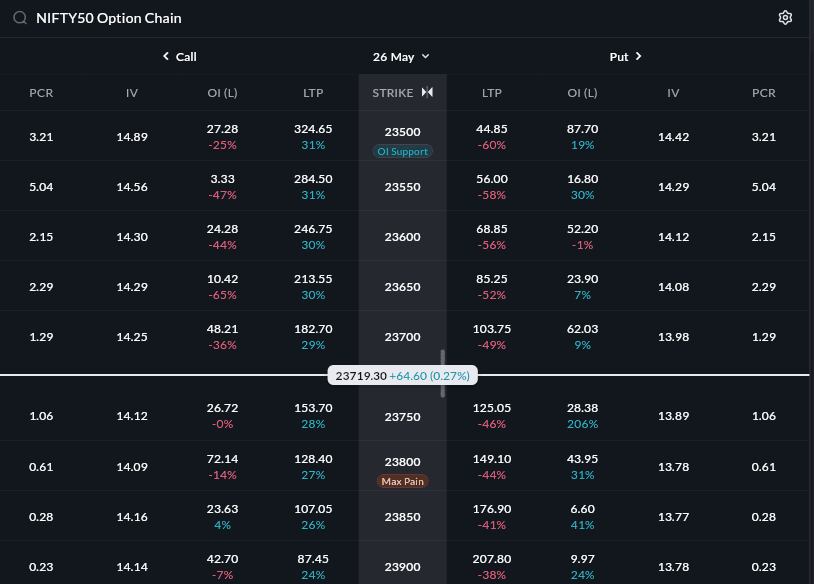
Open interest data reveals where large traders have placed their bets. On expiry day, the strike prices with the highest open interest on the call side act as resistance. The strike prices with the highest open interest on the put side act as support.
Follow these steps to use OI data for expiry day trading:
-
Check the NSE option chain at 9:00 AM before the market opens. Identify the top three strikes by OI on both call and put sides.
-
Look at the change in OI column. Rising OI with falling prices signals short buildup (bearish). Rising OI with rising prices signals long buildup (bullish).
-
Note the Max Pain level. The market often gravitates towards the price where option writers lose the least money. This level serves as a magnet on expiry day.
-
Track Put-Call Ratio (PCR). A PCR above 1.2 indicates bullish sentiment. A PCR below 0.8 indicates bearish sentiment. A reading between 0.9 and 1.1 signals a neutral or range-bound session.
What SEBI Rules Apply to Expiry Day Options Trading in India?
SEBI has introduced multiple regulations since October 2024 that directly affect how you trade options on expiry day. These rules aim to reduce speculative losses among retail traders. A SEBI study found that 91 percent of individual traders in the derivatives segment made net losses in FY25 (source: SEBI, July 2025).
Here are the current rules you need to know:
|
SEBI Rule |
What It Means for You |
|---|---|
|
One Weekly Expiry Per Exchange |
NSE offers weekly options for Nifty 50 only. Bank Nifty and other indices have monthly expiry contracts. |
|
Additional 2% Extreme Loss Margin |
If you hold short option positions on expiry day, your broker will block an extra 2% margin on top of the standard requirement. |
|
No Calendar Spread Margin Benefit |
On expiry day, you will not receive margin offsets for calendar spread positions involving the expiring contract. |
|
Upfront Premium Collection |
You must pay the full options premium at the time of placing the trade. No leverage on option buying. |
|
Revised Lot Sizes |
Nifty 50 lot size has been revised so that the contract value falls between ₹15 lakh and ₹20 lakh at the time of introduction. |
These rules increase the capital requirement for expiry day trading. A trader who once needed ₹50,000 to sell a Nifty straddle may now need ₹1.5 lakh or more. Factor these margin requirements into your trading plan before the session begins.
Read this also: SEBI Margin Benefit Calendar
What Common Mistakes Should You Avoid on Expiry Day?
Expiry day trading punishes certain behaviours more than regular session trading. The compressed timeframe turns minor errors into large financial losses. Recognising these patterns in your own trading helps you avoid repeating them.
-
Holding Losing Positions Until the End: Many traders hold out-of-the-money options hoping for a last-minute reversal. This rarely works. If your position is losing value at 1:00 PM, exit and preserve your remaining capital.
-
Selling Naked Options Without a Hedge: Selling a naked call or put on expiry day exposes you to unlimited loss if the market moves sharply against you. Use spreads to define your risk at all times.
-
Overtrading After a Loss: The desire to recover a morning loss often leads to impulsive trades in the afternoon. Afternoon trading on expiry day carries higher risk due to thin liquidity and sharp swings.
-
Ignoring Open Interest Data: Trading without checking the option chain is like driving without a map. The OI data tells you where the market is most likely to settle, and where the largest risks lie.
Final Words
Expiry day or 0DTE options trading on NSE can offer quick opportunities, but it also carries high risk due to rapid theta decay and sharp price swings. Success in this segment depends on disciplined risk management, proper use of open interest data, and selecting the right strategy based on market conditions.
Traders should focus on defined-risk setups, avoid overtrading, and treat capital protection as the top priority while trading Nifty 50 expiry day options.
All topics
Click the link, confirm the box next to sahi.com is checked — ignore any other results.