
How News Moves Stock Prices: Earnings, Inflation, Interest Rates & More
Good news, stock falls. Bad news, markets rally. Here's the logic behind every confusing market move.

Stock prices move when news changes investor expectations, not simply because news is "good" or "bad." A company can report record profits and still fall if analysts expected more. The four things traders watch: Was the news surprising? Does it affect future earnings? How does it shift sentiment? What are bonds, oil, and currencies doing? Once you understand the expectations gap, most confusing market reactions start making sense.
A company announces record profits. The stock falls 8%.
If that's confused you before, you're asking exactly the right question, because the stock market doesn't react to news the way most people expect.
It doesn't ask, "Is this good or bad?" It asks, "Is this better or worse than what I already assumed?"
That single shift in framing explains almost every market move that seems irrational at first glance. Here's the framework traders use to read it.
Why Stock Prices React to News
At its core, a stock price reflects what investors collectively believe a company's future profits are worth today. News matters because it updates those beliefs.
If a report suggests profits will grow faster than expected, demand for the stock rises. If it signals trouble ahead, investors reduce exposure. Markets are constantly trying to price in the future, which is why prices often start moving before an announcement and sometimes barely twitch after it.
The Four News Categories That Actually Move Markets
Most daily headlines don't matter much. These four consistently do.
1. Corporate Earnings
Quarterly results show revenue, profit, and future guidance, but the market doesn't react to the numbers in isolation. It reacts to the gap between the numbers and what analysts expected.
A real example: Lenskart's Q4 FY26 results showed net profit fell nearly 8% YoY. That sounds like bad news. The stock rose around 6% anyway, because revenue jumped 45.61% YoY to ₹2,515.71 crore, well ahead of expectations. The profit dip didn't matter as much as the revenue surprise. That's the expectations game in action.
Read more about it here.
Forward guidance matters just as much as current results. Strong quarterly numbers can still send a stock lower if management signals slowing demand or rising costs ahead.
2. Inflation Data
Rising inflation worries markets for one specific reason: it usually forces central banks to raise interest rates. Higher rates mean higher borrowing costs, slower business expansion, weaker consumer spending, and ultimately lower future earnings.
CPI reports are watched this closely because a single data point can simultaneously move bond yields, currencies, and equities. Even a slight beat on inflation estimates just 0.1% above forecast can trigger a meaningful selloff in rate-sensitive sectors.
3. Interest Rate Decisions
Interest rates are arguably the single most powerful lever on equity valuations. When the RBI or Federal Reserve raises rates, two things happen that hurt stocks:
- Bonds become more attractive relative to equities; why take a risk for 10% when you can get 7% with nearly none?
- The present value of future profits falls, especially for growth companies whose earnings are projected years out
This is why technology stocks react most sharply to rate news. Their valuations depend heavily on distant future earnings, and higher rates shrink those projections significantly.
When rates fall, the logic reverses: equities look more attractive, credit gets cheaper, and growth projections improve.
4. Geopolitical Events
Wars, elections, sanctions, and trade disputes create the one thing markets hate most: uncertainty. Geopolitical stress typically flows through oil prices; rising crude drives inflation higher, which feeds rate pressure, which weighs on equities.
The Iran-Israel conflict has followed this pattern closely, pushing crude higher and keeping global markets volatile. India hasn't been immune. The BSE Sensex was near 83,347 in late February 2026 and has fallen to around 76,000 by late May 2026, a move driven partly by geopolitical tension, higher oil, and global inflation concerns.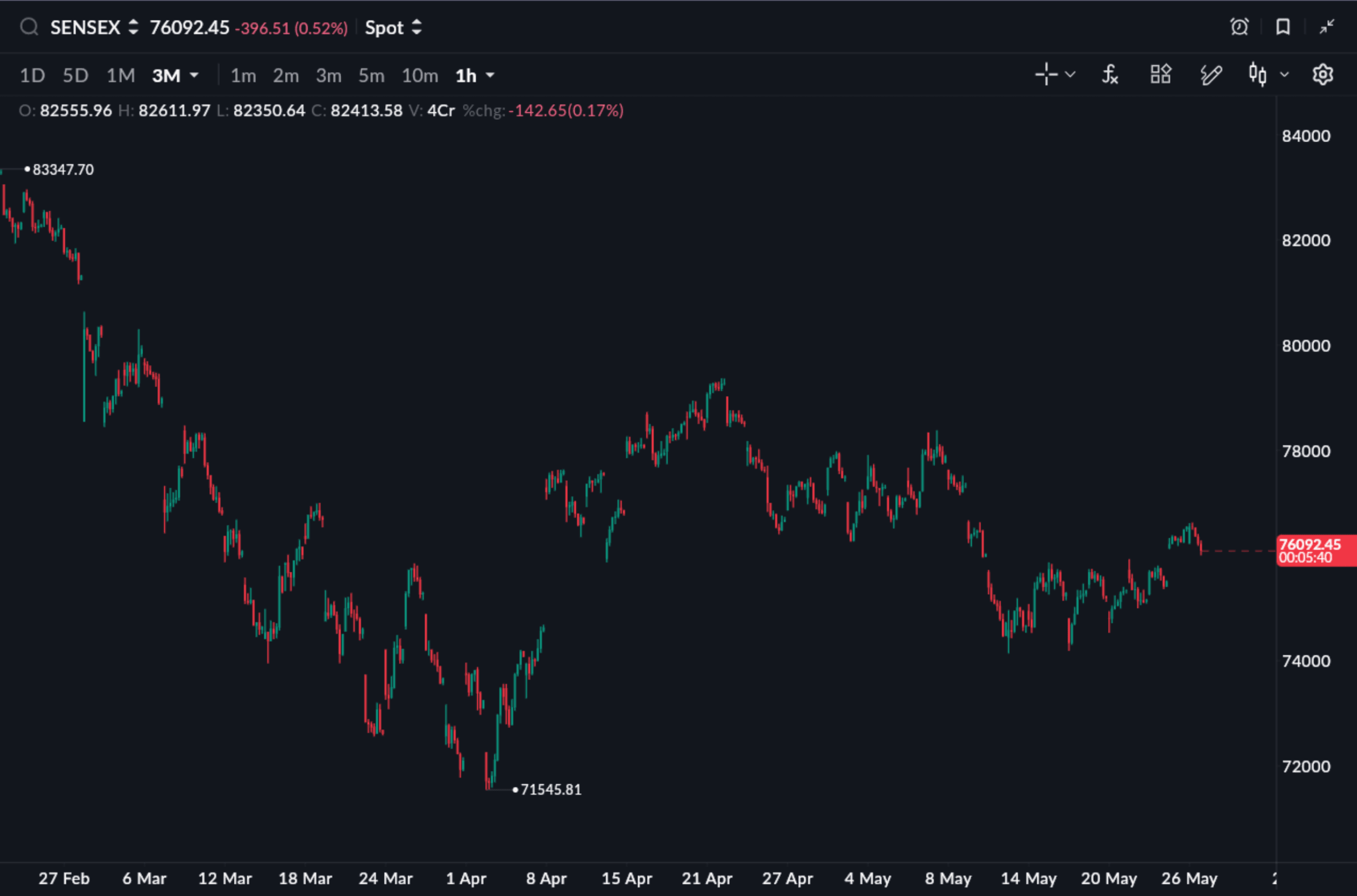
The sector impact isn't uniform, though. Energy companies benefit from higher oil. Defence stocks attract attention. Airlines and logistics absorb the cost hit.
The Trader's Framework: Four Questions That Cut Through the Noise
Professional traders don't ask, "Is this news good or bad?" They ask four specific questions.
1. Was It a Surprise?
Markets react strongest to surprises. If inflation rises exactly in line with forecasts, the reaction is muted. If it spikes far above estimates, volatility follows immediately. The magnitude of the surprise matters more than the direction of the headline.
2. Does It Change the Earnings Outlook?
Every piece of news gets filtered through one question: does this help or hurt future profits? Rising raw material costs hurt manufacturers. Strong consumer spending data lifts retail. A rate cut supports capex-heavy industries. The market is always reacting to the expected impact, not the event itself.
3. What Mood Is the Market In?
The same headline produces completely different reactions depending on investor sentiment. During bull markets, weak data gets shrugged off. During fearful periods, even neutral news can trigger sharp selling. Context shapes interpretation, always.
4. What Are Other Markets Saying?
Experienced traders never look at stocks in isolation. Rising bond yields signal inflation concerns. A stronger dollar pressures emerging markets. Falling oil usually indicates demand weakness. Gold rising sharply often means investors are seeking safety. These cross-market signals tell you what investors are actually worried about — often before stocks reflect it.
Why Markets Sometimes Move Opposite to the Headline
This is where the "priced in" concept becomes essential.
If investors already expected bad news and positioned themselves defensively, the actual announcement may barely move markets or even trigger a relief rally ("It wasn't as bad as feared"). Conversely, even mildly disappointing news causes sharp drops if markets have grown overly optimistic.
The market is always reacting to the difference between reality and expectation, not reality alone. Understanding this makes moves that look irrational start looking very logical.
Sector Rotation: Not All Stocks React the Same
| News Event | Sectors That May Benefit | Sectors That May Face Pressure |
|---|---|---|
| Rising oil prices | Energy companies | Airlines, logistics |
| Higher interest rates | Banks (net interest margins) | Real estate, technology |
| Strong consumer spending | Retail, consumer discretionary | — |
| Weak economic growth | Healthcare, utilities (defensive) | Cyclicals, industrials |
| AI investment boom | Semiconductors, tech infrastructure | — |
Knowing which sectors move in which direction is half the battle when trading around major news events.
The Bottom Line
The stock market is an expectations machine. Prices don't reflect what's happening today, they reflect what investors collectively believe will happen tomorrow. News matters because it updates those beliefs, sometimes violently and within minutes.
For traders, the goal isn't to predict every market swing. It's to understand the relationship between information and expectations well enough that surprising reactions stop feeling random. Once you see that framework clearly, the market starts making a lot more sense, and a lot fewer of its moves catch you off guard.