
Siemens Q4 FY26 Results: Revenue Jumps 14.6%, Orders Surge 32.6%
Strong order inflows and India's infrastructure push drove topline growth, but margin pressure and a major demerger make FY26 a transition year for Siemens India.

Siemens Q4 FY26: Revenue rose 14.6% to ₹4,618 crore and new orders surged 32.6% to ₹6,731 crore — but PAT fell 9.6% to ₹355 crore due to commodity costs and restructuring charges. The energy business demerger makes FY26 an 18-month transition year. Siemens enters FY27 with a ₹45,033 crore order backlog and a sharper focus on automation, electrification, and smart infrastructure.
Two numbers tell the whole story of Siemens' Q4 FY26.
Revenue: up 14.6%. Orders: up 32.6%.
Those are strong headline numbers. But look at the profit line and you'll see the other side — PAT down nearly 10%, operating profit down 15%. This is a company winning on the top line while fighting a margin battle at the bottom.
Add in a major demerger, an 18-month financial year, and a leaner balance sheet — and you get one of the more complex quarterly results in the Indian industrial space this year.
Here's exactly what the numbers say.
Siemens Q4 FY26 — Key Numbers at a Glance
| Particulars | Q4 FY26 | Q4 FY25 | YoY Change |
|---|---|---|---|
| Revenue from Operations | ₹4,618 crore | ₹4,029 crore | +14.6% |
| New Orders | ₹6,731 crore | ₹5,074 crore | +32.6% |
| Profit from Operations | ₹375 crore | ₹442 crore | -15.0% |
| Profit After Tax (PAT) | ₹355 crore | ₹393 crore | -9.6% |
| EPS | ₹9.97 | ₹11.03 | Declined |
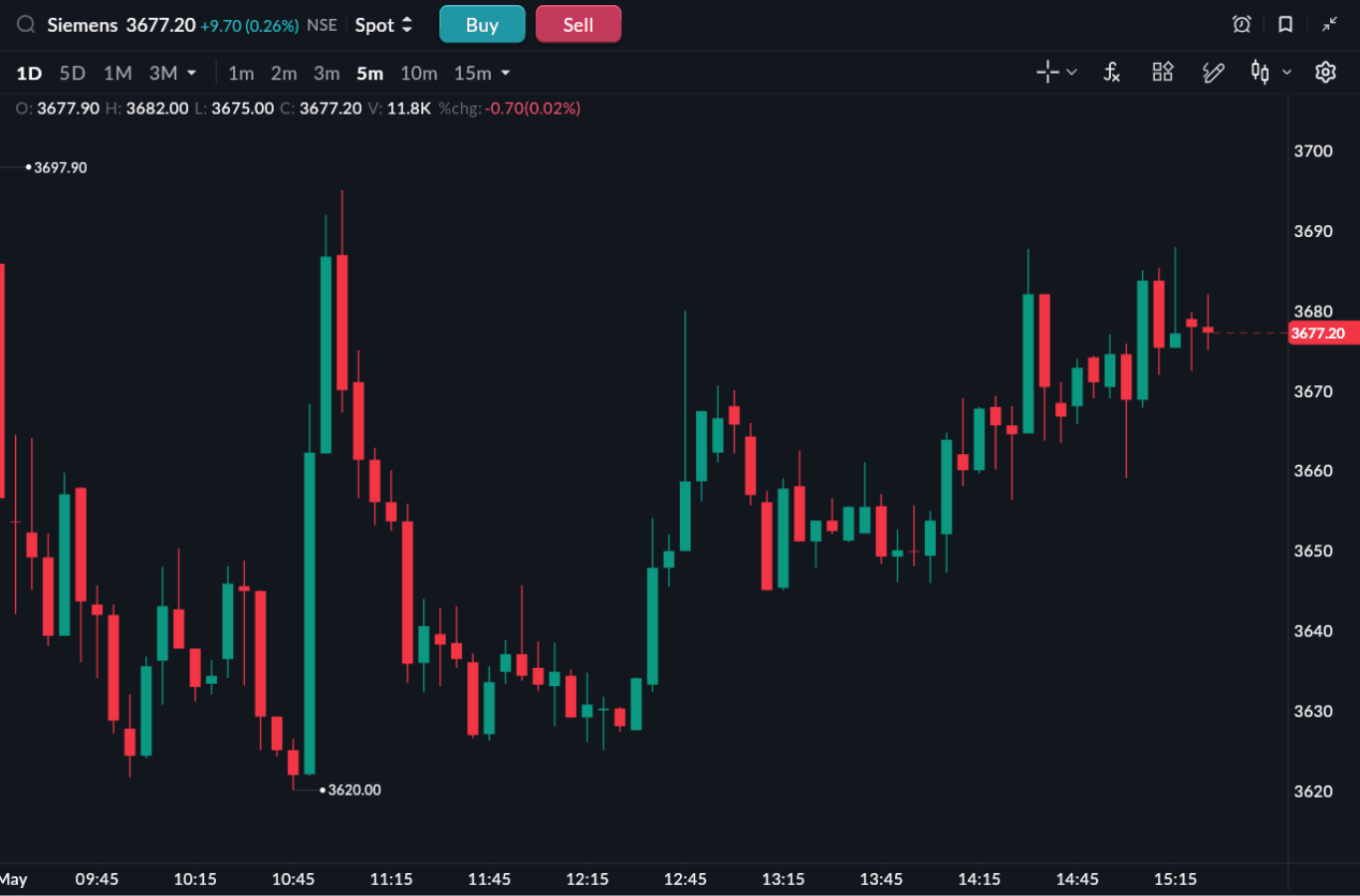
Siemens shares closed 0.26% higher on May 26 before results were announced after market hours, suggesting investors went in cautiously optimistic. The order book number largely justifies that sentiment.
What's Driving Revenue Growth
The short answer: India's infrastructure spending, and Siemens is right in the middle of it.
The company's order backlog grew 9.3% to ₹45,033 crore. That's a forward revenue pipeline of roughly 2.5 years at the current quarterly run rate, which means visibility is strong even if any individual quarter looks lumpy.
Three areas drove the bulk of revenue in Q4:
Smart Infrastructure: The Biggest Piece
This segment covers electrification systems, smart grids, building technologies, and energy-efficient infrastructure. It remained Siemens' largest business by revenue this quarter, benefiting directly from the urban infrastructure build-out happening across tier-1 and tier-2 cities.
Mobility — Riding the Railway Wave
Railway modernisation and metro expansion projects kept this segment growing. With the Indian government continuing to push both passenger and freight rail capacity, Siemens' signaling, rolling stock, and rail infrastructure products are well-positioned here.
Digital Industries — Factory of the Future
This division covers factory automation, industrial software, and smart manufacturing solutions. Indian manufacturers upgrading their production lines, especially in auto, pharma, and electronics, are Siemens' customers here.
Segment Revenue Breakdown
| Segment | Q4 FY26 Revenue |
|---|---|
| Smart Infrastructure | ₹2,594 crore |
| Mobility | ₹833 crore |
| Digital Industries | ₹1,175 crore |
| Others | ₹61 crore |
Smart Infrastructure alone accounts for over 56% of total quarterly revenue, a sign of how central the infrastructure build-out theme is to Siemens India's growth story.
Why Margins Fell Despite Strong Revenue
Here's the part that requires a closer look.
Revenue grew 14.6%. But operating profit dropped 15% and PAT fell nearly 10%. That's a significant disconnect, and it wasn't a one-off.
Siemens cited four main factors:
- Higher commodity prices — Key inputs like steel, copper, and electronic components saw cost increases, squeezing margins on fixed-price contracts
- Rupee depreciation — Siemens imports components and equipment. A weaker rupee makes those imports costlier
- Rising project execution costs — Long-cycle industrial projects are sensitive to input cost inflation; when you've already committed to a project price, cost overruns come out of your margin
- Demerger and restructuring adjustments — One-time costs and accounting changes related to the energy business separation impacted reported profitability
This is a structural challenge for industrial companies like Siemens. You win contracts years in advance at a fixed price, then execute over 18–36 months. If input costs rise sharply during that execution window, your margin gets compressed, even if your revenue grows.
The Demerger That Changed FY26 Numbers
You can't read Siemens' FY26 results without understanding the context of the energy business demerger.
Siemens transferred its energy business, power generation, transmission, and grid solutions to a separate entity called Siemens Energy India Limited (SEIL), effective March 25, 2025. As a result, the energy business now appears as "discontinued operations" in Siemens' books rather than as ongoing revenue.
This is also why FY26 was an 18-month period rather than a standard 12-month year. Siemens changed its financial year-end during the restructuring process.
What the energy business contributed during that 18-month window:
| Energy Business | FY26 (18 Months) |
|---|---|
| Revenue | ₹25,608 crore |
| Profit After Tax | ₹4,185 crore |
Separately, Siemens also approved the transfer of its Low Voltage Motors (LVM) business to Siemens Large Drives India Private Limited. The LVM business generated ₹1,521 crore in revenue during the same 18-month period.
Both moves are part of a deliberate strategy, Siemens is shedding businesses that don't align with its core focus areas to become a sharper, more technology-driven company.
Balance Sheet: Leaner After the Split
The balance sheet change is stark.
Total assets fell from ₹24,252 crore (September 2024) to ₹19,790 crore (March 2026) — a drop of roughly ₹4,500 crore. That reduction reflects assets and cash that moved to the energy business entity after the demerger.
Cash and equivalents stood at ₹1,303 crore as of March 2026.
Liabilities also reduced proportionally post-restructuring. The net result is a company that is smaller by balance sheet size but more focused, with capital now concentrated in higher-growth industrial and infrastructure businesses.
Cash Flow Was Negative
Net cash used in operating activities came in at negative ₹971 crore for the 18-month period.
The culprit: working capital. As Siemens executes large infrastructure and industrial projects, receivables build up — money that's been billed but not yet collected. A growing order book means more work-in-progress and more receivables on the balance sheet.
This is common in the industrial and engineering space, especially when revenue scales rapidly. The cash eventually comes in when project milestones are met and invoices are cleared.
On the investing side, cash flow was positive, driven by fixed deposit maturities, interest income, and dividends from subsidiaries. Financing outflows were expected, given dividend payments and restructuring-related distributions.
Dividend: ₹18 Per Share
Siemens' board recommended a dividend of ₹18 per equity share (face value ₹2), representing a 900% payout on face value.
Given the margin pressure and ongoing restructuring, the dividend signals confidence in the company's long-term cash generation capacity. Management is not conserving cash at the expense of shareholder returns, even in a transition year.
What This Means for Investors
Siemens India's Q4 FY26 results tell you three things clearly:
1. Demand is real and growing. A 32.6% jump in orders isn't a statistical quirk, it reflects genuine acceleration in infrastructure spending, industrial automation, and rail projects. The order backlog of ₹45,033 crore gives revenue visibility that most industrial companies would envy.
2. Margin recovery is the key watch item for FY27. Revenue growth is not the issue. The question is whether Siemens can price new contracts to protect margins as input costs normalise or whether commodity and currency headwinds persist into the next cycle.
3. FY26 is a transformation year, not a trend. The 18-month period, the energy demerger, and the LVM transfer: these are one-time structural changes. Comparing FY26 numbers to prior years without this context leads to misleading conclusions. FY27 will be the first clean, comparable year for the restructured Siemens India.
Frequently Asked Questions (FAQs)
All topics
Click the link, confirm the box next to sahi.com is checked — ignore any other results.