
Jio Financial Services Results: Income Jumps 78%, Profit Dips, AI Takes Centre Stage
FY26 income grew 78% and lending AUM rose 2.5x, but net profit slipped 3% as costs outran growth

Jio Financial Services results for FY26 show total income excluding dividends up 78% to ₹3,274 crore. Income from core operations rose about four times to ₹1,390 crore. But net profit slipped 3% to ₹1,561 crore because costs grew faster than income. JioCredit AUM hit ₹25,711 crore. The FY26 annual report puts AI at the centre of the plan. The stock traded near ₹262 on 3 August 2026, still about 23% below its 52-week high.
Jio Financial Services (JFSL) has stopped calling AI a support tool. Its FY26 annual report treats AI as the base on which the whole business is meant to sit. The company calls the idea "Intelligent Finance".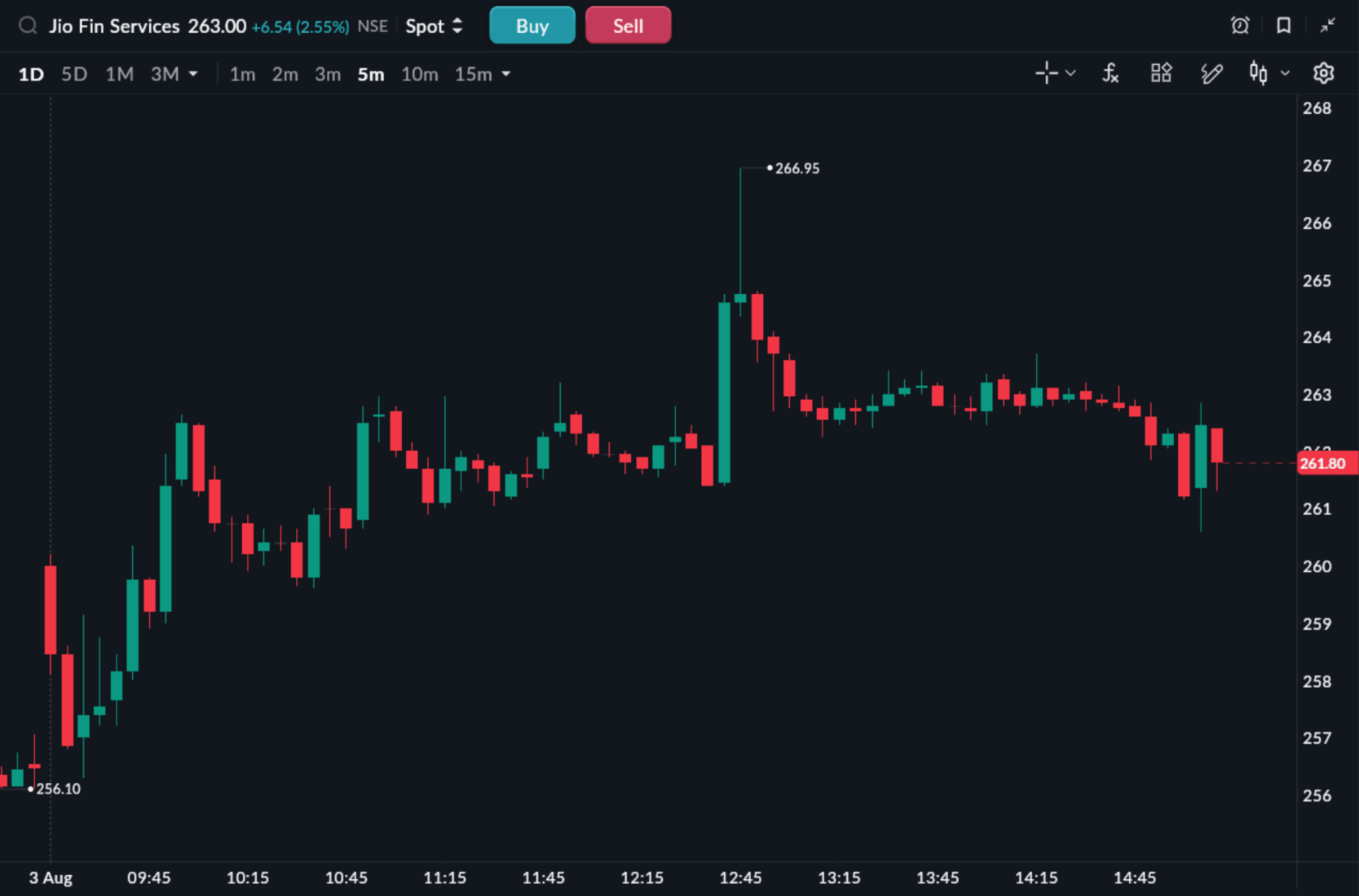
The growth numbers back some of that ambition. But the profit line tells a second story, and it is the one most coverage skipped.
Income jumped 78%, yet profit fell
JFSL reported consolidated total income excluding dividends of ₹3,274 crore in FY26. That is 78% higher than a year earlier.
Income from core operations rose to ₹1,390 crore. The company puts that at about four times the year before. It made up 54% of net total income, so more than half the business is now operating income rather than treasury income.
Pre-provision operating profit, excluding dividends, came in at ₹1,357 crore.
Here is the part the headlines missed. Net profit did not grow. It fell.
| Metric | FY26 | FY25 | Change |
|---|---|---|---|
| Total income (ex-dividends) | ₹3,274 cr | — | +78% |
| Income from core operations | ₹1,390 cr | — | About 4x |
| Pre-provision operating profit | ₹1,357 cr | — | — |
| Consolidated net profit | ₹1,560.90 cr | ₹1,612.59 cr | -3.2% |
The March 2026 quarter was sharper. Net profit for Q4 FY26 fell 13.9% to ₹272.22 crore from ₹316.11 crore. Revenue for that quarter more than doubled. Total expenses rose about 327%.
That gap is not a red flag by itself. It is what building costs look like. JFSL is hiring, lending, opening branches and buying technology all at once. Still, readers deserve the full picture: FY26 was a year of fast growth and slightly lower profit.
Where the growth actually came from
No single business carried FY26.
| Business | FY26 figure | Growth |
|---|---|---|
| JioCredit AUM | ₹25,711 cr | About 2.5x |
| Jio Payment Solutions TPV | Over ₹52,200 cr | About 2.5x |
| Jio BlackRock AMC AUM | Over ₹15,200 cr | From a standing start |
| Jio Payments Bank deposits | ₹544 cr | +84% |
| Jio Insurance Broking premium | ₹982 cr | About +10% |
Lending is the engine. JioCredit's assets under management reached ₹25,711 crore by 31 March 2026, up around two and a half times.
The asset management arm is the surprise. Jio BlackRock crossed ₹15,200 crore of AUM within nine months of launch. Its quarterly average AUM was above ₹16,700 crore.
Jio Payments Bank grew deposits 84% to ₹544 crore, with a CASA base of 3.7 million customers. Products now reach more than 19,000 PIN codes.
One arm lagged. Jio Insurance Broking placed premiums of ₹982 crore, up only about 10%. In a year when lending and payments grew 150% each, insurance barely moved. That is worth watching.
Jio Financial Services grew FY26 income 78%. What happened to its net profit?
What "Intelligent Finance" actually means
The AI talk is not just branding. Some of it is already running.
The new JioFinance app is built as what the company calls a neural agentic marketplace. It runs on roughly 15 AI agents and about 70 decision engines. These read a user's intent, eligibility and financial context in real time.
The aim is what JFSL calls an "N=1" model. In plain terms, each user should see products chosen for them, not the same menu everyone else sees. The app pulls data from Account Aggregators and credit bureaus, then adds live behaviour data on top.
The back office numbers are more concrete:
- All inbound calls at JioCredit are now handled by bots
- AI resolves about 88% of queries at Jio Insurance Broking
- AI handles about 57% of emails at Jio Payments Bank
The app itself has 1.7 million downloads. Across its digital properties JFSL counts 23 million unique users, with 9.3 million monthly active users in Q4 FY26.
The scale to aim at is the Jio ecosystem, which already reaches hundreds of millions of people. Converting telecom users into credit and insurance customers is the whole bet.
The June quarter, and a catch worth knowing
The FY26 report is not the newest data. Q1 FY27 landed in July 2026, and it looks much better.
Net profit for the June 2026 quarter rose 156% to ₹830.25 crore from ₹324.66 crore. Revenue from operations went from ₹612.46 crore to ₹2,004.47 crore. Total income excluding dividends rose 141% to ₹1,496 crore.
Now the catch. Pre-provision operating profit excluding dividends was ₹505 crore for the quarter, up 38%. Reported net profit was ₹830 crore. The company also booked ₹508.59 crore of dividend income in the same quarter.
So a large slice of the headline profit came from dividends on JFSL's own holdings, not from lending or payments. That is exactly why the company reports so many figures "excluding dividends". Anyone judging this business should watch the ex-dividend lines, because those show what the operating engine really earns.
Why does Jio Financial Services report income "excluding dividends"?
What the stock has done
The share price has not matched the growth story.
JFSL traded near ₹262 on 3 August 2026, up about 2% that day. But the stock is up only around 4% in 2026 so far. It sits roughly 23% below its 52-week high of ₹338.60. Its 52-week low is ₹223.
Market capitalisation is about ₹1.73 lakh crore. The trailing P/E is close to 84. That is a rich multiple for a company whose profit just fell, and it explains why the stock has drifted even as the business grew.
Two near dates for holders. The ₹0.60 dividend goes ex on 10 August 2026. The AGM is on 26 August 2026. JFSL is one of several listed Reliance group companies, and it is part of the financial sector basket covered in this guide to the Bank Nifty and FinNifty indices.
What to watch from here
Four things will decide whether FY26 was a turning point or just a spending year.
First, does profit follow income? Growth is proven. Operating leverage is not. Second, how much of profit stays dividend-led? The ex-dividend lines are the honest scoreboards. Third, does insurance broking wake up? At 10% growth it is the weak link. Fourth, does the AI spend show up as a lower cost per customer, not just better press?
Credit quality is the quiet risk. A lending book that grows two and a half times in one year has not yet been tested through a full cycle. For a wider frame on judging stories like this, see this guide on how to identify multibagger stocks.
FY26 was the year JFSL's ambition became visible. Whether the AI-first model turns into durable profit is still an open question.
Sources: Jio Financial Services FY26 annual report and audited results, JFSL Q4 FY26 and Q1 FY27 exchange filings and earnings call, and Screener.in data as of 3 August 2026. This article is for information only. It is not investment advice.
Frequently Asked Questions (FAQs)
All topics
Click the link, confirm the box next to sahi.com is checked — ignore any other results.