
How to Read a Stock's Balance Sheet (Without Being a Finance Expert)
A beginner's guide using TCS's FY26 balance sheet

A balance sheet answers three questions about any company: what it owns (assets), what it owes (liabilities), and what is left for shareholders (equity). It always follows one rule: Assets = Liabilities + Equity. Beginners do not need a finance degree to read one. Focusing on five things—cash, debt, receivables, reserves, and the right industry lens—is enough to understand the business. This guide decodes TCS's FY26 balance sheet (year ended March 31, 2026) line by line.
Most people who start investing look at the stock chart first. If the price rises, excitement begins. If it falls 5%, panic kicks in. Far fewer ask the more useful question: what does this company actually look like financially?
The moment someone opens a balance sheet, it can feel too technical, full of terms like "trade receivables," "other equity," and "current liabilities." But a balance sheet is one of the simplest ways to understand a business once it is explained properly, and no finance degree is required.
So instead of learning this theoretically, this guide decodes the FY26 balance sheet of Tata Consultancy Services (TCS) to show what the company owns, what it owes, and what beginners should actually focus on.
First, what is a balance sheet?
A balance sheet is a financial health snapshot of a company on a single date. It answers three simple questions:
- What does the company own?
- What does the company owe?
- What is left for shareholders?
Everything inside it revolves around one equation:
In plain language: everything a company owns has been funded either through borrowed money or through shareholders' money. The figures below are from the TCS FY26 consolidated balance sheet (year ended March 31, 2026).
Step 1: Start with total assets
The first thing to notice is the overall financial size of the business.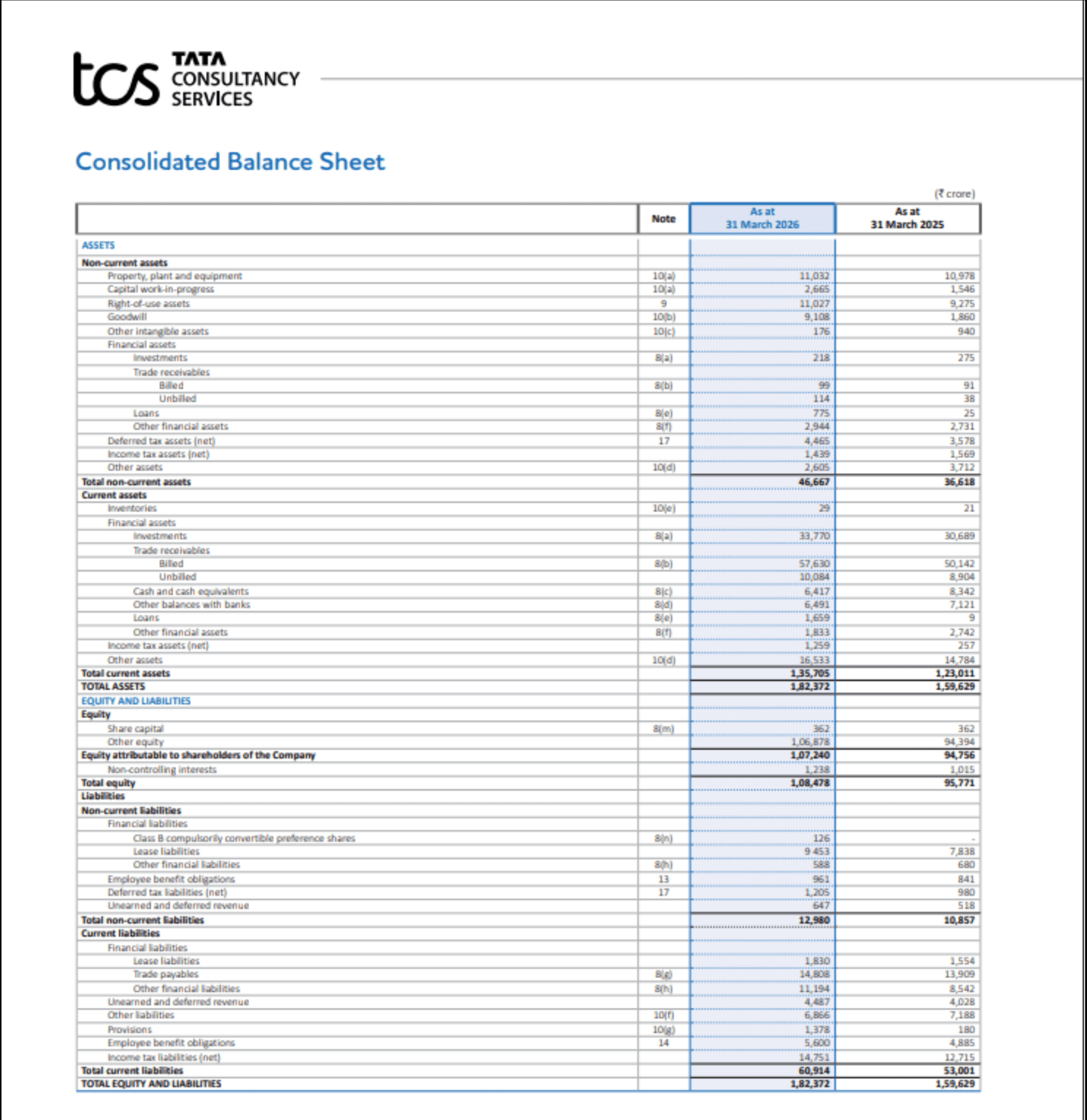
- Total assets in FY26: ₹1,82,372 crore
- Total assets in FY25: ₹1,59,629 crore
Beginners often assume a bigger number automatically means a better company. It does not. This figure only tells you how large the company is financially. The real insight comes from understanding what those assets actually are.
Step 2: Understand what TCS owns
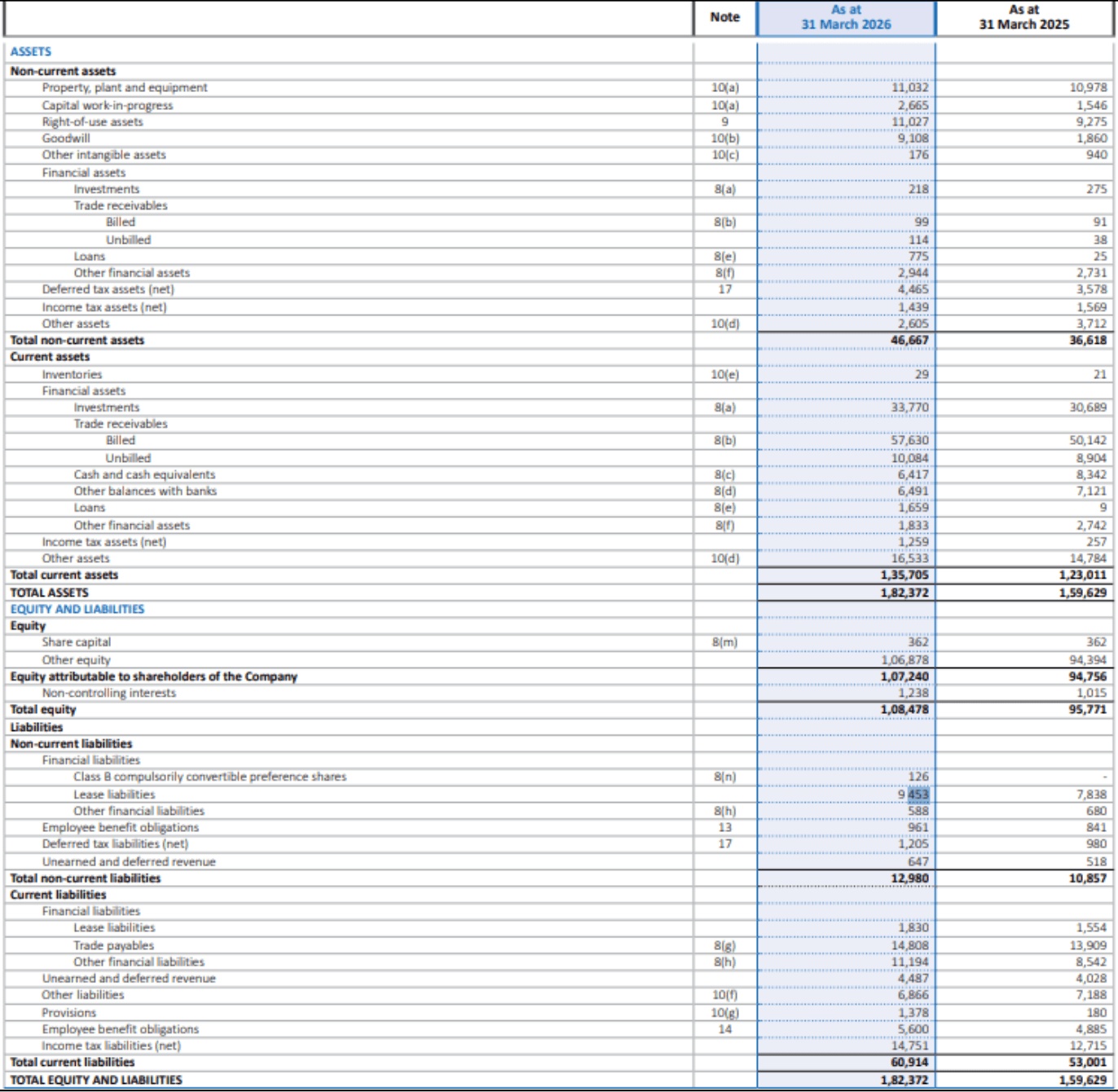
Assets are things the company owns or controls. They split into long-term (non-current) and short-term (current) assets. For TCS, major non-current assets include:
- Property, plant & equipment: ₹11,032 crore
- Capital work-in-progress: ₹2,665 crore
- Right-of-use assets (leased offices): ₹11,027 crore
- Non-current investments: ₹218 crore
- Other financial assets: ₹2,944 crore
TCS is an IT services company. It does not need massive factories or heavy machinery like steel, cement, or automobile firms, so its balance sheet naturally looks very different from a manufacturing business. That difference leads to one of the biggest lessons for beginners.
The mistake beginners make: judging every company the same way
The numbers that matter most depend heavily on the industry the company operates in.
- IT companies (like TCS) are asset-light, so investors watch cash reserves, receivables, employee costs, and operating margins.
- Steel and infrastructure firms are capital-heavy, so the focus shifts to debt levels, plant & machinery, inventory, capital expenditure, and interest costs.
- Banks and NBFCs are read through loan books, deposits, NPAs, provisioning, and capital adequacy.
- FMCG companies live and die by inventory turnover, because products move fast and demand cycles matter.
Reading a balance sheet is not about memorising formulas. It is about understanding the nature of the business first. A strong balance sheet for an IT company looks very different from a strong one for an airline, telecom operator, or manufacturer.
One of the most important numbers: cash
Look at this line carefully:
- Cash and cash equivalents: ₹6,417 crore
- Current investments: ₹33,770 crore
Cash gives a business survival power. Companies with strong cash and liquid investments generally have more operational flexibility, a better ability to handle downturns, and lower financial stress during difficult periods. With over ₹33,000 crore in current investments alongside its cash, TCS is sitting on a very large, liquid capital base.
Step 3: How to read receivables
Next line:
- Trade receivables: ₹57,630 crore
This is money clients still owe TCS. Because it works with large global clients, payments are often received after services are delivered. This is where reading a balance sheet becomes powerful. If this number keeps rising aggressively every year while revenue growth slows, it can signal slower collections, delayed client payments, or cash-flow pressure. Experienced investors track the trend over several years, not one isolated figure.
Step 4: The liabilities side
Liabilities are obligations — the money a company owes. TCS's total liabilities in FY26 stood at ₹73,894 crore.
Beginners often panic at large liability numbers, but liabilities are not automatically bad. Every large business has obligations. The real question is: can the company comfortably manage them?
Major line items include:
- Trade payables: ₹14,808 crore — money owed to vendors and suppliers, which is completely normal.
- Lease liabilities: roughly ₹11,000 crore in total, the large majority of it long-term. These relate to office spaces and operational leases, and broadly match the right-of-use assets of ₹11,027 crore noted earlier.
The key observation: those leases are TCS's main "borrowings". The company does not rely on traditional interest-bearing debt the way capital-intensive industries do, and that itself says something important about the business model.
The most underrated section: equity
Equity quietly reveals a lot about long-term financial strength.
- Total equity: ₹1,08,478 crore
- Other equity: ₹1,06,878 crore
Total equity is what belongs to shareholders after all liabilities are removed. The more interesting figure is "other equity", which is largely retained earnings and reserves built up over the years. In plain terms, TCS has accumulated substantial reserves, which usually means better financial cushioning, more flexibility, and lower dependence on outside funding.
What beginners should actually focus on
Most people make balance sheets more complicated than they need to be. Five things cover most of what matters:
- 1. Cash position. Does the company have healthy cash reserves for flexibility and survival?
- 2. Debt levels. Is debt rising aggressively? High debt turns dangerous when growth slows, interest costs rise, or cash flows weaken.
- 3. Receivables. Are clients taking longer to pay? Rising receivables without matching revenue growth can signal stress.
- 4. Reserves & equity. Is the company building financial strength over time?
- 5. Industry context. Are you using the right lens? What matters for a bank may not matter for an IT company.
One interesting observation from the TCS balance sheet
Compare these two numbers:
- Total assets: ₹1,82,372 crore
- Total equity: ₹1,08,478 crore
A large portion of TCS's assets is supported by shareholder equity rather than heavy liabilities. On its own this does not make the company "good" or "bad", but it tells you how the business is financially structured — and that is the entire purpose of reading a balance sheet. Not predicting tomorrow's price, but understanding the quality of the business underneath.
Final thoughts
Most people spend hours watching stock prices move every day. Very few spend even 20 minutes understanding the business behind those prices. Balance sheets quietly reveal financial discipline, liquidity strength, operational structure, reserve building, and long-term stability — things headlines often miss.
The best part is that you do not need to be a finance expert to start. You just need curiosity. Once you stop seeing balance sheets as accounting documents, you start seeing them as business stories hidden inside numbers.
Source: TCS Annual Report and consolidated financial statements for FY 2025-26, available on the TCS Investor Relations page. Figures are illustrative for learning and are not investment advice.
Frequently Asked Questions (FAQs)
All topics
Click the link, confirm the box next to sahi.com is checked — ignore any other results.