
BSE Shares Rise Nearly 5% as SEBI to Review Derivative Settlement Rules
BSE shares gained nearly 5% after SEBI said it would review the methodology for determining derivative settlement prices following concerns over volatility and price distortions during the Closing Auction Session (CAS).

BSE Share Price: BSE shares gained nearly 5% after SEBI said it would review the methodology for determining derivative settlement prices following concerns over volatility and price distortions during the Closing Auction Session (CAS).
BSE Share Price: BSE shares rose nearly 5% on September 4 after market regulator SEBI said it would review derivative settlement rules following feedback on the recently introduced Closing Auction Session.
The regulator said it would propose changes to the methodology for determining settlement prices of derivative contracts and issue a discussion paper outlining the proposed changes within a week.
At 10:10 am on September 4, BSE shares were trading 4.5% higher at ₹3,453.8 apiece.
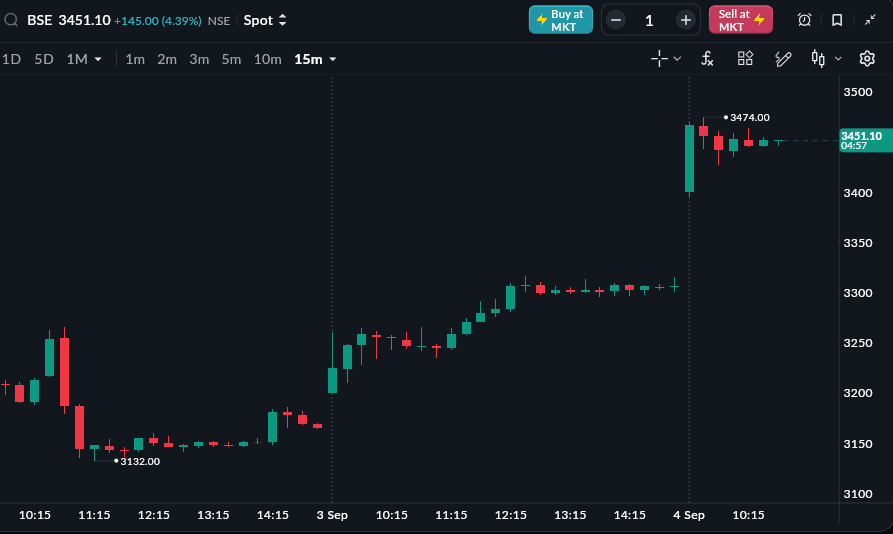
As of 3 Sep, 10.55 AM
Why is SEBI Reviewing Derivative Settlement Prices?
SEBI launched CAS on August 3 to determine closing prices of securities. However, its implementation has raised concerns over divergent index closing levels, volatile options pricing and potential manipulation, particularly on derivatives expiry days.
SEBI said it had received feedback from various stakeholders after the initial implementation period. A key area under review is the use of CAS-determined closing prices for calculating settlement prices of derivative contracts on expiry.
The review follows sharp movements seen during the roughly 20-minute auction window.
READ THIS ALSO: Gland Pharma Shares Fall After ₹2,121 Cr Block Deal
What Problems Has the Closing Auction Session Created?
CAS has resulted in sharp swings and price divergences in benchmark indices since its introduction.
On Thursday, the indicative Sensex close briefly dropped 2.5%, according to BSE's website. Premiums on some BSE Sensex put options subsequently spiked between 400% and 500% during the closing auction.
Exchange data showed that CAS trades accounted for less than 1% of daily cash-market turnover and less than a third of volumes under the previous closing-price system.
Thin liquidity means relatively small buy or sell orders can have a larger impact on benchmark indices.
What Changes are Being Considered for CAS?
BSE MD & CEO Sundararaman Ramamurthy said index option volumes had declined following the introduction of CAS. Feedback from dealers included:
-
Delinking F&O expiry from CAS
-
Implementing CAS gradually
-
Not allowing order modification
The regulator is expected to outline proposed changes in a discussion paper within a week.
Separately, exchanges modified certain CAS norms, allowing the volume weighted average price of trades executed between 3 pm and 3:15 pm to be used for determining the reference price of stock and index futures.
How CAS Affected Trading Volumes?
The introduction of CAS has coincided with weaker derivatives activity. NSE's total monthly equity derivatives turnover stood at ₹34.48 lakh Cr in August, the lowest since November 2023.
BSE's August turnover stood at ₹32.2 lakh Cr, its lowest since June 2025.
Industry index options premium average daily turnover also declined in August, while other derivative products witnessed weaker activity. BSE's August average daily turnover was reported at ₹18,700 Cr, down 26% from the previous month.
Conclusion: What Does This Mean for Investors?
BSE shares gained nearly 5% after SEBI announced a review of derivative settlement-price methodology following concerns over CAS-related volatility. The proposed changes could address liquidity and expiry-day distortions, while the impact of CAS on derivatives volumes remains an important factor for BSE and other capital-market companies.
All topics
Click the link, confirm the box next to sahi.com is checked — ignore any other results.