
BSE Shares Rise 4.5% as NSE Self-Listing Faces Hurdle
BSE shares gained 4.5% after CEO Sundararaman Ramamurthy said NSE cannot self-list and trade on its own platform under the current regulatory framework.

BSE Shares Price Today: BSE shares gained 4.5% after MD & CEO Sundararaman Ramamurthy said NSE has confirmed that no addendum will be issued for self-trading along with its IPO offer document, keeping self-listing outside the current regulatory framework.
BSE Shares Price Today: BSE shares rose 4.5% on September 3 after the exchange's MD & CEO said NSE cannot list and subsequently trade on its own platform following its proposed IPO.
Ramamurthy said NSE has confirmed that no addendum will be issued for self-trading along with its offer document. He also said self-listing is not permitted under the current regulatory framework.
Ramamurthy said BSE had also sought permission to trade on its own exchange in 2017 but was not allowed to do so.
Reports had suggested that NSE could potentially trade on its own exchange through the "permitted to trade" category after listing on BSE. The latest comments from BSE's CEO indicate that such self-trading will not be included through an addendum to NSE's IPO offer document.
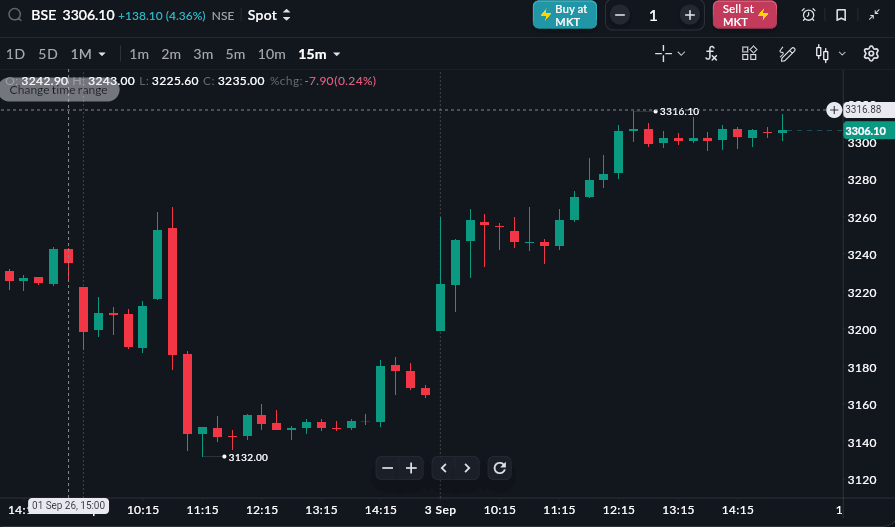
As of 3 Sep, 3.30 PM
What Could NSE Self-Listing Mean for BSE?
The possibility of NSE trading on its own exchange has been viewed as a potential factor for BSE's earnings.
Street estimates suggest that NSE's move could have an impact of roughly 1-2% on BSE's FY27 earnings if BSE's cash-market share does not improve further.
However, the current regulatory framework does not permit self-listing, according to the BSE CEO's comments.
READ THIS ALSO: India Manufacturing PMI Slips to 52.8 in August: What Does It Mean?
BSE CEO Flags Liquidity Concerns in Closing Auction Session
Ramamurthy also discussed the recently introduced Closing Auction Session (CAS), saying that index option volumes have declined.
CAS is a roughly 20-minute end-of-day auction in which buy and sell orders are matched to determine a stock's official closing price. It was introduced on August 3, replacing the earlier system under which closing prices were based on the average price of trades during the final 30 minutes of continuous trading.
According to Ramamurthy, liquidity is an important requirement for CAS, but participation has been limited because of a lack of liquidity. He said BSE has been conducting meetings with dealers to collect feedback on the new system.
The feedback received so far includes:
-
Delinking F&O expiry from CAS
-
Implementing CAS gradually
-
Not allowing order modification
BSE is collating the feedback and plans to present it to regulators.
BSE, NSE Trading Volumes Under Pressure
The introduction of CAS has been accompanied by lower participation and greater volatility during the closing process.
Exchange data showed that CAS trades accounted for less than 1% of daily cash-market turnover and less than a third of the volumes recorded under the previous closing-price system. Thin liquidity means relatively small buy or sell orders can have a larger impact on benchmark indices.
Separately, NSE's total monthly equity derivatives turnover stood at ₹34.48 lakh Cr in August, the lowest since November 2023. BSE's August turnover was ₹32.2 lakh Cr, its lowest since June 2025.
Brokers have reportedly been squaring off positions earlier, around 3:05-3:10 pm, while traders have also been closing positions early to avoid higher volatility during the final minutes.
READ THIS ALSO: Karnataka Approves ₹29,679 Cr Investments: Mahindra, TVS Motor, Havells in Focus
Conclusion: What Does This Mean for Investors?
BSE shares gained after the exchange's CEO said NSE cannot pursue self-listing under the current regulatory framework and confirmed that no addendum for self-trading would accompany its IPO offer document.
For BSE, the development removes a potential concern around NSE trading on its own platform, while the ongoing changes to the Closing Auction Session and weaker derivatives turnover remain important factors to watch.
All topics
Click the link, confirm the box next to sahi.com is checked — ignore any other results.