
BSE Sensex on 13 July 2026: 5 Reasons the Market Fell and Recovered
BSE Sensex and Nifty opened sharply lower on rising crude oil prices and fresh West Asia tensions but recovered most of the losses. Here's what caused the fall and the five key reasons behind the rebound.

BSE Sensex Today: The stock market opened sharply lower on rising crude oil prices and renewed West Asia tensions but recovered most losses later. Value buying, strong FII inflows, gains in IT stocks and support near the 24,000 level helped the market rebound.
BSE Sensex Today: Indian stock markets saw a volatile start to the week as BSE Sensex and Nifty 50 opened lower on Monday after fresh geopolitical tensions in West Asia pushed crude oil prices higher. Renewed concerns over Iran's decision to close the Strait of Hormuz weighed on investor sentiment, triggering broad-based selling across sectors.
However, the market recovered from its losses within the first two hours of trade as investors returned to quality stocks at lower levels. IT shares gained following strong quarterly earnings from Tata Consultancy Services (TCS).
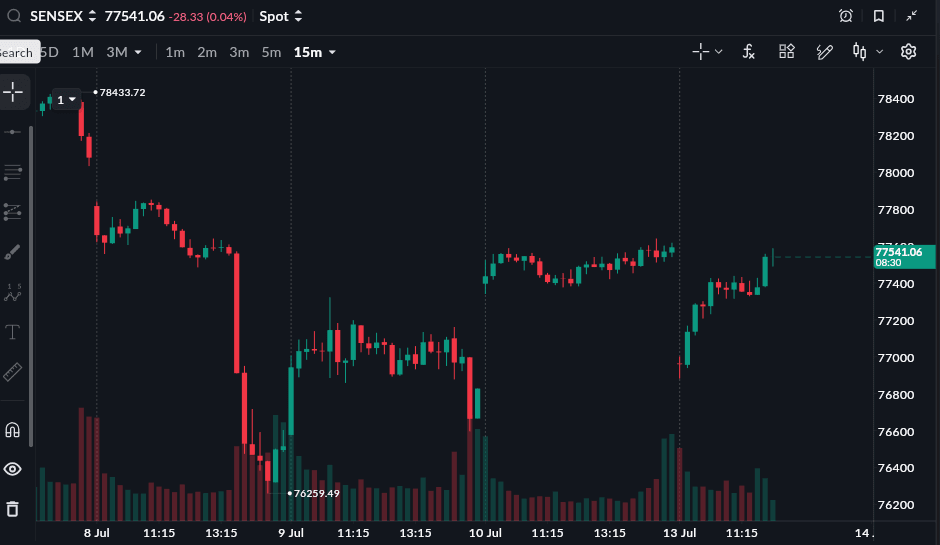
As of 13 July, 12.21 PM
Why Did BSE Sensex Fall Today?
Here are some top reasons why the market crashed today
1. Iran's Closure of Strait of Hormuz Triggered Selling
The biggest reason behind Monday's decline was the renewed escalation in the Middle East. Iran claimed it had once again closed the Strait of Hormuz after fresh military exchanges involving the United States and Gulf nations.
The Strait of Hormuz is one of the world's busiest oil shipping routes, carrying nearly 20 million barrels of crude oil every day. Any disruption raises fears of supply shortages and higher oil prices, which negatively affect oil-importing countries like India.
2. Crude Oil Prices Jumped Nearly 5%
The geopolitical tensions pushed global crude oil prices sharply higher.
-
Brent crude rose 4.38% to around $79.50 per barrel
-
WTI crude climbed 4.30% to around $74.20 per barrel
The rally came after both benchmarks had already gained around 5.5% last week. Higher crude prices increase India's import bill, raise inflation risks and can pressure corporate earnings, which generally damages equity markets.
3. Weak Asian Markets Added Pressure
The negative sentiment was visible across Asia. South Korea's Kospi plunged nearly 7%, while Japan's Nikkei 225, Hong Kong's Hang Seng and China's Shanghai Composite also traded lower, adding pressure on domestic equities.
4. Broad-Based Selling Across Sectors
Selling was seen across almost every sector. Financials, auto and metal stocks fell around 1% each, while all 16 major sectoral indices traded in the red during early trade.
Among Sensex stocks, InterGlobe Aviation, Tata Steel, Maruti Suzuki, Asian Paints, HDFC Bank and Bajaj Finserv were among the biggest losers.
But after the gap down on Monday, the market immediately recovered. Here are the reasons why
READ THIS: 3 Breakout Stocks for Swing Trading this Week
Why Did BSE Sensex Recover? 5 Reasons
Despite the weak opening, the market saw a sharp recovery during the morning session. Here is why:
1. Investors Bought Stocks at Lower Levels
After the steep decline, investors returned to fundamentally strong companies at attractive valuations. This value buying helped benchmark indices recover nearly 550 points from their intraday lows.
2. FII Buying Continued to Support the Market
Foreign Institutional Investors continued their buying trend. FIIs purchased equities worth ₹2,603.72 crore on Friday. The buying momentum has continued through July.
Market experts believe India's stable macroeconomic environment and resilient rupee are attracting foreign investors. Weakness in South Korea's semiconductor-heavy market has also encouraged FIIs to shift money towards India.
3. Strong TCS Results Lifted IT Stocks
Technology stocks remained one of the biggest supports for the market after Tata Consultancy Services (TCS) reported better-than-expected quarterly earnings.
Nifty IT Index traded around 0.72% higher, with eight of its ten constituents remaining in positive territory. TCS itself gained nearly 6%, helping limit the fall in benchmark indices.
4. Nifty Defended 24,000 Mark
Technical buying also played a key role. Nifty touched an intraday low of 24,000.20 before witnessing strong buying interest.
24,000 remains an important support level. A decisive break below this level could trigger further selling towards 23,800, but Monday's rebound suggests buyers remain active around this zone.
5. India VIX Improved
India VIX, often referred to as the market's fear gauge, recovered during the session.
The improvement in volatility, combined with value buying and positive FII flows, helped restore confidence and supported the recovery in benchmark indices.
READ THIS: Kusumgar IPO Allotment Status
Conclusion: What Should Investors Watch Next?
Investors should closely monitor developments in the Middle East, crude oil prices and foreign investment flows over the coming sessions. While geopolitical tensions have increased uncertainty, steady FII inflows, resilient IT stocks and strong buying near the 24,000 level indicate that investors are still willing to accumulate quality stocks during market corrections.
If Brent crude remains below $90 per barrel, analysts believe Indian markets could continue to absorb external shocks. However, any fresh escalation in the conflict or a sustained spike in oil prices may keep the BSE Sensex and Nifty 50 volatile in the near term.
All topics
Click the link, confirm the box next to sahi.com is checked — ignore any other results.