
Why Vedanta Shares Crash 9% Today?
Vedanta shares slipped nearly 9% after a ₹2,149 crore block deal involving around 7.3 crore shares. Investors are now watching promoter actions, debt-related developments, and the impact of the company's recent demerger.

Vedanta shares price fell nearly 9% after a ₹2,149 crore block deal involving around 7.3 crore shares. The transaction, reportedly linked to promoter entity Twin Star Holdings, has raised investor concerns over promoter stake sales, debt management, and the company's post-demerger outlook.
Vedanta shares price came under heavy selling pressure on 23 June, falling nearly 9% after a block deal of around ₹2,149 crore hit the market. While block deals are not uncommon, this transaction has attracted attention because reports suggest the seller was a promoter entity, Twin Star Holdings.
FYI: A block deal refers to a large-volume share transaction executed through a special stock exchange window. These transactions can create short-term volatility in the stock price.
For investors, the bigger question is not that a block deal happened. The real question is whether this is a one-time transaction or a sign of further promoter stake dilution after Vedanta's much-awaited demerger.
What Exactly Happened In Vedanta Share?
According to market reports, around 7.3 crore Vedanta shares changed hands through block deals at approximately ₹292 per share. The total transaction value stood at around ₹2,149 crore. And as per the media reports seller was promoter entity Twin Star Holdings and the details about buyers is not out yet.
Earlier reports suggested that promoter entity Twin Star Holdings planned to sell up to 6.5 crore shares, representing around 1.8% stake in Vedanta, at a floor price of ₹291 per share.
Vedanta shares fell 8.77% to ₹279 during the session
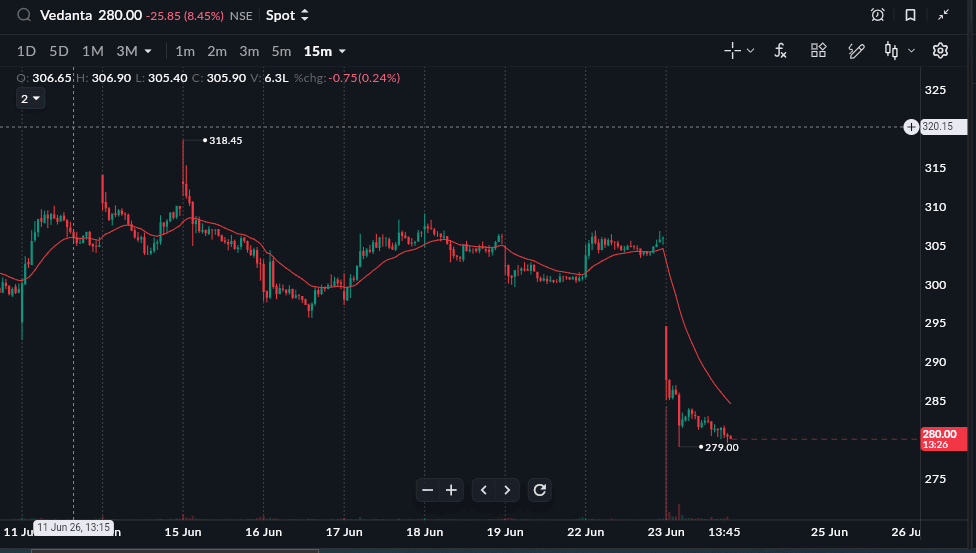
As of 23 June 2026, 2.16 PM
Why Did Vedanta Shares Fall After the Block Deal?
The market generally reacts negatively to large block deals for 3 reasons.
-
Such transactions are executed at a discount to the prevailing market price. The floor price for this deal was ₹291 per share, which was around 4.9% lower than Vedanta's previous closing price.
-
A sudden increase in share supply often creates short-term pressure on stock prices.
-
Third, investors start worrying whether additional shares could come into the market in the future. This is commonly referred to as a "supply overhang."
In Vedanta's case, these concerns become even more important because the likely seller belongs to the promoter group.
Why Does Promoter Selling Matter More?
Not every large share sale carries the same importance. If a mutual fund or institutional investor sells shares, it may be a portfolio rebalancing exercise.
However, when a promoter entity sells shares, investors pay closer attention because promoters have a deeper understanding of the business, future plans, and financial position. That does not automatically mean there is a problem with the company.
Promoters may sell shares for liquidity requirements, debt repayment, restructuring, or capital allocation purposes. However, investors still ask one important question:
Why now: That is exactly what the market is trying to understand in Vedanta's case.
How Much Stake Does Twin Star Hold In Vedanta?
As of 31 March 2026, Twin Star Holdings held 40.02% stake in Vedanta. The promoter group collectively owned 56.38% of the company.
This means promoter ownership remains strong even after the block deal, but investors will closely watch whether further stake sales take place.
Why is the Timing of the Sale Important?
The timing is crucial because Vedanta recently completed one of the biggest corporate restructuring exercises in India. The company demerged its businesses into 4 separate listed entities:
-
Vedanta Aluminium Metal
-
Vedanta Power
-
Vedanta Oil and Gas
-
Vedanta Iron and Steel
The objective was to unlock value by creating focused, sector-specific businesses. When a promoter-linked entity sells shares shortly after a value-unlocking exercise, investors become curious.
Read this: Ujin Pharma IPO
Is This Block Deal Linked To Debt Management?
This is perhaps the most important investor question.
Over the years, investors have closely tracked promoter-level debt, refinancing plans, dividend payouts, asset monetisation initiatives, and stake sales across Vedanta Group.
Whenever a promoter-linked entity raises more than ₹2,000 crore through a stake sale, investors wonder whether the funds will be used to improve liquidity or reduce debt.
If the proceeds ultimately support debt reduction, the market may view the transaction differently. However, until there is clarity, uncertainty is likely to remain.
Final Words
Vedanta's ₹2,149 crore block deal has shifted investor focus from the company's operations to promoter actions. While the demerger story remains intact, the market will closely watch whether this was a one-time stake sale or the start of further promoter dilution.