
Top 5 EV Stocks in India
Explore the top EV stocks in India based on market capitalisation, financial performance, EV expansion plans, and the long-term growth outlook of the country's fast-growing electric vehicle industry.

India's EV retail sales rose 24.6% year-on-year to 24.52 lakh units in FY26, driving interest in electric vehicle stocks. Maruti Suzuki, Mahindra & Mahindra, Bajaj Auto, TVS Motor and Tata Motors are expanding EV portfolios and manufacturing capacity to capture future growth.
India's electric vehicle market is growing quickly as more buyers shift towards EVs and automobile companies expand their electric vehicle portfolios. In FY26, EV retail sales in India reached 24.52 lakh units, growing 24.6% year-on-year.
This growth has also brought EV stocks into focus. From electric car and two-wheeler manufacturers to battery and auto component companies, several listed businesses are investing in India's EV transition.
In this article, we will look at the top 5 EV stocks in India, their financial performance, role in the EV market and future growth plans.
Top 5 EV Stocks in India
The table below shows the best EV stocks by market capitalisation. These companies are among the most renowned in the market, and their performance determines the health of the automobile industry.
| Company | Market Capitalisation in ₹ Crore | 5 Years CAGR | Dividend Yield | ROE | ROCE |
|---|---|---|---|---|---|
| Maruti Suzuki India | 4,53,131 | 14% | 0.98% | 14.4% | 19.0% |
| Mahindra and Mahindra | 3,89,200 | 33% | 1.04% | 15.4% | 15.4% |
| Bajaj Auto | 2,74,830 | 20% | 1.48% | 29.2% | 28.2% |
| TVS Motor | 1,66,060 | 44% | 0.32% | 33.8% | 17.4% |
| TATA Motors CV | 1,58,800 | NA | 0.92% | 34.0% | 35.9% |
Source: Screener, data as of 1 July 2026.
* Tables marked NA are due to no data being present for that particular category on the stated date.
Overview of Top 5 EV Stocks in India
Given below is the overview of the top 5 EV stocks in India, along with their financial performance and core business.
1. Maruti Suzuki India
Maruti Suzuki is one of the industry leaders, having over 40% market share in the passenger vehicle sector. The company has dominated the automobile industry with its range of vehicles to cater to different customers and has become a household name.
Maruti Suzuki’s eVitara, which marked its entry into the EV sector in FY26, comes with two battery options, 49 kWh and 61kWh, developed on a dedicated EV platform. Suzuki, the parent company, has already announced investing ₹70,000 crore to further develop the EV and hybrid segment in India.
To meet the EVs’ rising demand, the company increased its production capacity with a new production line becoming operational in Gujarat from July 2026, improving its total output capacity from 7.5 lakh units to 10 lakh units annually, and is also planning to open two new facilities in Hansalpur and Kharkhoda, increasing production capacity by 5 lakh units.
Maruti Suzuki also announced it will launch 4 new EVs by 2031 as part of its long-term strategy to dominate the EV sector.
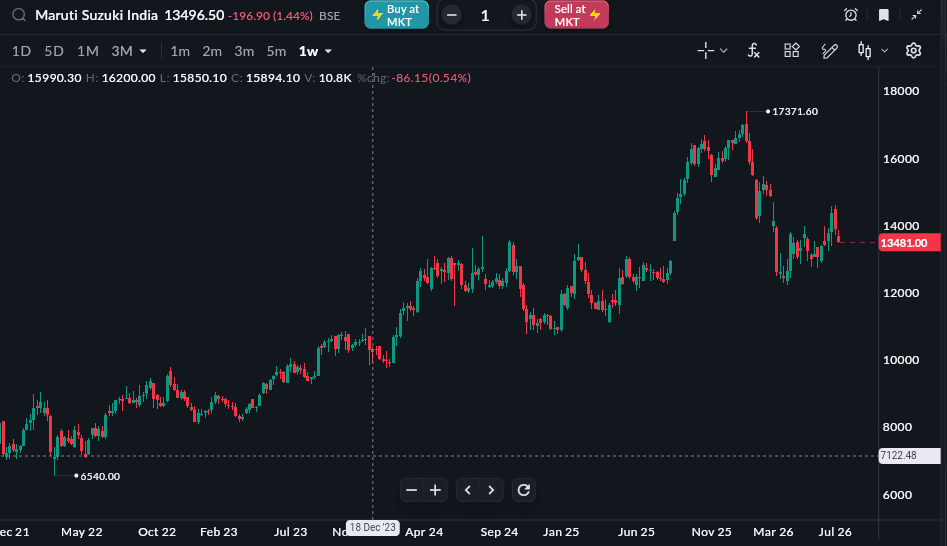
As of 14 July 2026
By 2031, how many new EVs does Maruti Suzuki plan to launch?
2. Mahindra and Mahindra
Mahindra and Mahindra is the largest SUV maker in India and on the way to being one of the biggest EV manufacturers in India, commanding almost 24% market share in the EV sector in FY26.
The automobile company has sped up its EV production by receiving investment worth $250 million in 2022 from the British International Investment, a leading finance institution based in the United Kingdom.
It recently launched 3 models – BE6, XEV9E, and XEV 9S, where the first two jointly crossed 50,000 sales in April 2026, less than a year after their release.
Mahindra and Mahindra is establishing a Nagpur Greenfield facility worth ₹15,000 crore, operational in FY28 and likely to further improve capacity for 5 lakh vehicles, strengthening the company’s drive to become the industry leader.
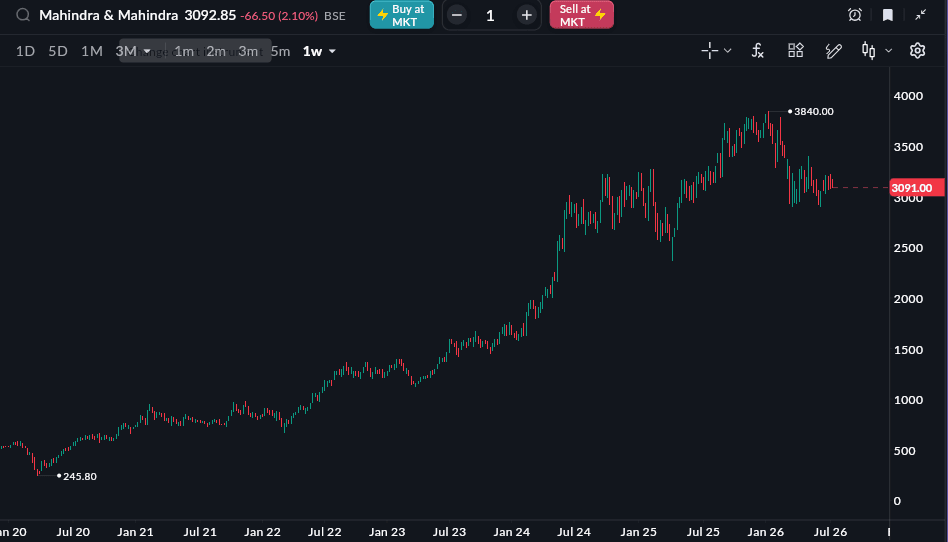
As of 14 July 2026
3. Bajaj Auto
Bajaj Auto is one of the largest producers of two- and three-wheeler vehicles in India and has consistently been profitable in the sector.
Bajaj is betting on its Chetak electric scooter to position itself as a market leader in the EV sector, as it works to match the sales volumes of the Ola S1 and TVS iQube by increasing manufacturing capacity, strengthening its product proposition, and expanding its market reach.
Bajaj Auto, however, remains a market leader in the three-wheeler vehicle segment as it recently, in April 2026, launched 4 EV models – P50, P70, P90, and C90 with battery ranges between 9.2kWh and 12.1 kWh, except for the P90 range, which comes with a massive 17.7 kWh battery.
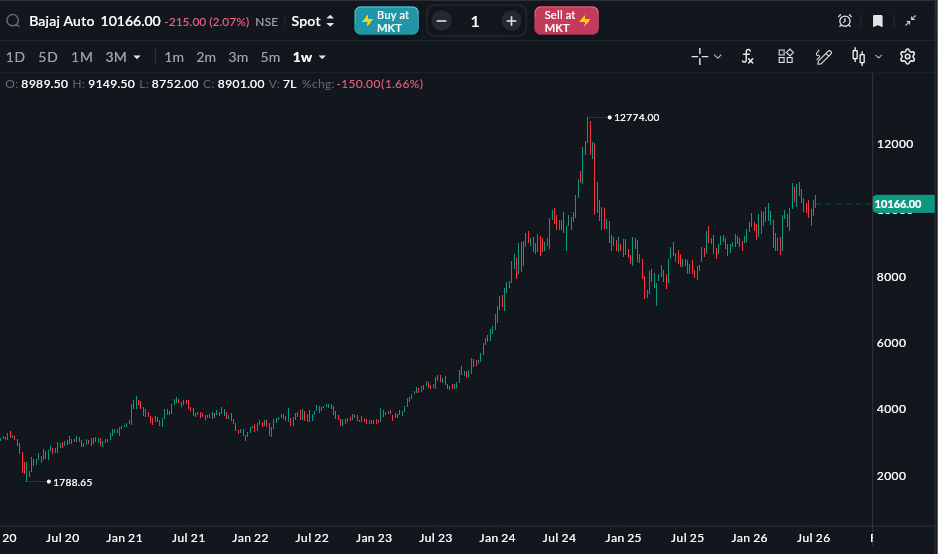
As of 14 July 2026
4. TVS Motor Company
TVS Motors is considered to be a market leader in the two-wheeler segment. The company has made significant strides in the EV sector as its flagship model, the iQube electric scooter, recently, in June 2026, reached the production of its 1 millionth unit rolled out of its Hosur facility in Tamil Nadu.
To meet the growing EV demand, TVS Motor announced that it will invest around ₹3,500 crore in FY27 to improve capacity, product development, and R&D. The company is also planning to add a further 1.5 million units of yearly production by 2027 in its bid to become the EV leader in the two-wheeler segment.
TVS Motors recently, in April 2026, announced a joint venture with Hyundai Motors to jointly develop and commercialise electric three-wheeler vehicles, a move that will strengthen their position in the three-wheeler category.
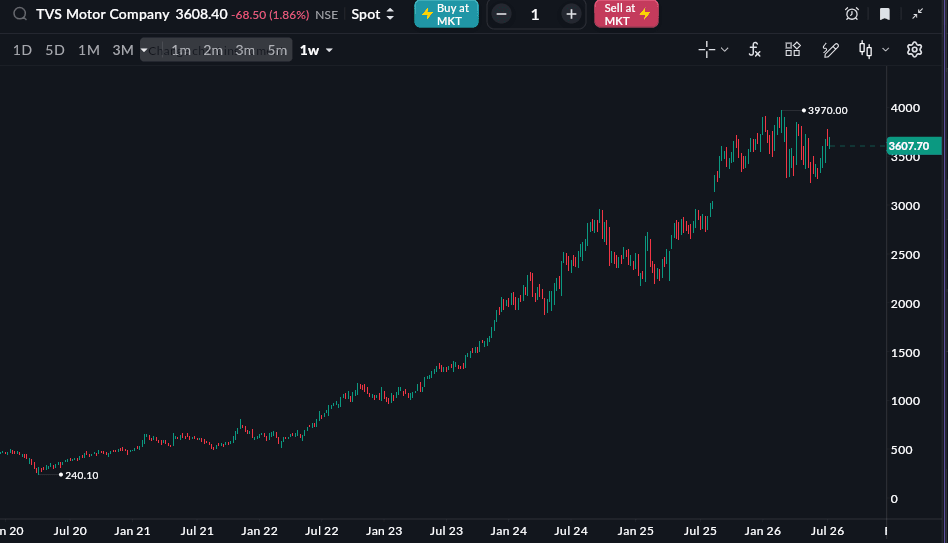
As of 14 July 2026
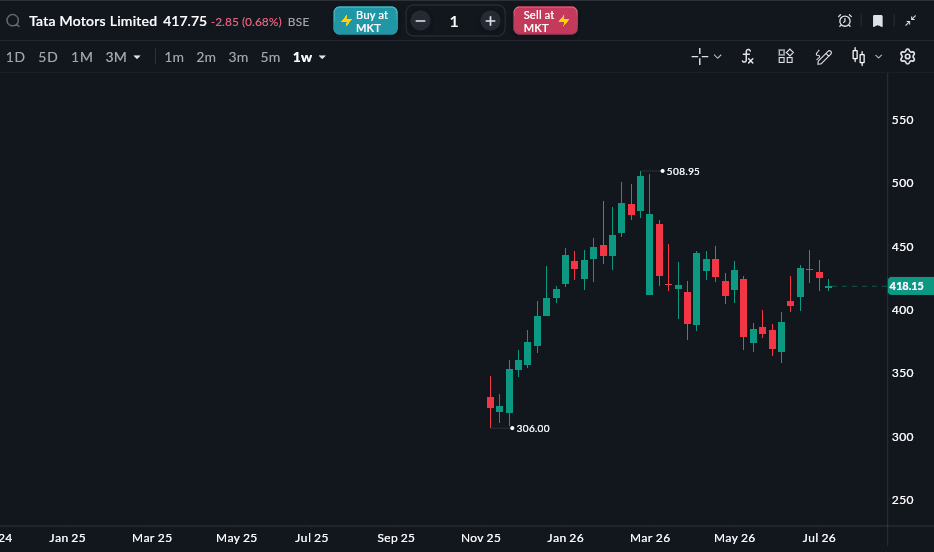
5. Tata Motors CV
Tata Motors features a range of models and is the number one manufacturer with more than 1.5 lakh units produced.
The sales of Tata Motors' EVs tripled, seeing a 183% rise with the passenger vehicle segment being the biggest winner.
The company’s long-term project includes Avinya, which is a premium EV platform likely to position itself at the higher end of the EV vertical.
The company, to meet the surging demand for EVs in India, is aiming that by 2030 for one out of every five new cars sold in India to be theirs – with its EV models making up 30% of its total annual sales.
As of 14 July 2026
India’s EV Industry Outlook
Given below is an overview of how the EV sector is likely to perform in the future:
- The EV sector in India is forecasted to rise from $26.2 billion in 2026 to $194.9 billion in 2033 due to a drop in battery prices, rising fuel costs, and government incentives.
- A total of ₹10,900 crore has been allocated under the PM Drive scheme, followed by a PLI incentive worth ₹18,100 crore, and FAME II subsidies for the EV sector, which have reduced battery costs and increased manufacturing capacity across different vehicle segments.
- India is targeting having close to 80 million EV vehicles on the road by 2030, of which 30% of EVs would be private vehicles, followed by 80% in two-wheeler and three-wheeler segments, and 70% in commercial vehicles.
- India has around 26000 charging stations in India, which is projected to rise to 40,000 by 2027. Under the second phase of the FAME II scheme, the government in 2023 already infused $96 million to set up 7,432 stations.
- India is already looking to introduce electric power into other modes of transportation sectors such as railways, aviation, and waterways.
According to the article, what is the projected size of India's EV market by 2033?
Conclusion
The EV sector in India is on an upward streak, with it projected to grow to $194.9 billion by 2033. With several big names already having entered the sector by introducing vehicles across segments, the Indian Government’s investment makes this sector a profitable one in the future.
More transport modes are expected to go electric in the future, and with battery costs dropping, investing in renowned EV stocks would be a smart investment strategy.
All topics
Click the link, confirm the box next to sahi.com is checked — ignore any other results.