
Tejas Networks Up 30% in 5 Days — What's Driving the Move?
From a 5G deal with NEC Japan to D2M trials — here's what's behind the sudden rally.

Tejas Networks stock surged up to 18% intraday, extending its five-session rally to around 30%. Three catalysts are driving the move: a 5G massive MIMO supply agreement with Japan's NEC Corporation, successful D2M (direct-to-mobile) technology trials backed by multiple government agencies, and growing investor optimism around AI-driven telecom infrastructure demand. Despite the rally, the company reported a net loss of ₹211 crore in Q4 FY26 with revenue down 83% year-on-year.
Tejas Networks share price has suddenly become one of the most closely watched telecom and technology stocks in the Indian market. On May 7, Tejas shares surged up to 18% intraday, touching ₹547.85 on the NSE, extending the five-session rally to around 30%. The sharp move came even as the broader market remained relatively flat, with the Nifty 50 closing marginally lower on the day.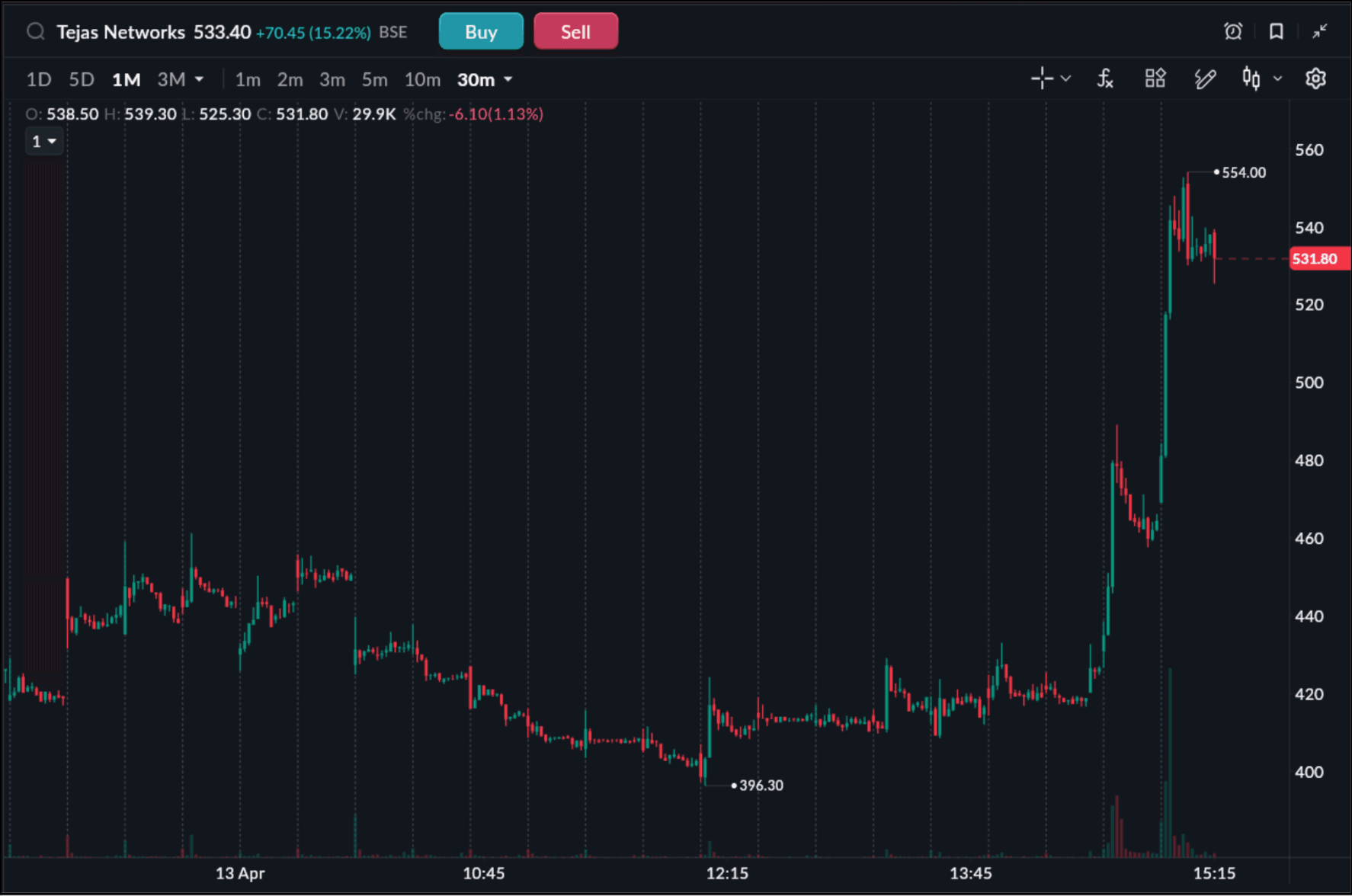
So, what exactly is driving this rally in the Tejas share price?
Tejas Share Gains Attention Amid Global 5G Push
One of the biggest triggers behind the recent momentum is the company's growing presence in international wireless infrastructure markets.
In February 2026, Tejas Networks announced that it had signed an agreement with Japan-based NEC Corporation to manufacture and supply 5G massive MIMO radios for a global customer. Management reiterated this development during the company's recent earnings conference call, highlighting it as a strategic milestone in the company's international expansion.
Massive MIMO technology is considered a critical part of modern 5G infrastructure because it enables telecom operators to handle significantly larger data traffic and improve network efficiency.
The development is being seen as important because it signals Tejas Networks' transition from being largely India-focused to becoming part of global telecom supply chains. For investors, this potentially opens the door to larger export opportunities and deeper participation in international telecom infrastructure deployment.
The company also stated that it is conducting ongoing 4G and 5G network trials across regions, including the Americas and South Asia. These trials are important because successful deployments could strengthen the company's credibility in overseas markets where competition is intense and dominated by global telecom equipment giants.
AI Infrastructure Boom Could Benefit Telecom Equipment Companies
Another key reason behind the optimism is the growing belief that artificial intelligence will create a massive demand cycle for digital infrastructure globally.
According to company management, existing communication networks may struggle to support the expected explosion in AI-driven data traffic over the coming years. As AI adoption expands across industries, demand for high-capacity fibre networks, wireless backhaul systems, and advanced telecom infrastructure is expected to rise sharply.
This narrative has become increasingly relevant globally as companies and governments invest heavily in AI data centres, cloud infrastructure, and high-speed connectivity systems. Telecom equipment firms that already possess optical networking and wireless capabilities are increasingly being viewed as potential beneficiaries of this structural shift.
D2M Technology Trials Added Fresh Momentum to Tejas Share Price
Another major trigger for the rally came after reports suggested that Tejas Networks' equipment successfully cleared lab and field trials related to direct-to-mobile broadcasting technology.
The trials were conducted under the supervision of multiple government-backed agencies, including the Ministry of Information and Broadcasting, the Department of Telecommunications, the Ministry of Electronics and Information Technology, and Prasar Bharati. The D2M initiative has entered advanced trials across 19 cities including Mumbai, Delhi, and Bengaluru, and is targeting a phased commercial rollout by mid-to-late 2026.
D2M technology has attracted growing attention because it aims to deliver video and multimedia content directly to mobile devices without relying heavily on traditional cellular data networks. If scaled commercially, the technology could potentially reduce network congestion while expanding digital broadcasting capabilities.
Importantly, the trials reportedly confirmed that D2M signals coexisted without interfering with existing 2G, 3G, 4G, and 5G telecom services. The tests also validated the performance of compatible receivers, smartphones, dongles, and home gateways.
Financial Performance Still Remains Under Pressure
Despite the sharp rally in Tejas share price, the company's latest financial numbers reflected significant pressure.
For the March quarter (Q4 FY26), Tejas Networks reported a consolidated net loss of ₹211 crore, substantially wider than the ₹71.8 crore loss reported during the same period last year. Revenue from operations also declined sharply by nearly 83% year-on-year to ₹333 crore, compared to ₹1,907 crore in Q4 FY25.
However, investors appear to be focusing more on future execution potential rather than the current earnings cycle. The company ended the quarter with an order book of ₹1,514 crore — up 49% year-on-year — and received ₹69 crore in production-linked incentive (PLI) benefits, which may support future operational expansion. For the full year FY26, Tejas reported revenue of ₹1,103 crore and a net loss of ₹909 crore.