
PFC-REC Merger Explained: Share Swap Ratio, Timeline & What Investors Should Know
PFC and REC boards have approved their merger, but both stocks declined after the announcement. Here's everything investors need to know about the share swap ratio, merger timeline, regulatory approvals, and REC's ₹1.4 lakh crore fundraising plan.

PFC and REC have approved their merger, under which REC will merge into PFC through a share swap ratio of 88:100. The combined entity will have a loan book of over ₹11 lakh crore, while REC has also approved raising up to ₹1.4 lakh crore through bonds.
On 28 June 2026, the boards of Power Finance Corporation (PFC) and REC approved the merger scheme under Sections 230 to 232 of the Companies Act, 2013, under which REC will merge into PFC.
The proposal has already received approval from the President of India and the Ministry of Power. Finance Minister Nirmala Sitharaman had also announced the restructuring of both companies in the Union Budget 2026 to improve efficiency and create a larger public sector financing institution. The proposal comes nearly 7 years after PFC acquired the Government's majority stake in REC.
PFC Share Price Today
PFC and REC shares traded lower in early trade on Monday, 29 June 2026, after both state-owned lenders approved their long-awaited merger scheme. PFC shares slipped nearly 2% to ₹424.75, while REC declined 0.32% to ₹363.50.
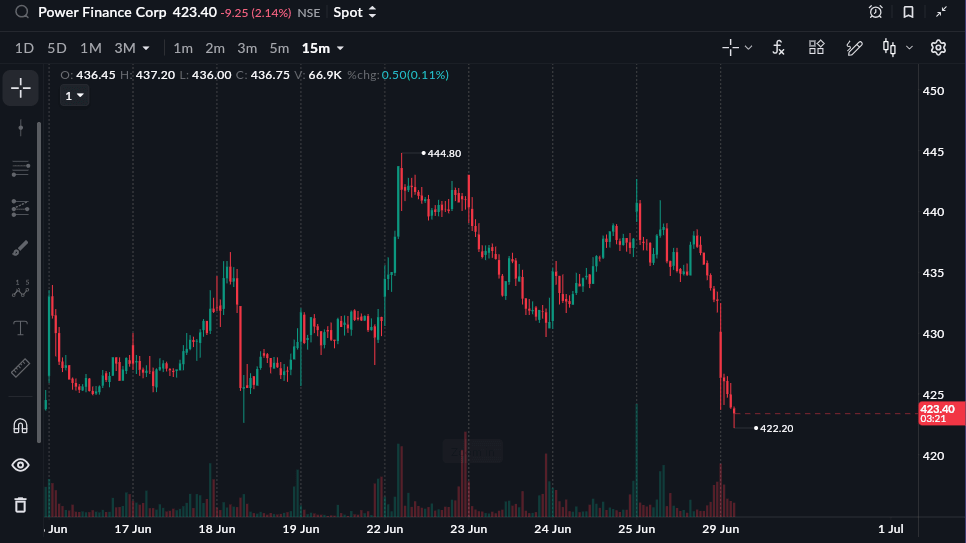
As of 29 June 2026, 10.27 AM
Although the merger will create India's largest power sector financing company with a combined loan book of more than ₹11 lakh crore, investors remained cautious as the merger still requires several approvals and is expected to become effective only from 1 April 2027.
PFC-REC Share Swap Ratio
Under the approved merger scheme, REC shareholders will receive 88 equity shares of PFC for every 100 REC shares held.
The share exchange ratio has been determined based on a joint valuation exercise carried out by independent valuers. The record date for PFC-REC merger will be announced later after all approvals are completed.
READ THIS ALSO: Why Did Astral Share Price Fall 10% Today?
Why is PFC-REC Merger Important?
Once completed, the merger will create a financing institution with a combined loan book of over ₹11 lakh crore, making it one of India's largest government-owned NBFCs focused on the power sector.
The government expects the merger to:
-
Create greater scale.
-
Improve operational efficiency.
-
Strengthen the combined balance sheet.
-
Increase lending capacity for India's power and energy sector.
-
Simplify the ownership structure.
The merger is also subject to the combined company continuing to qualify as a Government company, as the Government of India retains majority voting rights and management control, directly or indirectly.
REC Approves ₹1.4 Lakh Crore Fund Raise
Apart from approving the merger, REC's board also cleared a proposal to raise to ₹1.4 lakh crore through the private placement of secured or unsecured non-convertible bonds and debentures over the next one year, subject to shareholder approval at the upcoming AGM.
The company said the proceeds will be used to support its lending operations.
What is Expected Timeline for PFC-REC Merger?
According to the implementation roadmap:
-
June 2026: Draft merger scheme and board approvals completed.
-
Next: Shareholder, creditor and regulatory approvals.
-
Early 2027: Regulatory clearances are expected.
-
1 April 2027: Proposed effective date of the merger.
READ THIS ALSO: Turtlemint Fintech Solutions Share Price List at 11% Discount What Should Investors Do?
What Should Investors Watch?
The merger has only received board approval and several regulatory steps are still pending. Investors should keep an eye on the announcement of the record date, shareholder and regulatory approvals, and the progress of the merger over the next few quarters. The combined company's lending growth, integration process and execution will also remain key factors to watch after the merger becomes effective.