
Nvidia AI Server Price Hike: Why Indian IT Stocks Rallied
Memory costs are pushing AI server prices up more than 15%. Indian IT stocks read that as good news.

Nvidia has told large customers that AI server prices will rise more than 15% for systems shipping in early 2027, mainly because memory chip costs have surged. Indian IT stocks rose on 24 August 2026, and the IT pack was the best sector in early trade with a 0.93% gain. Hexaware jumped as much as 7.7% after saying over half its active engagements are now AI-infused. The real signal is not that AI spending is breaking down. It is that the market now prices AI builders and AI users differently.
Indian IT stocks opened firm on Monday, 24 August 2026. Infosys and HCLTech led the gains, and the IT index outperformed every other sector in the first hour. The trigger came from outside India. Over the weekend, reports said Nvidia had warned its biggest customers about steep price increases on AI servers.
At first glance, costlier AI hardware and stronger Indian IT stocks look unrelated. They are not. The link runs through one question the market keeps asking: how much longer can the world keep spending this much on AI infrastructure?
What Nvidia actually told its customers
Nvidia has told big buyers that servers built on its Grace Blackwell and new Vera Rubin chips will cost more than 15% extra in many setups. Some reports put the increase as high as 17% on the GB300 and VR200 racks. The new prices apply to systems shipped from early next year.
Memory is the reason. Server DRAM prices roughly doubled in the first quarter of 2026. Memory now makes up about a quarter of the cost of a high-end AI rack. That is a big share for a part that used to barely move rack prices.
Nvidia does not assemble most of these racks itself. Contract makers heard first. They passed the word up to buyers like Microsoft, Google and Amazon Web Services.
The dollar figures show the scale. Blackwell-based GB200 NVL72 systems have been shipping at roughly $2.8 million to $3.4 million each. Early inquiries on the Vera Rubin VR200 racks that succeed them are landing between $5 million and $7 million. Nvidia also runs a gross margin near 75%. When a firm with that much cushion still passes costs on, memory supply must be very tight.
The Korea link is not what it looks like
Several write-ups paired this news with a fall in South Korea's KOSPI. That pairing needs care, because two details cut against it.
First, the KOSPI move on Monday was small. The index slipped 0.73%, or 50.77 points, to 6,862.18 in the first minute of trade, after closing above 6,900 on Friday. The stated reason was profit booking in large chip stocks before Nvidia's results on 27 August. It was not a panic about AI costs. The sharp fall came earlier in the month, when the index dropped as much as 6.8% intraday on 19 August as global bond yields rose. It rebounded 5.9% the very next day.
Second, higher memory prices actually help Samsung Electronics and SK Hynix. Nvidia passing on memory costs is a sign of pricing power for memory makers, not a threat to them. So "Korean chips down, Indian IT up" is a weak frame. The better read is that investors are re-sorting the AI trade, not leaving it.
Why is Nvidia raising prices on its AI server racks?
How Indian IT stocks traded on Monday
At 9:32 am, the Sensex stood at 77,650.09, up 109.26 points or 0.14%. The Nifty 50 was at 24,277.20, up 25.20 points or 0.10%. Friday's closes were 77,540.83 and 24,252.00.
The index moves were small. The sector move was not. IT gained 0.93% and topped the sector table in early trade, while metals added 0.78%. Infosys rose 1.56% and HCLTech gained 1.08%. Wipro traded slightly higher, and TCS and Tech Mahindra also held gains.
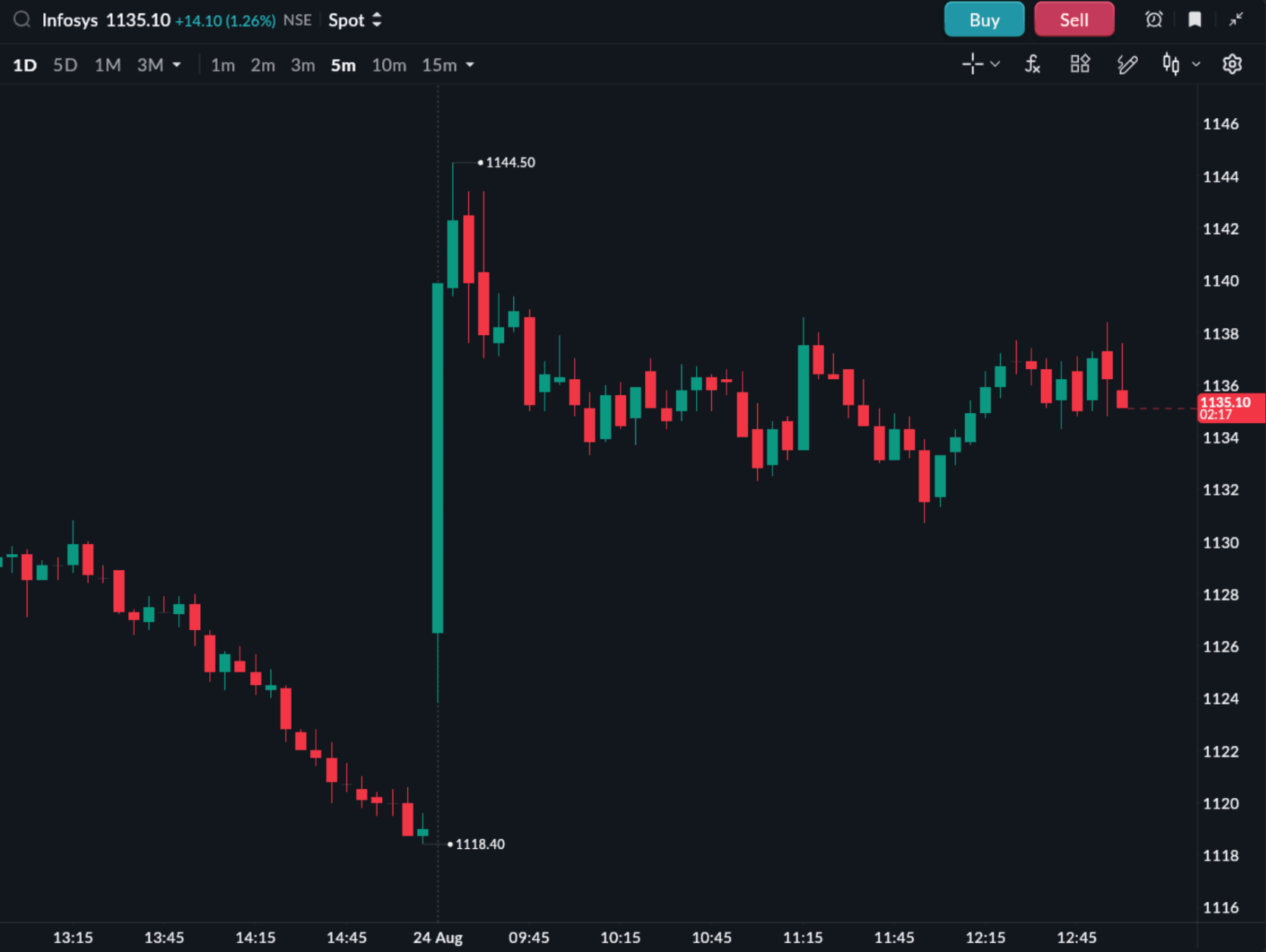
(As of 01:00 PM on August 24, 2026)
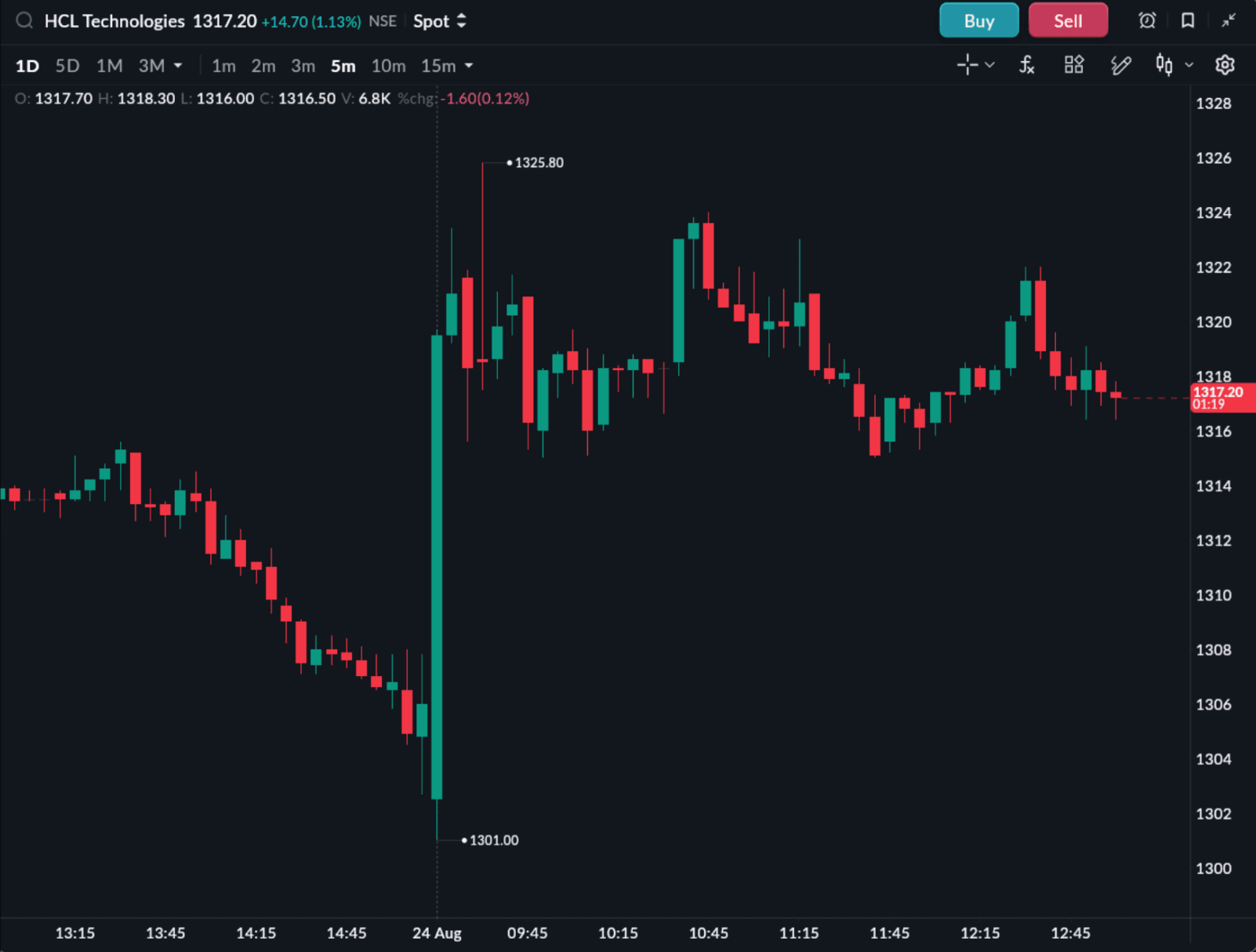
(As of 01:00 PM on August 24, 2026)
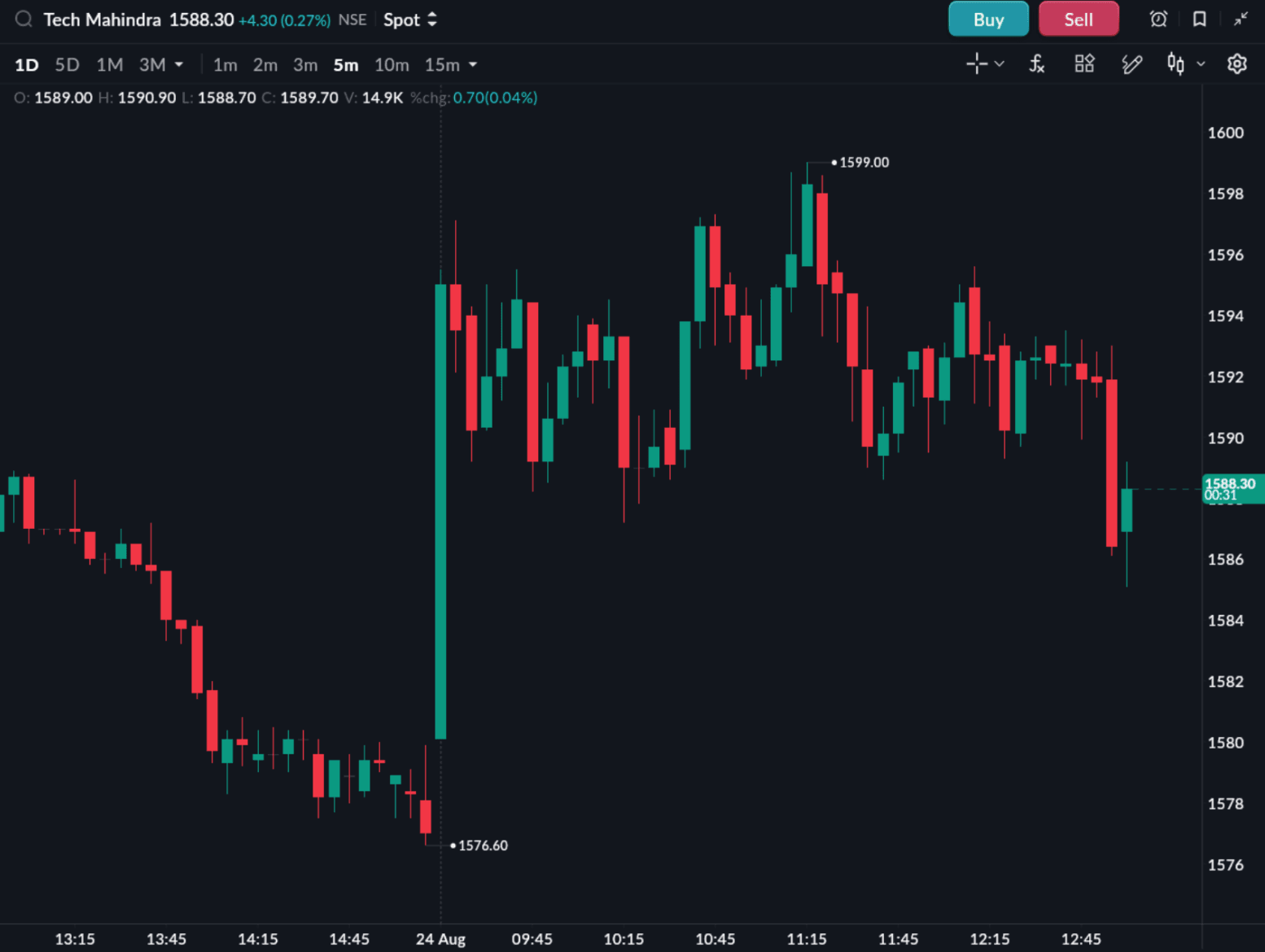
(As of 01:00 PM on August 24, 2026)
Crude helped at the margin. Brent traded near $93.07 a barrel and WTI near $85.68, both lower on the day. Even so, oil at these levels still caps how far Indian shares can run. Supply risk has not gone away either.
Hexaware's AI Day was the second trigger
Hexaware Technologies was the standout in the pack. The stock rose as much as 7.70% to ₹574.20 on the BSE before easing to around ₹556, still up about 4.5%. Volume ran at 7.85 times its 10-day average.
The move followed the firm's AI Day. Its theme was "Zero Friction, Infinite Momentum". Hexaware said more than half its active engagements are now AI or AI-infused. It also showed over 900 AI agents in production. More than 70% of its delivery work is now AI-assisted. AI work runs across more than 46% of its client base. The team set a 30% win-rate target, and it is chasing deals above $100 million.
One number frames the rally properly. Hexaware was still down roughly 26% for 2026 before Monday's move. This was a bounce in a beaten-down corner of the market, not a fresh re-rating of the business.
Analysts did not agree after the event:
| Brokerage | Rating | Target price |
|---|---|---|
| CLSA | Buy | ₹730 |
| MOFSL | Buy | ₹720 |
| Kotak Equities | Buy | ₹660 |
| IIFL | Accumulate | ₹620 |
| Axis Capital | Buy | ₹610 |
| JM Financial | Add | ₹605 |
| ICICI Securities | Hold | ₹580 |
| Jefferies | Underperform | ₹500 |
The spread runs from ₹500 to ₹730 on the same set of numbers. That gap is the honest summary of where this debate stands.
What did Hexaware disclose at its AI Day that lifted the stock?
Why the "anti-AI trade" label is getting weaker
For much of the past year, Indian IT stocks fell whenever AI optimism ran hot. The fear was simple. AI agents would eat into old software and support work. When AI hopes cooled, the same stocks bounced. That pattern earned the sector an "anti-AI trade" tag.
The tag is getting harder to defend. Indian IT firms are not betting against AI. Several are building it into delivery, pricing and hiring. The paths of TCS, Infosys and HCLTech have already split. Infosys has gone further with a direct AI partnership of its own.
Two outcomes remain live. AI could shrink demand for hours-based work. AI could also lift spending on fixing old systems, cleaning data and securing it. Indian IT sits between those two. That is why the sector swings so hard on mood. A similar swing drove the 16% Nifty IT rally in July 2026.
What experienced traders watch from here
Three checkpoints matter more than Monday's tape.
- Nvidia's results on 27 August. Its outlook on orders and margins will set the tone for the whole AI trade. That includes Indian IT.
- Disclosure quality at Indian IT firms. Watch if AI revenue comes with hard numbers, or just a share of "engagements". The two are not the same.
- Memory prices and margins. If DRAM stays dear, AI budgets get squeezed. That can slow the big cloud spending that funds tech projects later.
Mistakes to avoid on days like this
An early-trade snapshot is not a trend. A 0.93% sector gain at 9:32 am can fade by close, and one-day IT rallies have reversed before.
A foreign index move does not always cause an Indian one. One morning proves little, and this move was under 1%.
One firm's numbers are not sector proof. Hexaware's data says something about Hexaware. It does not prove that every Indian IT firm has solved the AI question.
A bounce in a stock down 26% this year is not a re-rating. Size the position with care. Index and sector data can be checked on the NSE site.
Sources: Bloomberg and Fortune (Nvidia price notices, 22 August 2026); Seoul Economic Daily (rack price detail); Korea JoongAng Daily (KOSPI open, 24 August 2026); Business Today (Hexaware AI Day and broker targets, 24 August 2026); NSE and BSE (index and stock data, 24 August 2026). All prices are as of the morning session on 24 August 2026 unless stated otherwise.
Frequently Asked Questions (FAQs)
All topics
Click the link, confirm the box next to sahi.com is checked — ignore any other results.