
HDFC Bank Shares Rise 3%: Why the Stock Is in Focus Today
HDFC Bank shares gained up to 3% after Sashidhar Jagdishan decided not to seek reappointment as MD and CEO. Investors are now watching the succession process and the bank’s next phase of growth.

HDFC Bank Stock Price Today: HDFC Bank shares gained up to 3% in early trade on August 31 after MD and CEO Sashidhar Jagdishan decided not to seek reappointment, with investors assessing the impact of the leadership transition and awaiting clarity on his successor.
HDFC Bank Share Price: HDFC Bank shares rose 2.7% to ₹ 739.75 in early trade on August 31, outperforming a weak broader market. At 9:35 am, Sensex was down 291 points, or 0.38%, at 76,973, while Nifty declined 122 points to 24,054. The stock was also reported trading at ₹ 735, up ₹ 14.70, or 2.04%, in early market data.
The move came after Jagdishan informed HDFC Bank’s board that he would not seek another term and would retire on October 26, bringing his nearly three-decade association with the lender to an end.
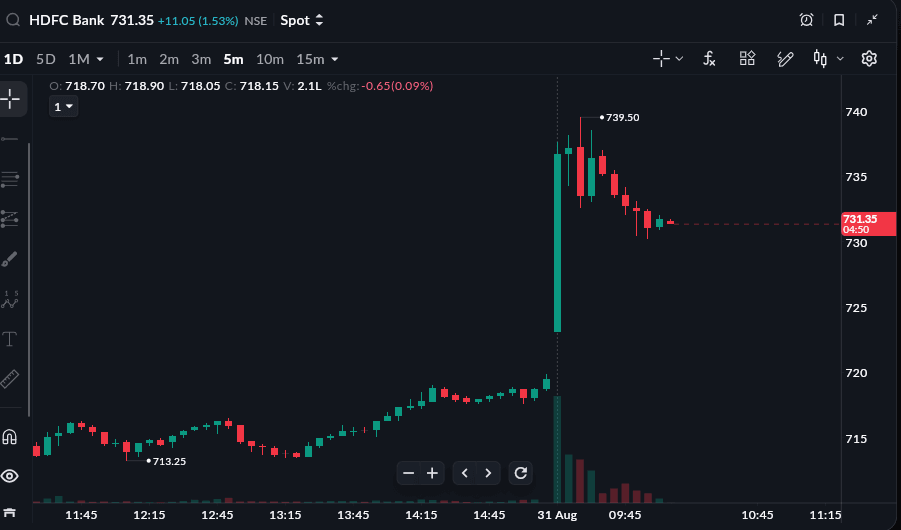
As og 31 Aug, 10.05 AM
Why is HDFC Bank’s CEO transition important?
The leadership change comes at a crucial point for HDFC Bank, with the choice of successor becoming central to the investment case. The incoming management will inherit a lender still navigating some of the after-effects of its merger with erstwhile HDFC Ltd.
Jagdishan was handpicked by founding CEO Aditya Puri to succeed him and took over as chief executive in 2020. His tenure was defined by the merger between HDFC Bank and Housing Development Finance Corporation, which was completed in 2023.
The transaction brought together HDFC Bank’s banking operations and HDFC’s housing-finance business, substantially altering the lender’s balance sheet and operating structure. The integration also created challenges around asset-liability management, funding costs and margins.
The bank’s board has accelerated the process of identifying a successor and is committed to appointing the new MD and CEO well before Jagdishan’s retirement.
READ THIS ALSO: Augmont Enterprises Shares List at 22% Premium on NSE
Who could succeed Sashidhar Jagdishan?
The board is considering both internal and external candidates, with chairman Rajiv Kumar playing a key role in the selection process alongside the nomination and remuneration committee.
Kaizad Bharucha, deputy managing director, is viewed as an internal front-runner. He has been associated with HDFC Bank since 1995. However, regulatory limits on the tenure of executive bank directors could leave him with about three years on the board.
External candidates reportedly being considered include SBI’s Ashwini Tewari, Tata Capital’s Rajiv Sabharwal, ICICI Bank’s Rakesh Jha, ICICI Life’s Anup Bagchi and Aditya Birla Capital’s Vishaka Mulye. Former SBI chairman Dinesh Khara has also emerged as a potential contender.
The possibility of an interim MD and CEO while external profiles are examined has also not been ruled out.
What are street expectations on HDFC Bank?
Street expectations remain broadly constructive on the possibility of a management reset, although near-term uncertainty around succession could weigh on the stock. A timely appointment of a credible successor could reduce the leadership overhang, while the incoming CEO could provide an opportunity to reset the bank’s narrative.
Market expectations also point to the importance of reviving net interest income growth. Deposit mobilisation and fee income remain areas to monitor during the transition, while uncertainty could affect investor confidence and valuations.
How has HDFC Bank stock performed?
HDFC Bank shares closed 1.3% higher at ₹ 720.30 on August 28. Despite the latest rebound, the stock has fallen 27.3% so far in 2026, substantially underperforming Nifty 50, which has declined 7.5% over the same period. The bank’s market capitalisation stands at more than ₹ 11.1 lakh crore.
Conclusion: What does this mean for your portfolio?
HDFC Bank’s immediate share-price reaction indicates that investors are focusing on the potential impact of the leadership change. The key monitorables now are the choice and timing of the successor, whether the board opts for an internal or external candidate, and how the new leadership addresses the challenges emerging from the post-merger transition.
All topics
Click the link, confirm the box next to sahi.com is checked — ignore any other results.