
5 Reasons Why Electronics Manufacturing Stocks Are Rising in India
Cyient DLM, Dixon, PG Electroplast and Kaynes rallied after India's ₹1.9 lakh crore Semicon 2.0 and mobile manufacturing push

EMS stocks like Cyient DLM, Dixon Technologies, PG Electroplast and Kaynes Technology rallied up to 7.8% on July 16, 2026 after the Union Cabinet approved a combined ₹1.9 lakh crore manufacturing push: the ₹1.27 lakh crore Semicon 2.0 programme and the ₹62,500 crore Mobile Phone Manufacturing Scheme, which aims to double mobile phone exports to nearly ₹15 lakh crore. Extended customs duty concessions on components until March 2029 add a further tailwind.
From Dixon Technologies and Kaynes Technology to Cyient DLM and PG Electroplast, electronics manufacturing services (EMS) stocks have suddenly found themselves back in the spotlight.
On July 16, shares of several electronics manufacturers rallied sharply. Cyient DLM surged as much as 7.8% to ₹580.95 per share, while Dixon Technologies and PG Electroplast gained up to 6% and 5% respectively. Kaynes Technology and Syrma SGS Technology also rose nearly 3%.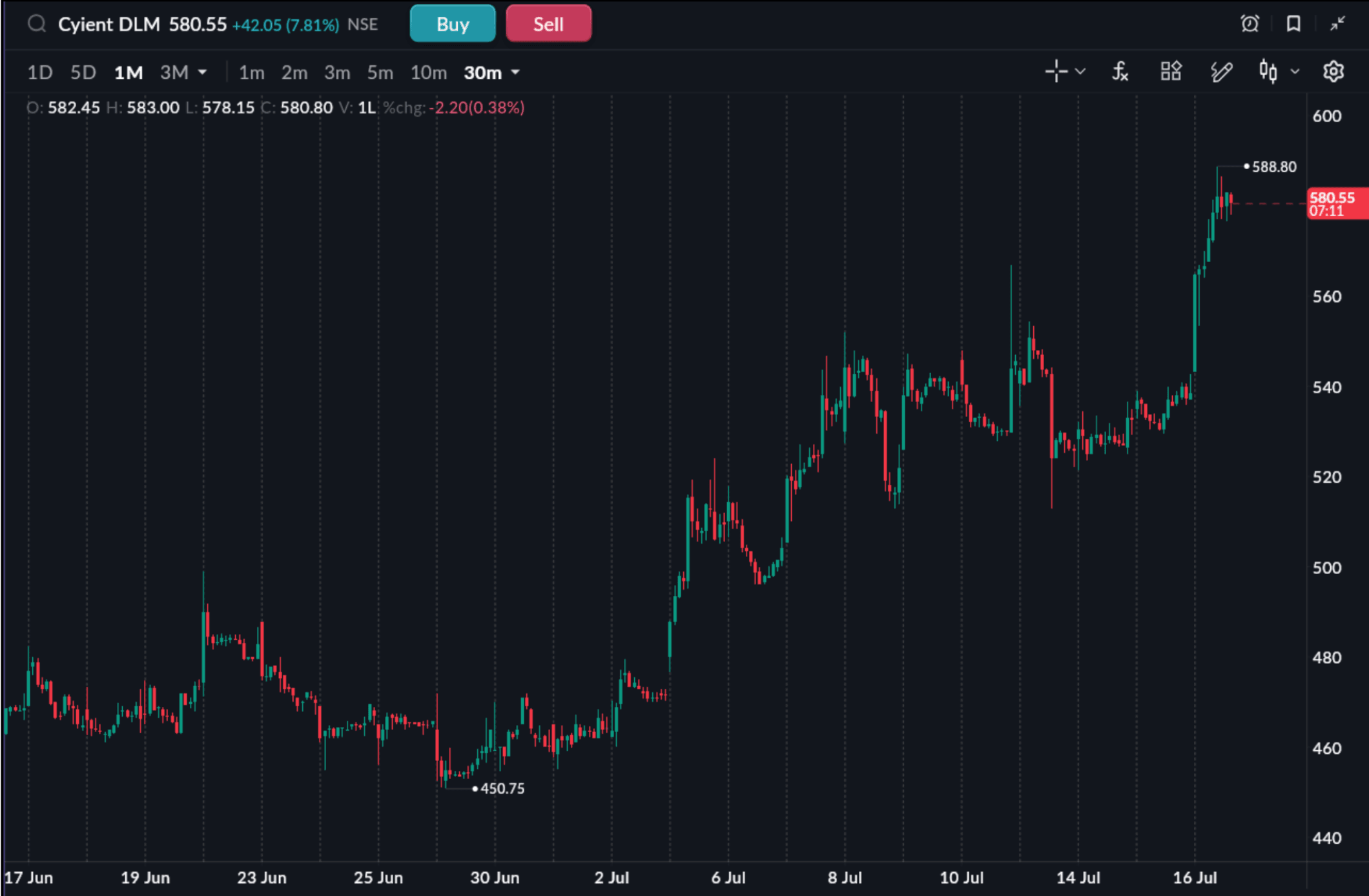
(As of 1:37 PM on July 16, 2026)
So what changed overnight?
The answer lies in a series of policy decisions that could reshape India's electronics manufacturing ecosystem over the next few years.
Here are five reasons why EMS stocks are rising.
1. India just announced a ₹1.9 lakh crore manufacturing push
The biggest trigger came from the Union Cabinet's approval on July 15 of two major manufacturing initiatives with a combined outlay of nearly ₹1.9 lakh crore.
The first is Semicon 2.0, a ₹1.27 lakh crore program aimed at strengthening India's semiconductor ecosystem.
The second is the Mobile Phone Manufacturing Scheme (MPMS) worth ₹62,500 crore, designed to expand domestic manufacturing, increase exports, and improve local value addition in smartphones.
For electronics manufacturers, this matters because more semiconductor production and more smartphone manufacturing eventually translate into more orders flowing across the supply chain.
And EMS companies sit right in the middle of that supply chain.
2. India is moving beyond assembly and into the entire semiconductor value chain
The first phase of India's semiconductor push was largely about attracting investments.
Semicon 2.0 appears to be broader.
The program focuses on six areas:
- Chip design
- Semiconductor equipment
- Materials
- Fabrication facilities
- Advanced packaging and testing
- Research, development and talent creation
That is an important shift.
Because the real money in electronics manufacturing often lies not just in assembling products but in controlling more parts of the value chain, as global chipmakers like Samsung and SK Hynix have shown.
The government's own estimates suggest the scheme could attract investments worth nearly ₹4 lakh crore, facilitate semiconductor production of around ₹2 lakh crore and support chip exports worth approximately ₹1 lakh crore over its duration.
What is the combined outlay of Semicon 2.0 and the Mobile Phone Manufacturing Scheme approved by the Union Cabinet in July 2026?
3. The government wants India to manufacture more of the components, not just the final products
For years, India has assembled electronics while importing a significant share of components.
That may gradually change.
The government recently extended customs duty concessions on machinery and components used in electronics manufacturing until March 31, 2029.
The objective is straightforward: reduce the cost of manufacturing components domestically and encourage companies to move further upstream.
The decision covers a surprisingly wide range of equipment and inputs across the electronics ecosystem.
This includes machinery used for lithium-ion battery production, equipment for advanced electronics assembly, and components used in wireless charging modules and display assemblies.
4. Mobile phone exports are expected to double
The newly approved Mobile Phone Manufacturing Scheme could become another major growth driver.
According to government estimates, mobile phone exports are expected to increase from around ₹7.5 lakh crore under the previous scheme to nearly ₹15 lakh crore under the new one.
That is not a marginal increase.
That is an attempt to double exports.
And if smartphone production scales up, the demand for printed circuit boards, modules, chargers, enclosures, displays, and several other electronic components could rise alongside it.
For EMS companies, higher production volumes often create operating leverage and improve manufacturing efficiency.
That possibility is one of the reasons investors are closely tracking these policy developments.
5. The next growth story may be components and backward integration
For a long time, electronics manufacturing growth in India was largely driven by assembling finished products.
The next phase could look different.
The government has expanded duty concessions to support the manufacturing of:
- Lithium-ion cells
- Display assembly components
- Wireless charging inductor coil modules
- Automotive and industrial electronics components
For example, the revised framework now covers 85 categories of machinery used across various stages of lithium-ion battery production.
Similarly, duty benefits have been extended to six components used in wireless charging inductor coil modules and five important components used in display assemblies for industrial, medical, and automotive applications.
The focus is clearly shifting toward backward integration and component manufacturing.
And that is often where manufacturing ecosystems become stronger and more competitive over time.
The bigger picture
The recent rally in EMS stocks is not simply about one government announcement or one day's market move.
Investors appear to be responding to a broader trend.
Over the past few years, the conversation around electronics manufacturing in India has gradually shifted from assembling products to building an entire ecosystem around them, from chips and components to batteries, displays and advanced manufacturing equipment.
Most listed EMS players are small-cap and mid-cap stocks, which tend to react sharply to policy news like this.
Whether these ambitions translate into long-term growth remains to be seen.
But one thing is becoming increasingly difficult to ignore:
India's electronics story is no longer just about making devices. It is increasingly about making the technologies that power them.
Sources: PIB Cabinet approvals (July 15, 2026), Business Standard, government customs notifications. Data as of July 16, 2026.
Disclaimer: This article is intended purely for educational and informational purposes and should not be interpreted as investment or trading advice. Trading and investing involve market risks, and outcomes are never guaranteed.
Frequently Asked Questions (FAQs)
All topics
Click the link, confirm the box next to sahi.com is checked — ignore any other results.