
Top 5 Auto Ancillary Stocks in India
India's auto component industry crossed ₹6.73 lakh crore in FY25. Here are five leading auto ancillary stocks benefiting from EV growth, localisation and global supply chain shifts.

Top 5 Auto Ancillary Stocks in India: India's auto component industry is growing rapidly, driven by EV adoption, localisation and rising vehicle demand. Leading players such as Samvardhana Motherson, Bosch India, Bharat Forge, Schaeffler India and Uno Minda are well-positioned to benefit from industry growth and global supply chain shifts.
When you think of investing in India’s auto boom, names like Tata Motors or Maruti probably come to mind. But behind every vehicle sits a set of winners. They are the companies that make the sensors, wiring harnesses, forgings, and tyres that go into every car. This is the auto ancillary sector of India. It has been compounding wealth faster than several car makers themselves.
According to ACMA, the Indian auto component industry's FY25 revenue stood at ₹6.73 lakh crore ($80.2 billion), and the industry grew at a CAGR of 14% between FY20 and FY25. The government is leaning in as well, nearly doubling the auto PLI allocation to ₹5,940 crore in the Union Budget 2026–27.
So, which auto ancillary companies are best placed to ride this growth? Let's look at the top 5 auto ancillary stocks in India.
Overview of Top 5 Auto Ancillary Stocks in India
Here is an overview of the best auto component stocks in India, along with their key strengths and growth drivers.
1. Samvardhana Motherson International
Samvardhana Motherson is one of the world’s largest auto component makers. It supplies wiring harnesses, mirrors, and full plastic modules to nearly every major carmaker globally. The company has grown through a long series of acquisitions and now operates plants across 47+ countries.
Its order book gives strong revenue visibility. The company has booked over $ 96 billion of business globally, with a large share linked to EV platforms. The company has planned a ₹5,911 crore capex for FY26 to expand capacity for EV and premium vehicle programmes, while its FY27 capex guidance stands at ₹6,000 crore.
In the five-year timeframe, Motherson's stock has remained in an uptrend despite two major corrections
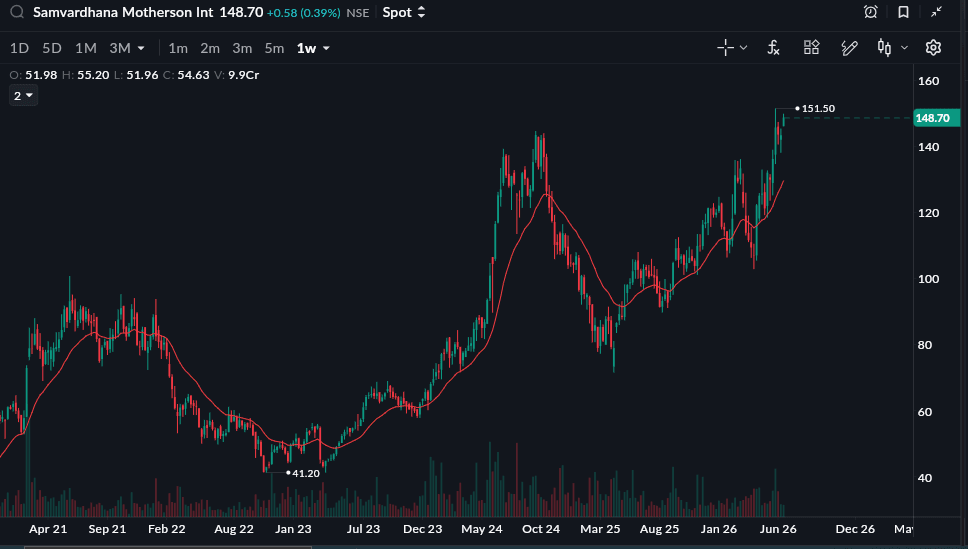
As of 16 June 2026
What investors should track: Integration of acquisitions, improvement in return ratios, growth in non-automotive businesses, and growing capex.
Here is the List of Best Auto Ancillary Stocks in India
The table below ranks the five biggest auto ancillary companies on Indian stock exchanges by their market capitalization.
|
Company |
Market Cap ₹Cr |
ROE % |
ROCE % |
5 yr CAGR Return % |
Dividend yield % |
|---|---|---|---|---|---|
|
Samvardhana Motherson |
1,51,351 |
11 |
13 |
10 |
0.42 |
|
Bosch India |
1,15,212 |
16 |
21 |
20 |
1.31 |
|
Bharat Forge |
₹92,993 |
12 |
13 |
21 |
0.44 |
|
Schaeffler India |
63,488 |
20.8 |
27.9 |
26 |
0.87 |
|
Uno Minda |
61,079 |
19 |
19 |
27 |
0.25 |
Source: Screener, data as of 12 June 2026
2. Bosch India
Bosch has been part of India's auto industry since 1951. The Indian arm of Robert Bosch GmbH supplies fuel injection systems, braking components, spark plugs, and a fast-growing range of EV parts. Its customers span two-wheeler, passenger car, and truck OEMs.
FY26 revenue breakup was led by Automotive Products at 88%, followed by Consumer Goods at 11% and Others at 1%. The company allocated ₹410 crore towards capex in FY26 to support future growth plans.
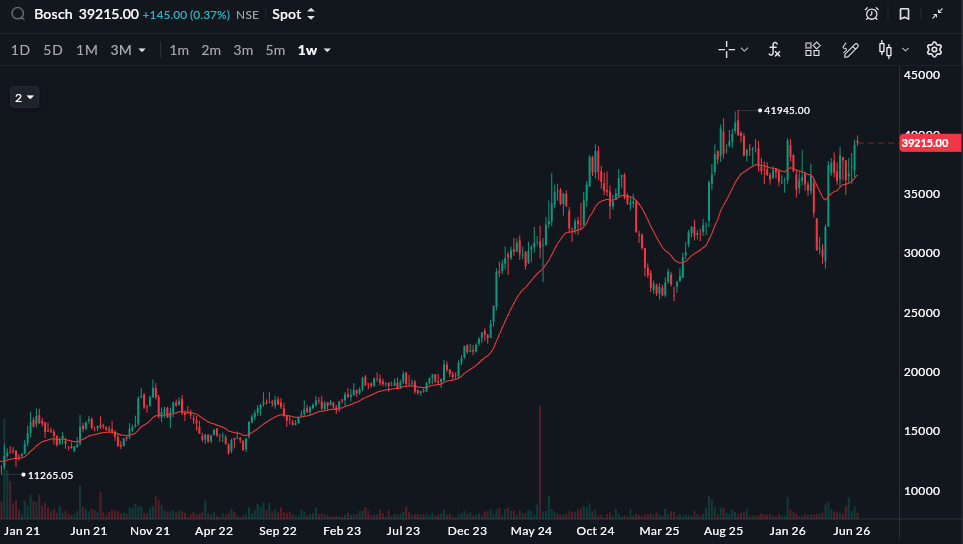
As of 16 June 2026
What investors should track: EV component revenue share, progress of the new commercial vehicle JV, and transition away from combustion-engine components.
3. Bharat Forge
Bharat Forge, the Kalyani Group flagship founded in Pune in 1961, is among the world's largest makers of forged and machined components. Its core auto business supplies crankshafts, axle beams, and chassis parts to truck and car makers in India, US, and Europe.
The company is investing in new programmes beyond traditional forging. It is co-developing the Vikram advanced armored platform with DRDO and Tata Advanced Systems. Defense and export orders drove growth this year, and non-auto segments now contribute a good percentage, a useful cushion when vehicle cycles slow.
During FY26, Bharat Forge secured new orders worth ₹4,814 crore, including ₹2,816 crore from the defence segment. Its defence order book stood at ₹10,961 crore at the end of FY26
Despite a sharp correction in FY 24-25, Bharat Forge's share resumed its uptrend and crossed its previous high by 2026.
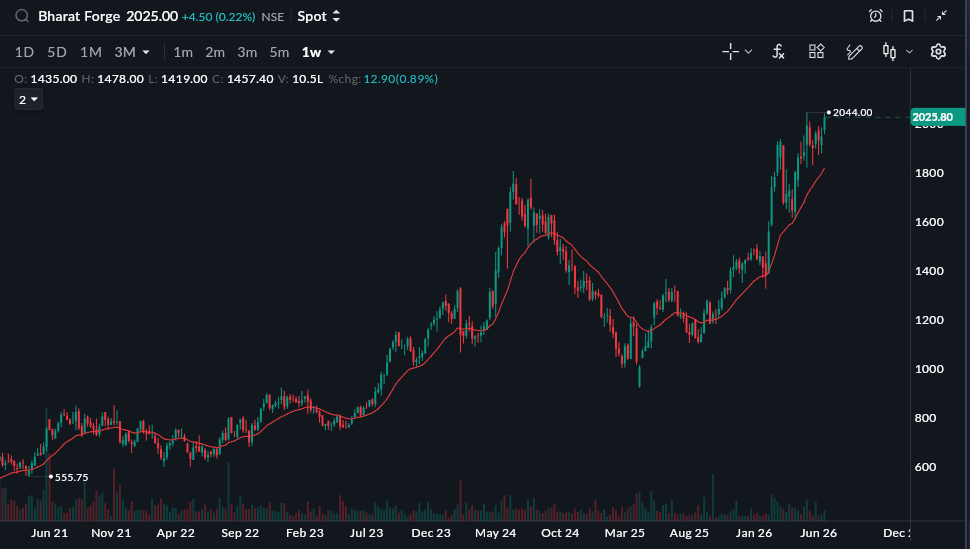
As of 16 June 2026
What investors should track: Growth in the order book beyond automotive and defence, increasing export revenue, and a return to profitability in the forging business.
4. Schaeffler India
When you think about bearings and critical auto components used in vehicles, there's a good chance Schaeffler India is involved. Incorporated in 1963, the company is the Indian arm of Germany's Schaeffler AG and sells products under the FAG, INA, and LuK brands. It is a key supplier to several leading automobile manufacturers in the country and also serves industries such as railways and industrial automation.
Its business is well diversified, with Bearings & Industrial Solutions contributing 39% of revenue and Automotive Technologies 35%. With 4 manufacturing plants, 3 R&D centres, 330 distributors, and over 33,000 retail touchpoints, the company has a strong nationwide presence and is expanding its focus on electric and hybrid vehicle components.
Schaeffler India's share price has remained in a steady uptrend over the past 5 years, delivering multifold returns to investors.
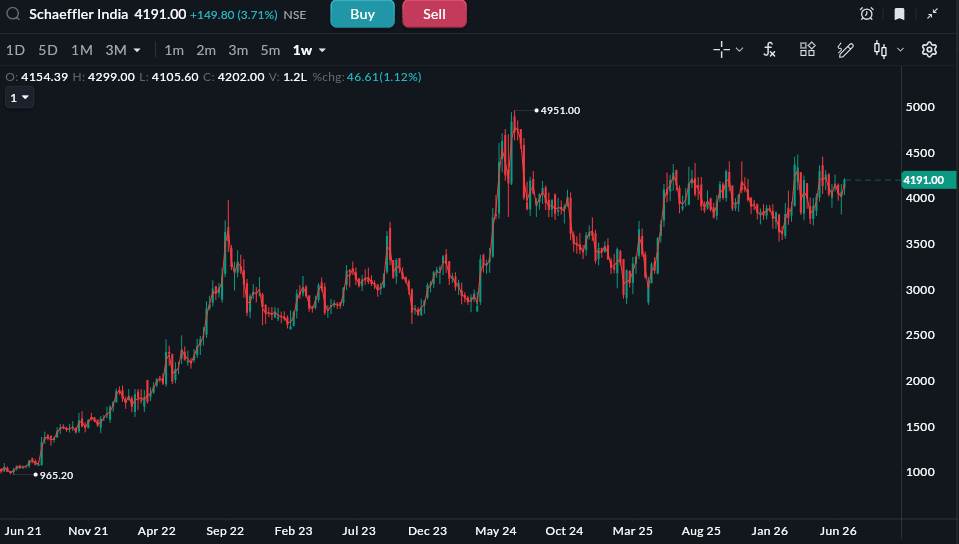
As of 16 June 2026
What investors should track: Revenue growth in the industrial segment (railways, wind energy, aerospace); EV component localisation progress; and whether premium valuation is sustained by earnings growth.
Learn how India's auto component industry is positioned for long-term growth
5. Uno Minda
Uno Minda started in 1958 as a small switch maker. Today, it is one of India's most diversified Tier-1 suppliers, making switches, lighting, horns, seating, and alloy wheels. Its customers include Hero MotoCorp, Honda, Bajaj, Maruti Suzuki, and Hyundai.
The company is expanding aggressively into EV components and premium products. It is adding new plants and winning fresh OEM model platforms. Exports to US and Europe are also scaling up.
In Q4 FY26, the company's revenue was led by Switches (25%), Lighting (22%), and Castings (18%), while Green Mobility and Seatings contributed 7% each. India accounted for 90% of revenue, with OEMs contributing 94% of sales.
The business remains heavily focused on the automotive sector, with 4-wheelers contributing 47% of revenue and 2-wheelers 42%. The company also secured a major 2-wheeler lamps order with an estimated peak annual value of ₹450 crore, with production expected to begin in H2 FY28.
Uno Minda shares also delivered multifold returns to investors between 2021 and 2025.
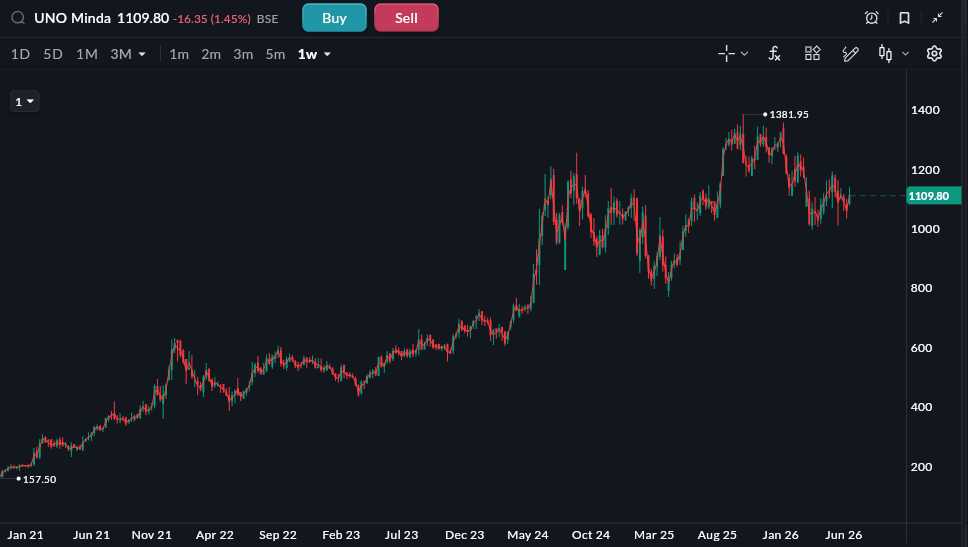
As of 16 June 2026
What investors should track: EV component revenue, new OEM model wins, and margin trends in premium product categories.
See which real estate companies could benefit from India's property market growth.
India's Outlook for the Auto Ancillary Industry
Before investing in the best auto ancillary stocks in India or any other multibagger stocks, always have a broader understanding of the industry.
-
Indian auto component industry is projected to reach $200 billion by 2030. The industry grew at a CAGR of 14% over the last five years and crossed $80.2 billion in FY25.
-
The opportunity isn't limited to new vehicles either. As of Feb 2026, India’s total vehicle numbers across segments is around 333 million but by 2030, that number is expected to rise to 430–435 million
-
The Union Budget 2022–27 doubled the PLI scheme for auto parts to ₹5,940 crore. This encourages companies to develop features that are exclusive to electric vehicles.
-
Global automakers are shifting their supply chains from China to India. By FY28, the Indian auto industry plans to invest ₹58,000 crore to boost localisation of advanced components such as electric motors and automatic transmissions, while benefiting from the China Plus One strategy.
Final Words
India's best auto ancillary stocks is at the center of a number of long-term trends, including rising vehicle demand, the rise of electric vehicles (EVs), changes in the global supply chain, and India's push to make more things. The sector has a mix of volume growth, technology tailwinds, and some export-led plays that are good for long-term investors. Before investing, check the company's finances, customer types, and EV readiness.
All topics
Click the link, confirm the box next to sahi.com is checked — ignore any other results.