
Nifty IT Has Crashed Almost 24% From Its Peak. Should You Buy or Stay Away?
AI disruption fears and ₹52,704 crore in FII outflows have pushed the Nifty IT index down 28% from its 52-week high, its worst Jan-Mar fall since 2008. Here's what's really happening and what to do.

India's IT sector has had a brutal start to 2026. The Nifty IT index, which hit a 52-week high of 40,301 in mid-2025, has fallen to approximately 29,071 as of mid-March 2026. A decline of around 28%. That makes this the worst January-to-March fall for Nifty IT since 2008, when the global financial crisis crushed technology spending worldwide.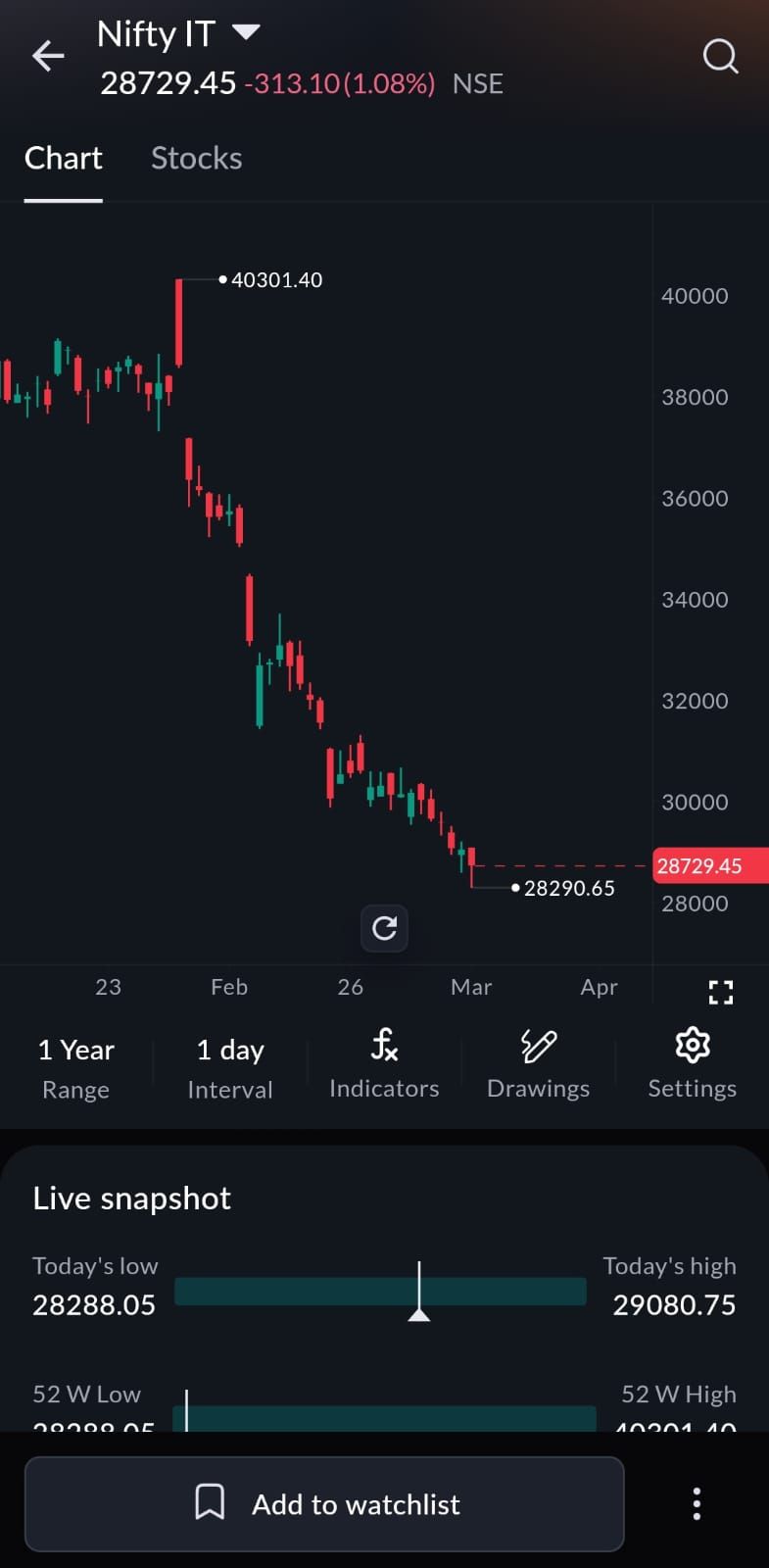
In total, more than ₹5.7 lakh crore in market capitalisation has been wiped from listed IT stocks in this correction in Feb, as per Mint. If you hold IT stocks or are considering buying the dip, this article breaks down what is actually happening, what the data says, and what you should do next.
Why Is Nifty IT Falling So Much in 2026?
Three forces have combined to create this sell-off:
1. AI Disruption Fear
The most significant driver is the growing fear that AI tools, particularly code-generation models and agentic AI systems, will structurally reduce the headcount demand for Indian IT companies. The traditional Indian IT model is built on billing large numbers of engineers for software development and maintenance work. If AI can replace even 20-30% of that work, the entire business model comes under pressure.
This is not a new concern, but it became more acute in early 2026 as several US tech companies publicly discussed cutting IT outsourcing budgets while increasing AI tool licenses. The market reacted by repricing Indian IT stocks lower.
2. Record FII Outflows
Foreign institutional investors (FIIs) have been selling Indian equities aggressively. In March 2026 alone, FII outflows from Indian markets reached ₹52,704 crore. One of the largest monthly outflows on record. IT stocks, which have historically attracted significant FII ownership due to their dollar-earning nature and large free float, bore a disproportionate share of this selling.
3. US Economic Slowdown Concerns
The US remains the largest revenue market for Indian IT companies, accounting for 50-60% of revenue for most large-cap IT firms. Rising fears of a US economic slowdown, driven by persistent inflation, high interest rates, and weakening consumer confidence, have led to concerns about IT budget cuts by US corporations. When US companies spend less on technology, Indian IT companies feel it directly in their revenue growth rates.
The 2008 Comparison: What's Different This Time
The last time Nifty IT fell this much in a single quarter was in early 2008, during the build-up to the global financial crisis. That year, fear about a complete collapse of global credit markets drove IT stocks down as companies cut tech spending across the board.
In 2026, the culprits are different but equally powerful:
- In 2008: Fear of a global recession cutting tech budgets
- In 2026: Fear of AI making Indian IT headcount-based models obsolete + record FII selling + US slowdown worries
The critical question is whether these fears are temporary (like 2008, which saw IT stocks recover strongly by 2009-2010) or structural (a permanent change to the business model).
Stock-by-Stock Performance: Who Has Held Up Best?
Not all IT stocks have fallen equally. Here is how the major names have performed from their recent peaks (in Dec 2025):
- TCS — Down approximately 25-27% from peak .
- Infosys — Down approximately 26-28%. PE also at multi-year lows.
- HCL Technologies — Among the large caps, HCL Tech has held up comparatively better, down roughly 20-23%. Its product-led revenue mix (through HCLSoftware) and stronger engineering services exposure have provided some insulation.
- Wipro — Down approximately 28-30%, in line with the broader index.
Valuation: Are IT Stocks Cheap Now?
Here is where the data gets interesting for long-term investors. TCS is trading at approximately 18x PE — a significant discount to its historical average of 25-28x. Infosys is similarly compressed on a valuation basis.
For context:
- During the 2020 COVID crash, TCS bottomed at around 16-17x before recovering sharply
- During the 2022 IT correction, TCS found support in the 20-22x range
- At 18x today, the stock is pricing in a meaningful and sustained earnings slowdown
If the AI disruption thesis proves overstated, or if Indian IT companies successfully transition to AI-led delivery models, current valuations could look very attractive in hindsight. On the other hand, if AI genuinely restructures the demand for outsourced engineering, the PE compression may be justified.
FII Selling: Will It Stop?
The ₹52,704 crore FII outflow in March 2026 is exceptional in its scale. Historically, such large outflow months are often followed by a stabilization or reversal, particularly if global risk sentiment improves or the Indian Rupee stabilises.
Several factors could trigger an FII reversal:
- A pause or cut in US interest rates (making emerging market assets more attractive)
- Stabilisation of the Indian Rupee against the dollar
- Strong Q4 FY26 corporate earnings from Indian IT companies
- A reduction in geopolitical risk (US-China trade tensions, global tariff uncertainty)
Should You Buy Nifty IT Stocks Now?
This depends entirely on your investment horizon and risk appetite.
For long-term investors (3+ year horizon): The current valuation of India's top IT companies — TCS, Infosys, and HCL Tech is at or near multi-year lows. The structural growth story for Indian IT (digital transformation, cloud migration, AI implementation services) remains intact. If you believe Indian IT companies will adapt to the AI era rather than be destroyed by it, current prices represent a reasonable entry point. Dollar-earning companies also benefit from a weak rupee.
For short-term traders: The downtrend is intact. There is no confirmed reversal signal. Technical support levels have been repeatedly broken. Until Q4 FY26 earnings provide a positive catalyst, the path of least resistance is sideways to down. Avoid catching a falling knife without a clearly defined stop-loss.
For SIP investors: A market correction of this magnitude is exactly when SIP investing makes the most sense. Continuing or increasing your SIP in IT-focused funds will average down your cost of acquisition and position you for the eventual recovery.
Key Risks to Monitor
- AI disruption accelerating faster than expected — If major US enterprises begin publicly announcing large reductions in IT outsourcing spend due to AI adoption, the sell-off could deepen significantly.
- Dollar-Rupee movement — A further depreciation of the Rupee is positive for IT revenues in Rupee terms but signals macro stress. Watch the Rupee closely.
- US recession materialising — If the US actually enters a recession in 2026, IT budget cuts would be real, not just feared.
Conclusion: The Nifty IT Crash in Perspective
A fall of around 22%, Year-to-date in the Nifty IT is a serious correction by any measure. The combination of AI disruption fears, record FII selling, and US macro concerns has created one of the worst starts to a calendar year for Indian IT stocks since the 2008 financial crisis.
But perspective matters. India's large IT companies are cash-rich, well-managed, and have navigated multiple technology transition cycles over four decades. The question is not whether they will survive the AI era, it is whether they will lead it or lag it.
For investors, the current environment demands patience, selectivity, and a clear investment horizon. At current valuations, the risk-reward for long-term investors in quality IT names is the most attractive it has been in several years. But timing a recovery in the short term remains difficult given the macro headwinds.
Watch Q4 FY26 earnings closely. They will set the tone for the next leg — up or down.
Disclaimer: This article is for informational purposes only and does not constitute investment advice. Investing in stocks involves market risk. Please consult your financial advisor before making any investment decisions.
Frequently Asked Questions (FAQs)
All topics
Click the link, confirm the box next to sahi.com is checked — ignore any other results.