

A key level trading strategy uses specific price zones — where the market has repeatedly reversed, stalled, or consolidated — as the basis for trade entries and exits. These zones, commonly called support and resistance levels, represent areas where a large number of buy or sell orders have historically clustered. Traders in Indian equity and derivatives markets use key levels to time entries on NSE and BSE instruments, though key level signals are probabilistic and not guaranteed by any regulatory framework under SEBI.
Key Level Trading Strategy: How to Identify and Trade Key Levels
Every price chart tells a story of supply and demand. At certain prices, buyers have consistently stepped in and pushed prices higher. At other prices, sellers have consistently appeared and pushed prices lower. These repeating battlegrounds are called key levels.
A key level trading strategy is built on one core idea: price tends to react predictably at levels where it has reacted before. Understanding how to identify these levels — and how to trade the two setups they create — is a foundational skill for technical traders.
What Is a Key Level?
A key level is a price zone where the market has shown a significant reaction on at least two previous occasions. There are two types:
- Support key level — A price zone where buying pressure has historically exceeded selling pressure. The market reversed upward from this zone in the past.
- Resistance key level — A price zone where selling pressure has historically exceeded buying pressure. The market reversed downward from this zone in the past.
The more times price has reacted at the same level, the stronger that level is considered. A level tested three or four times carries more weight than one tested only once.
Key levels are not single price points. They are zones — typically spanning 0.1% to 0.5% of the instrument's price. On Nifty 50 trading near 22,000, a key level zone might span 22,000 to 22,100.
How to Identify Key Levels on a Price Chart
Identifying key levels requires reading historical price action on a standard candlestick or bar chart. Follow this process:
- Step 1 — Use the right timeframe. For positional and swing trades, use the daily or weekly chart. For intraday trades, use the 15-minute or hourly chart. Higher timeframes produce stronger, more reliable key levels.
- Step 2 — Mark previous highs and lows. Look for price points where the market reversed sharply. Each reversal at the same approximate price zone is a data point for a key level.
- Step 3 — Identify consolidation zones. Areas where price moved sideways for multiple sessions before breaking out are strong key levels. The base of a breakout often becomes support on a retest.
- Step 4 — Check round numbers. Psychologically significant round numbers (e.g. Nifty 22,000, 22,500) tend to act as key levels because large institutional orders often cluster there.
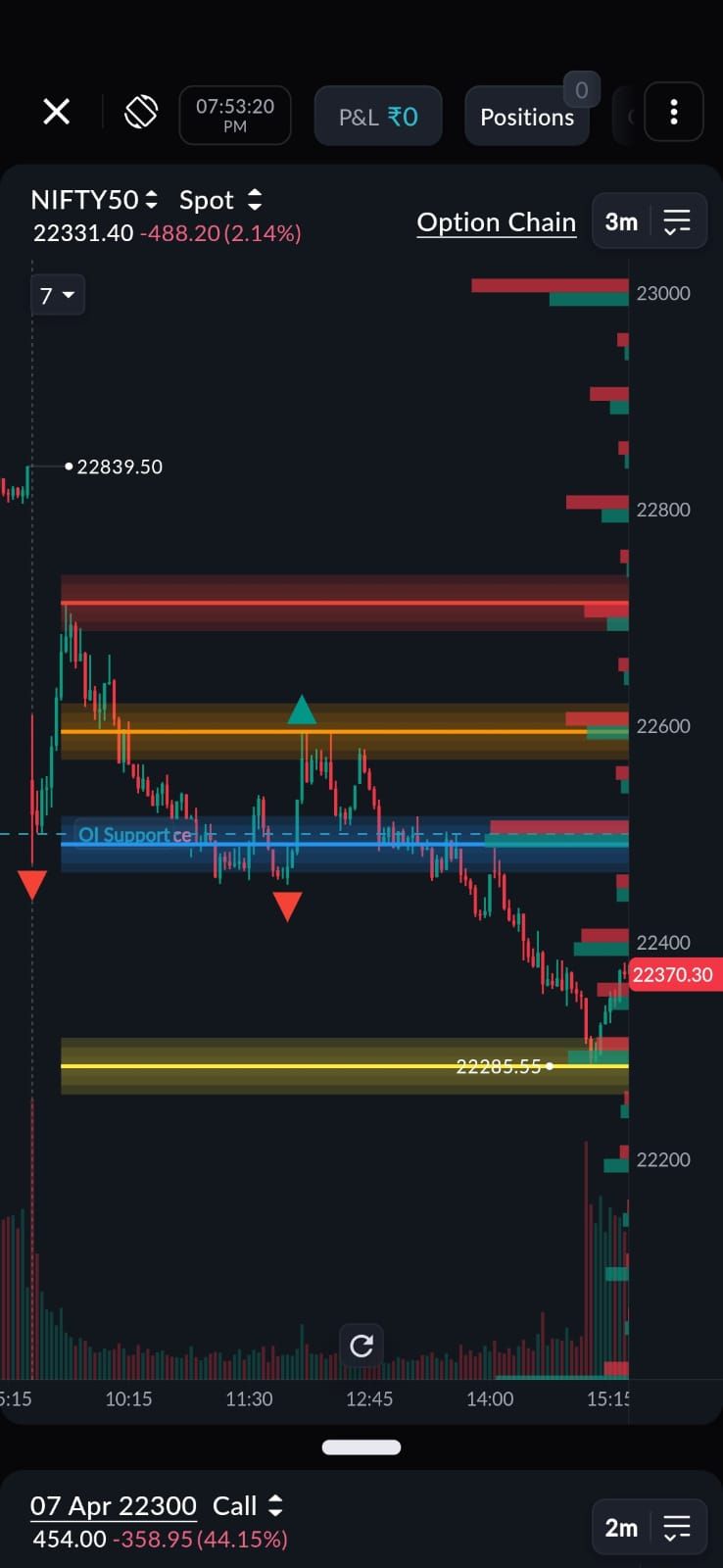
However, you can use SAHI for its exclusive key-level indicators that can simplify your trading setup.
Role Reversal: When a Broken Level Flips
When a key level breaks decisively, its role often flips. A broken support tends to become new resistance, and a broken resistance tends to become new support. If Nifty pushes above a level it struggled at for weeks, traders then watch that same level as a possible floor on the next pullback. This flip happens because the traders who defended the old level change their behaviour once it gives way. Watching for a retest of a flipped level is a common way traders frame the next reaction, though any level can fail.
Confluence: What Makes a Level Strong
Confluence means several independent signals point to the same price zone, and it is what separates a strong level from a weak one. A single line on a chart is easy to draw. A level becomes more reliable when, for example, a round number, a zone the market reversed at before, and a widely watched moving average all sit close together. The more reasons that stack at one price, the more traders are watching it, and the more likely it is to produce a reaction. A level with only one weak reason behind it deserves less trust than one with three.
The Two Key Level Trading Setups
Once key levels are identified, two trade setups emerge:
| Setup | Breakout | Bounce (Reversal) |
|---|---|---|
| Entry trigger | Price closes above resistance (or below support) with above-average volume | Price touches the key level and shows a reversal candle (hammer, engulfing, pin bar) |
| Trade direction | In the direction of the breakout | Away from the key level |
| Stop loss placement | Below the breakout level (for long trades) | Beyond the key level zone |
| Target | Next significant key level | Next significant key level in the reversal direction |
| Risk | False breakout — price reverses back through the level | Key level fails and price continues through it |
Breakout Trading at Key Levels
A breakout setup occurs when price moves decisively through a key resistance or support level. Traders who enter on breakouts are betting that the level has been overcome and the trend will continue in the breakout direction.
The key filter for a valid breakout on Indian exchanges is volume. According to NSE India market data, breakouts accompanied by volume that is at least 1.5 times the 20-day average volume are more likely to sustain than low-volume breakouts, which frequently reverse (false breakouts).
A common breakout entry technique is to wait for the candle to close above the key level before entering, rather than entering as soon as price touches the level. This reduces false breakout risk.
What a False Breakout Looks Like
Not every break is real. A false breakout is when price pushes past a level and then snaps back inside, trapping traders who entered on the move. It is common at heavily watched levels, because stops cluster just beyond them and get swept before price reverses. This is why many traders wait for a candle to close beyond the level, or for price to hold on a retest, before trusting a break. When a break fails, the level often becomes a bounce zone again rather than a fresh entry.
Bounce Trading at Key Levels
A bounce (or reversal) setup occurs when price approaches a key level but does not break through it. Traders who take bounce setups are betting that the level will hold and price will reverse.
The confirmation signal for a bounce is a reversal candlestick pattern at the level — a hammer, a bullish engulfing candle at support, or a bearish engulfing candle at resistance. Entering without a confirmation candle increases the risk of entering too early on a level that will eventually break.
Key Levels on Nifty 50 and Bank Nifty
For Indian derivatives traders, Nifty 50 and Bank Nifty options and futures are the most actively traded instruments on NSE. Key levels on these indices attract heavy option open interest, which can reinforce the levels' significance. The strike price with the highest open interest (the max pain level) often corresponds to an actively watched key level near expiry.
Nifty 50 key levels are widely discussed in Indian trading communities. However, because so many participants watch the same levels, they can become self-fulfilling — and institutional traders are aware of this. Retail traders should avoid assuming a widely-known key level is automatically reliable.
Stop Loss Placement Relative to Key Levels
Placing a stop loss too close to the key level — inside the zone rather than beyond it — leads to premature exits on normal price volatility. The standard practice is to set the stop loss beyond the far edge of the key level zone, not at the exact price of the level itself.
For example, if support is identified at 22,000–22,050 on Nifty, a trader buying a bounce would place a stop loss below 22,000, not at 22,050. This accounts for the width of the zone and reduces the chance of a stop being hit by noise rather than a genuine level failure.