
Carlsberg India IPO: What We Know About the $700 Million Listing
India's beer market is drawing global giants to its public markets - and Carlsberg's $700M IPO plan is the clearest signal yet.

Carlsberg India is planning a $700M (₹6,650 crore) IPO that could become one of India's biggest consumer-sector listings. The company is India's second-largest brewer with 22% market share and 14 breweries. The IPO hasn't been officially confirmed yet, but the move signals how global alcohol companies increasingly view India as a serious standalone growth market.
India's IPO market could soon witness one of the biggest consumer-sector listings from the alcohol industry.
According to recent reports, Carlsberg Group is preparing to file draft papers for the IPO of its India business. As per the Economic Times, the proposed Carlsberg India IPO could raise nearly $700 million (around ₹6,650 crore), making it one of the most closely watched upcoming IPOs in India's consumer market.
But the real story here is bigger than the IPO itself.
This is also a story about how India's beer market is evolving, why global alcohol companies are doubling down on the country, and how India is increasingly becoming a serious long-term consumption play for multinational brands.
Carlsberg India IPO: What We Know So Far
Reports suggest the proposed IPO could be launched later this year and may largely consist of a secondary share sale by the parent company.
At the moment, the company has not officially confirmed the IPO plans. Carlsberg representatives have only stated that the company is exploring options to enhance shareholder value and that no final decision has been made yet.
Still, the timing of these reports is important.
India has quietly become one of the most attractive growth markets for global beverage companies. Rising urbanisation, premium consumption trends, increasing disposable income, and changing drinking preferences have significantly expanded the beer market over the last decade.
And Carlsberg India already holds a strong position in that market.
According to company presentations cited in media reports, Carlsberg India is currently India's second-largest brewer with an estimated market share of around 22%.
The company entered India in 2007 and now operates 14 breweries across the country, including eight company-owned breweries and six contract manufacturing facilities.
That scale matters because India's beer industry is becoming far more economically significant than many people realise.
India's Beer Industry Is Becoming a Massive Economic Story
According to a study conducted by Oxford Economics and cited by the Brewers Association of India, the Indian beer industry contributed ₹92,324 crore to India's GDP in 2023. That accounted for nearly 0.3% of the country's total GDP.
That number becomes even more important when you understand how large the beer ecosystem actually is.
The industry impacts agriculture, glass manufacturing, packaging, transportation, hospitality, tourism, restaurants, retail distribution, and state tax revenues. Beer companies rely on farmers for barley and grains, glass makers for bottles, packaging firms for cans and cartons, and logistics networks to move products across states. That is why beer consumption does not just benefit breweries; it supports an entire supply chain economy.
The market itself is also highly concentrated. Reports state that three major companies - United Breweries, AB InBev, and Carlsberg - collectively account for more than 85% of beer sold in India while operating over 55 breweries across the country.
Interestingly, even with India's long-term consumption potential, listed beer companies have not been completely insulated from market pressures. United Breweries, the company behind Kingfisher beer, which is Carlsberg India's closest listed peer, currently has a market value of around $3.6 billion, but its shares have declined roughly 36% over the past year, compared to an 8% decline in the Nifty 50 Index during the same period.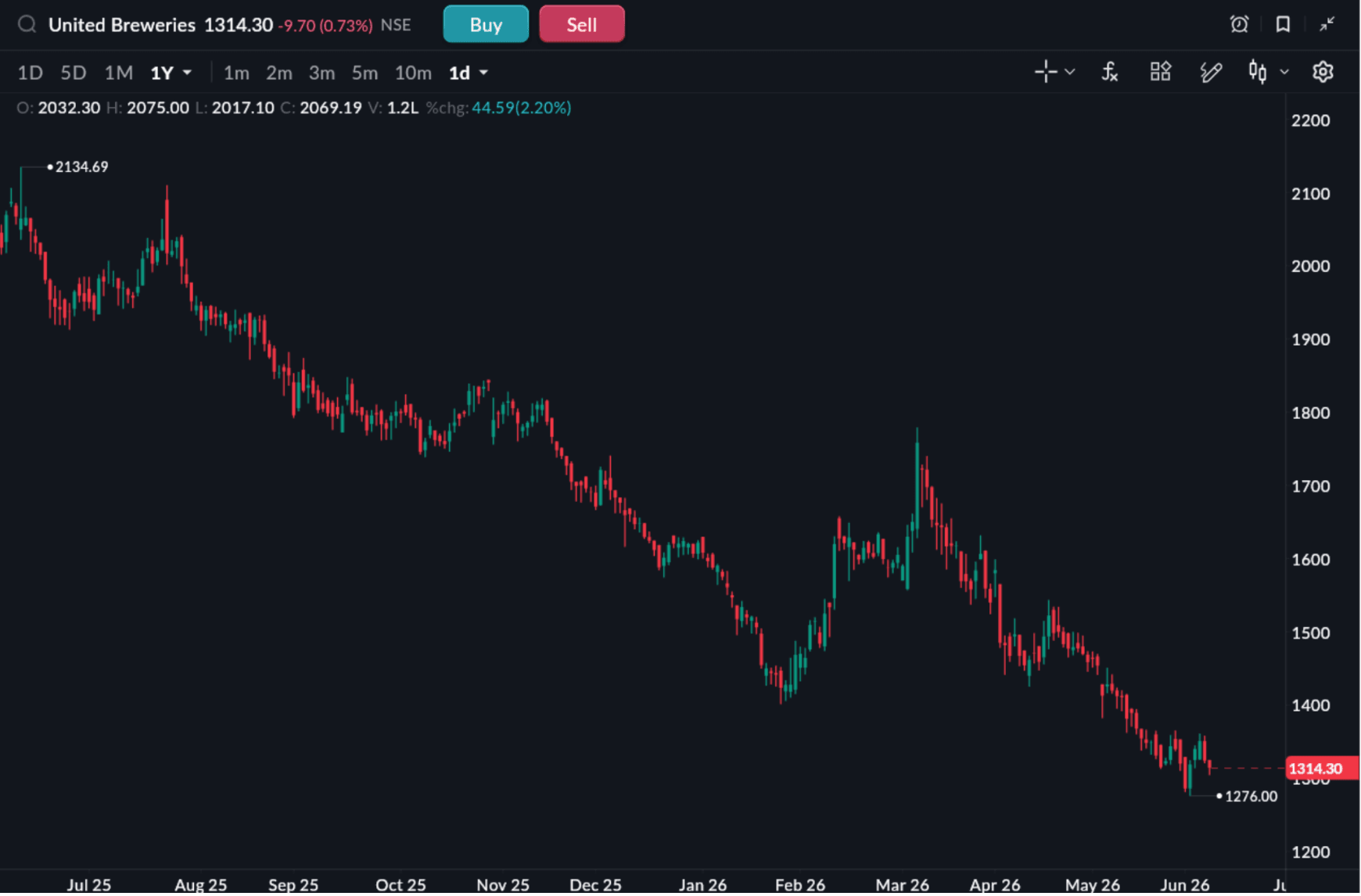
(As of 3:30 PM on June 08, 2026)
That explains why global brewers continue to invest aggressively while also remaining cautious about profitability, regulations, and market execution in India.
And Carlsberg is not alone in exploring India's public markets. Reports also suggest that Pernod Ricard, the maker of Absolut vodka and Chivas Regal Scotch whisky, has been evaluating a potential IPO for its India business as well.
Taken together, these developments indicate something larger: multinational alcohol companies increasingly see India as a standalone growth engine rather than just another emerging market.
Why the Carlsberg IPO Is Different From the Bira Story
Interestingly, the excitement around the Carlsberg India IPO also reminds many industry observers of another beer brand that once represented the future of India's premium beer market - B9 Beverages.
A few years ago, Bira became one of India's fastest-growing consumer startups, building strong recall among urban consumers as a premium, youthful alternative. At one stage, conversations around expansion and a potential IPO made it seem like Bira could completely disrupt the industry.
But the business ran into severe financial difficulties. Revenue fell to ₹638 crore in FY24 from ₹824 crore the year before, while losses widened to ₹749 crore. Sales volumes collapsed from 9 million cases to 6-7 million, with accumulated losses hitting ₹1,904 crore and liabilities exceeding assets by ₹619 crore.
The unravelling has since accelerated. In late 2025, B9 lost control of its pub chain, The Beer Cafe, after Kirin Holdings and its lender, Anicut Capital, seized pledged shares. Production halted, over 250 employees petitioned for a leadership change, and nearly ₹50 crore in salaries remained unpaid. Most recently, founder Ankur Jain is set to step down, with investors preparing a ₹400 crore rescue infusion at a sharp valuation cut.
That contrast is important because it highlights something investors often overlook about the alcohol business in India: demand alone does not guarantee profitability.
And that is exactly why the Carlsberg India IPO is attracting attention. Unlike newer consumer startups, Carlsberg already operates at a significant scale with an established manufacturing and distribution network across the country.
India Is Becoming Too Important to Ignore
The possible Carlsberg India IPO is not just about raising $700 million. It reflects how global companies increasingly see India as a serious long-term growth market rather than just a future opportunity.
Large multinational brands usually consider local listings only when a market becomes strategically important enough to operate independently at scale. And that shift is becoming increasingly visible across India's consumer economy.
Whether the IPO happens this year or not, one thing is becoming clear: global companies are betting much bigger on India's consumption story now.