
BSE Shares Hit 52-Week High: SEBI Approves IT Index Derivatives Plan
SEBI has approved BSE to launch derivatives on its Focused IT Index, a 14-stock sector product that expands BSE's F&O suite. Here's what it means and the record financials backing it.

India's capital markets are evolving rapidly, and one of the latest developments comes from the Bombay Stock Exchange. On April 9, 2026, SEBI approved BSE's proposal to launch derivative contracts on the BSE Focused IT Index, marking another expansion of India's F&O product suite and adding a sector-specific tool to an ecosystem that has been growing at pace.
The timing is significant. BSE just delivered its strongest quarter ever, the IT sector is under pressure from macro headwinds and the ongoing Iran war's global spillover, and BSE itself is actively expanding its derivatives basket to close the gap with NSE. The IT derivatives approval is part of a clear strategic pattern, and it tells investors something about where exchange competition in India is heading.
A New Derivatives Product Focused on IT
SEBI has approved BSE's proposal to launch derivative contracts based on the BSE Focused IT Index, a sector index that tracks the performance of 14 companies from the information technology sector. Unlike broader benchmarks, a focused index offers more targeted exposure, allowing traders and institutional investors to take or hedge positions specifically on India's IT sector without using individual stock derivatives.
BSE has confirmed the approval, but details such as contract specifications and launch timelines are yet to be announced; they will be communicated through official exchange circulars. What is clear is that this is part of a deliberate push by BSE to broaden its derivatives portfolio. In February 2026, SEBI had already approved BSE to launch derivatives on the BSE Focused Midcap Index and the Sensex Next 30, taking its derivatives basket from two indices (Sensex and Bankex) to four. The IT index approval takes it to five, moving closer to NSE's six-index derivatives suite.
If you're newer to how derivatives on indices work, our guide to key stock market terms and concepts explains F&O fundamentals in plain language.
Why This Development Matters
Derivatives tied to sectoral indices allow market participants to hedge sector-specific risk, take targeted directional views on an industry, and build strategies around earnings seasons or macro events, without taking on the broader index risk.
The IT sector has always been a heavyweight in India's equity markets, contributing a significant portion of Nifty and Sensex weight. A dedicated derivatives product on a focused IT index opens up several possibilities: fund managers can hedge their IT exposure more precisely, traders can express views on sector rotation, and the exchange deepens its revenue base from transaction fees on new contracts.
This also reflects the broader regulatory direction. SEBI has been encouraging product diversification at exchanges while simultaneously tightening rules around speculative weekly expiry contracts. By pushing BSE to broaden its derivatives suite beyond Sensex and Bankex, SEBI is supporting a more structured, sector-oriented derivatives market, one that serves institutional hedging needs rather than just short-term trading flows.
Market Reaction: BSE Shares Hit a 52-Week High
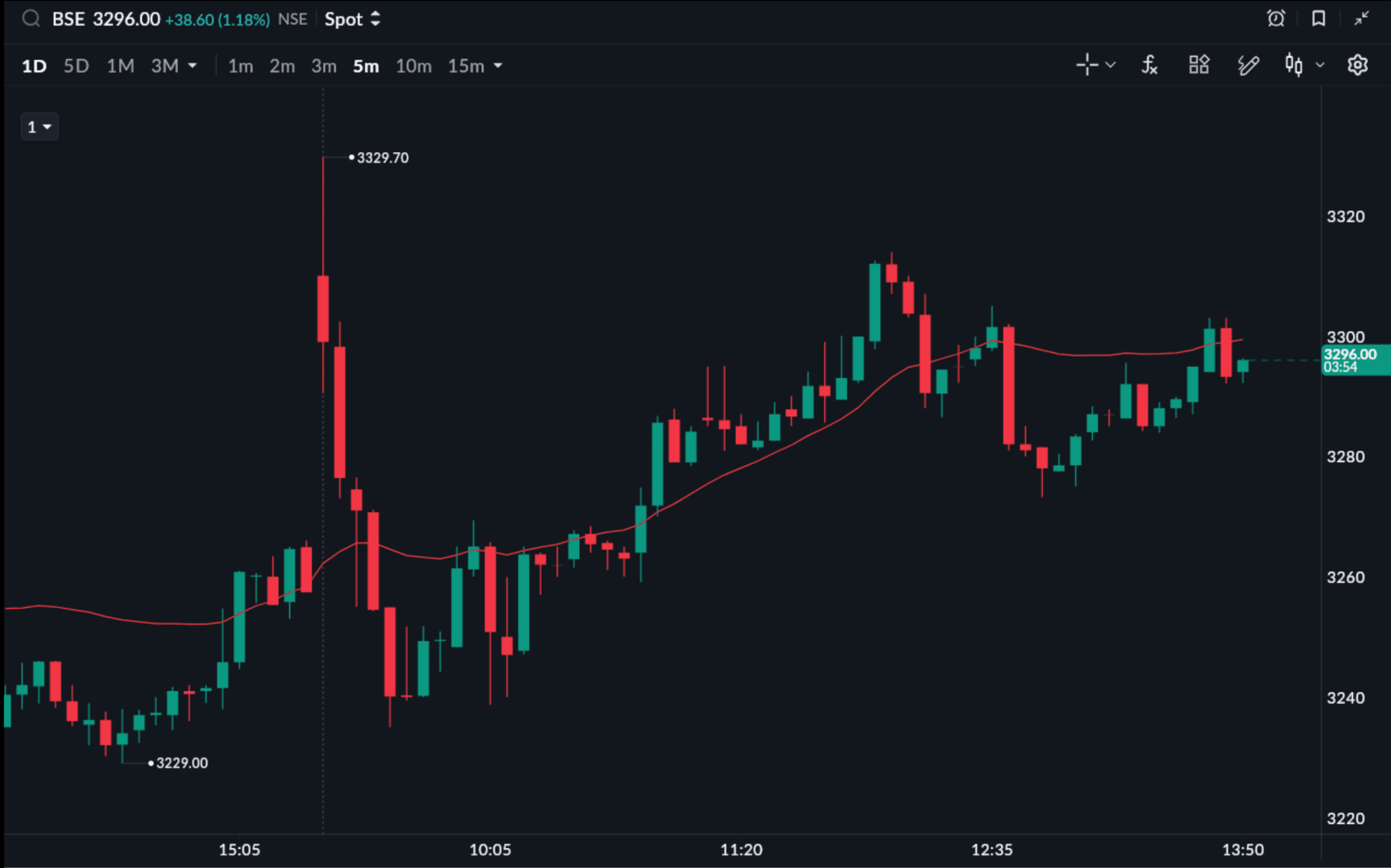
Following the SEBI approval announcement, BSE Ltd's stock hit a 52-week high of ₹3,330 in early trade on April 10, 2026, its highest level in a year. The stock was trading around ₹3,296 by 1:51 p.m., reflecting positive market reception to the news.
BSE's 1-year stock returns stand at approximately 75–77% as of the date of this article, a performance that reflects the broader re-rating of the exchange as a business, driven by its derivatives volume growth, SME platform momentum, and rising market participation. The market capitalisation of BSE Ltd stood at approximately ₹1.33 lakh crore as of April 9, 2026.
There is an interesting contrast worth noting: while BSE shares moved up on the IT derivatives news, the BSE Focused IT Index itself declined 2.54% in the same session, reflecting the broader weakness in IT stocks that persisted through the day. Structural developments and short-term sentiment don't always move in the same direction — this session illustrated that cleanly.
Strong Financial Performance Backing the Momentum
The derivatives expansion is not happening in isolation. BSE reported its strongest quarterly results in history for Q3 FY26 (October–December 2025), and the numbers provide important context for why the exchange is in an expansionary mode.
- Total consolidated revenue reached an all-time high of ₹1,334 crore, up 61% year-on-year
- Revenue from operations rose 62% to ₹1,244 crore
- Net profit surged 174% year-on-year to ₹602 crore
- Operating EBITDA (including Core SGF) tripled to ₹732 crore
- Operating margins expanded sharply to 59% from 31% in Q3 FY25
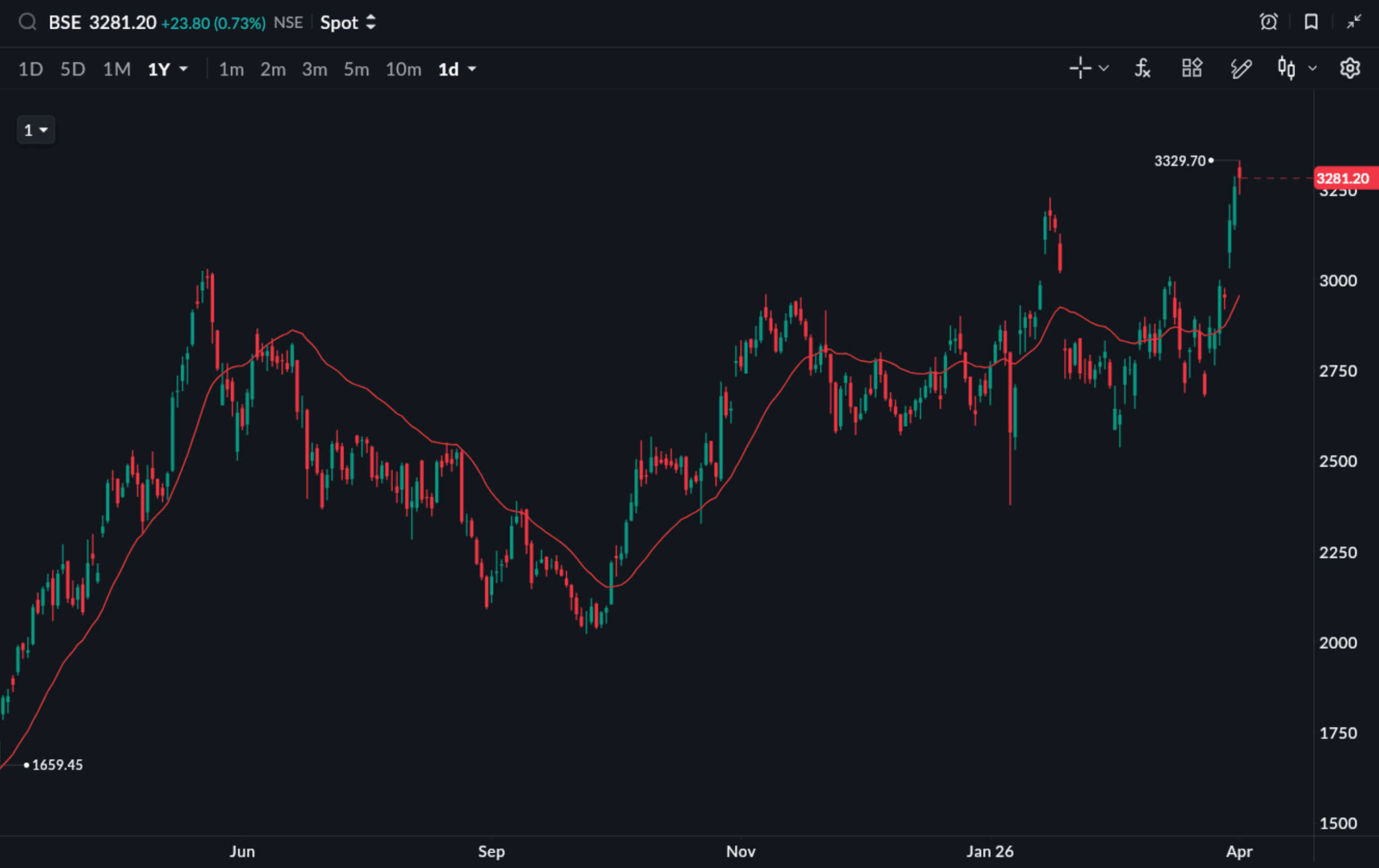
(1-Year returns as of 10 April, 2026)
This marked BSE's 11th consecutive quarter of record revenue, a streak that reflects the compounding effect of rising market participation, growing derivatives volumes, and a buoyant IPO ecosystem.
Growth Across Key Business Segments
1. Listings and Fundraising
During Q3 FY26 alone, 99 new equity listings were recorded across mainboard and SME platforms, raising ₹97,657 crore. On a full-year basis, BSE's platforms facilitated ₹22.4 lakh crore in fundraising during FY26, spanning equity, debt, bonds, commercial papers, and mutual funds. Understanding the difference between mainboard and SME IPOs helps put the scale of BSE's listing activity in context.
2. SME Platform
The SME segment crossed a significant milestone during the quarter. BSE's 700th SME listing was recorded on February 1, 2026, with the last 100 listings achieved in just 179 days — the fastest pace ever. Collectively, SMEs listed on BSE have raised ₹14,735 crore in capital and now command a combined market capitalisation of ₹1.8 lakh crore.
3. Derivatives and Mutual Funds
BSE set a new record by trading 772 crore equity derivatives contracts in Q3, generating ₹784 crore in revenue. Index derivatives saw a record average daily premium turnover of ₹19,459 crore, more than double the year-ago level, driven by continued growth in Sensex index options. BSE StAR MF processed 21.7 crore transactions during the quarter (up 21% year-on-year), maintaining a market share of 87.4% in mutual fund transaction processing.
The Competitive Context: BSE vs NSE
It is worth understanding what BSE is trying to achieve with this derivatives expansion beyond just the IT index. Historically, India's derivatives market has been overwhelmingly dominated by NSE, which offers products on Nifty, Nifty Bank, Nifty Financial Services, Nifty Midcap Select, Nifty Next 50, and Nifty IT. BSE has traditionally been limited to Sensex and Bankex derivatives.
The series of SEBI approvals in 2026, Focused Midcap, Sensex Next 30, and now Focused IT, represents a deliberate effort to broaden BSE's derivatives basket and attract more institutional and algorithmic participation. BSE's options premium market share improved to 26.8% in Q3 FY26 from 24.4% in Q2, a sign that the strategy is beginning to work. The broader context of exchange competition in India, including the anticipated NSE IPO, makes BSE's derivatives push an important strategic move in a two-horse race for market share.
What This Means for India's Capital Markets
The approval for launching derivatives on the BSE Focused IT Index is part of a broader transformation underway in India's financial markets. Exchanges are increasingly introducing sector-specific products, participation from retail and institutional investors continues to rise, and the overall depth of the derivatives market is expanding.
For traders and investors, sector derivatives offer tools that didn't exist before. Whether you're an institutional fund manager looking to hedge IT exposure ahead of a macro event, or an active trader looking to express a view on Indian IT earnings, a dedicated index derivative gives you a more precise instrument than either individual stock options or broad index products.
The contrast on April 10, IT stocks falling while BSE stock rose — is itself instructive. Markets can simultaneously price in short-term sector weakness and long-term structural progress in market infrastructure. Both can be true at once.
Disclaimer: This article is for informational and educational purposes only and does not constitute investment advice or a recommendation to buy or sell any securities. Financial data for BSE Q3 FY26 is sourced from BSE's official press release. Stock price data reflects intraday levels on April 10, 2026. Please consult a SEBI-registered financial advisor before making any investment decisions. SAHI is not responsible for any investment decisions made based on this content.
Frequently Asked Questions (FAQs)
All topics
Click the link, confirm the box next to sahi.com is checked — ignore any other results.