
Adani Power Hits All-Time High: Nuclear Energy Move, Summer Demand & ICRA Rating Explained
Adani Power touched an all-time high of ₹200 driven by its nuclear energy subsidiary, India's SHANTI Act 2025, summer demand, and ICRA's AA rating reaffirmation. Here's what it all means.

Adani Power shares hit an all-time high following the passage of India's Shanti Act 2026, which provides a clear policy framework for private sector nuclear energy development. Adani Power is widely expected to be one of the major private beneficiaries given its existing power infrastructure and the group's track record in large-scale energy projects. The move signals a structural shift in India's energy policy and could significantly expand Adani Power's addressable market over the next decade.
Adani Power shares touched a fresh all-time high of ~₹207 on Monday, April 20, 2026, gaining approximately 3% intraday as investors responded to a combination of near-term and long-term triggers converging at the same time. This rally did not happen randomly. It is the result of multiple factors arriving together — a nuclear energy move, strong summer demand expectations, and a positive credit rating development — that has made Adani Power one of the most closely watched power stocks right now.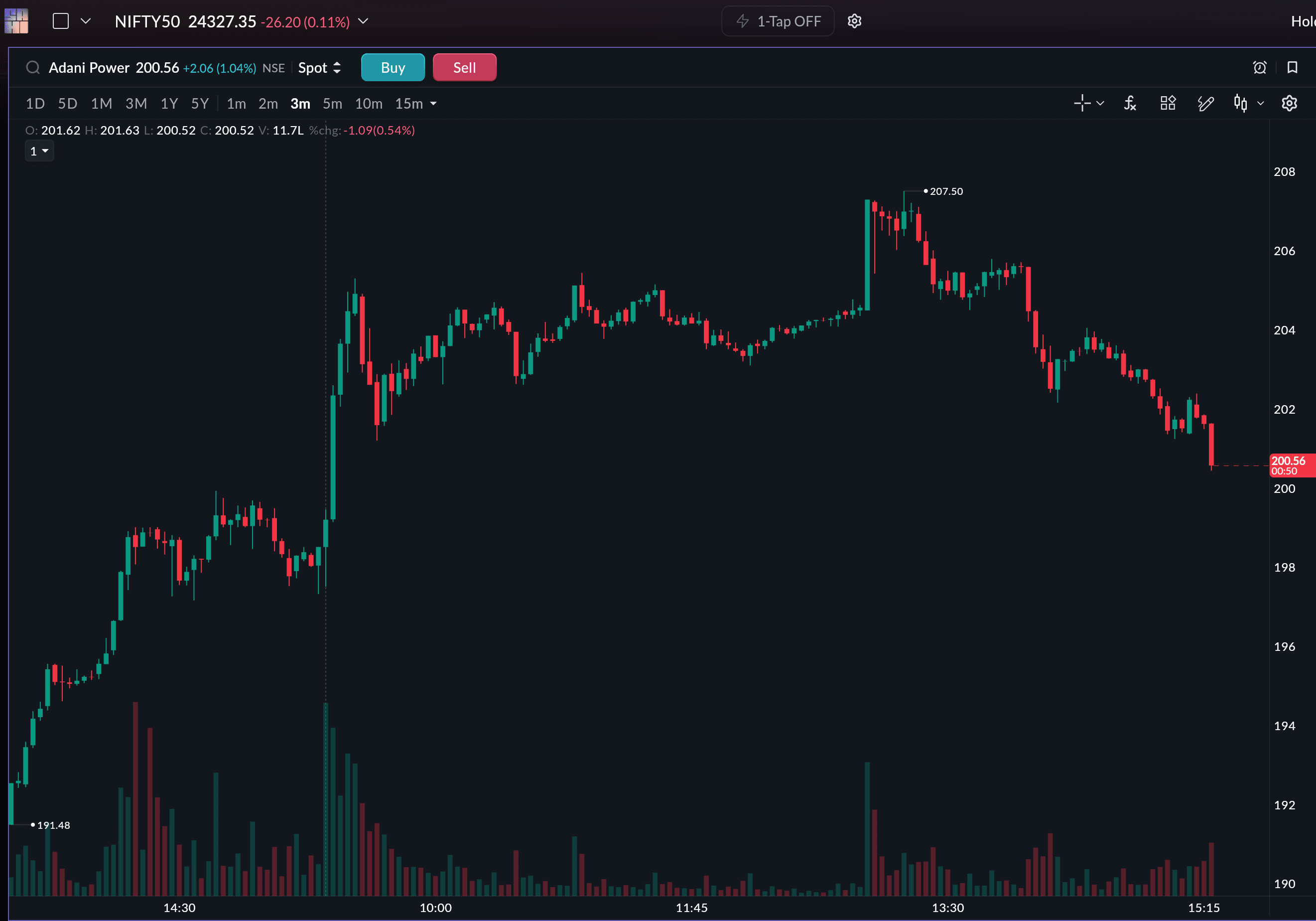 (Stock price is as of 3:15, 20th April)
What Is Driving the Rally?
1. The Nuclear Energy Move
The most significant near-term catalyst was Adani Power's latest step into the nuclear energy space.
Adani Power's wholly-owned subsidiary, Adani Atomic Energy Limited (AAEL), incorporated a new step-down subsidiary called Coastal-Maha Atomic Energy Limited (CMAEL) on April 13, 2026. The company received its certificate of incorporation on April 18, 2026. CMAEL's primary purpose is the generation, transmission, and distribution of power derived from nuclear and atomic energy sources.
| Detail | Value |
|---|---|
| Entity name | Coastal-Maha Atomic Energy Limited (CMAEL) |
| Date of incorporation | April 13, 2026 |
| Certificate of incorporation received | April 18, 2026 |
| Parent entity | Adani Atomic Energy Limited (AAEL) |
| Ultimate parent | Adani Power Limited (100% ownership) |
| Authorised capital | ₹5,00,000 (50,000 shares of ₹10 each) |
| Business purpose | Generation, transmission and distribution of nuclear/atomic energy |
Source: Adani Power exchange filing, NSE/BSE, April 18, 2026
CMAEL follows the earlier incorporation of AAEL in February 2026, Adani Power is building a dedicated nuclear energy vertical within its group structure. The company has reportedly set an ambition to develop 30 GW of nuclear capacity over the long term, effectively positioning nuclear as the eventual replacement for its thermal capacity.
This does not mean revenue starts tomorrow. Nuclear energy projects take years to develop, require extensive government approvals, and involve massive capital investment. But markets often price in future possibilities well before numbers appear, and that is precisely what is happening here.
2. The SHANTI Act: Why This Is Now Possible
The context for Adani's nuclear move is critical. For over six decades, India's nuclear sector was a complete state monopoly — private companies were legally barred from building or operating nuclear power plants.
That changed on December 20, 2025, when the Sustainable Harnessing and Advancement of Nuclear Energy for Transforming India (SHANTI) Act, 2025 received presidential assent. Passed by both houses of Parliament during the Winter Session, the SHANTI Act is the most consequential restructuring of India's nuclear sector since independence.
| SHANTI Act — Key Details | Value |
|---|---|
| Passed by Lok Sabha | December 17, 2025 |
| Passed by Rajya Sabha | December 18, 2025 |
| Presidential assent | December 20, 2025 |
| Replaces | Atomic Energy Act 1962 and Civil Liability for Nuclear Damage Act 2010 |
| Key change | Private companies can now build, own, operate and decommission nuclear power plants |
| State-reserved activities | Uranium enrichment, heavy water production, spent fuel management |
| India's nuclear capacity target | 100 GW by 2047 (from ~8.8 GW currently) |
| Estimated total investment required | ~$214 billion |
Source: World Nuclear News; Holtec International; PRS India; Parliament of India
The SHANTI Act also introduces a graded liability framework (replacing the flat ₹1,500 crore cap), grants statutory status to the Atomic Energy Regulatory Board (AERB), and creates licensing pathways covering the full nuclear value chain. For private players like Adani, it opens the door to a market that was previously inaccessible — and the scale of the opportunity (100 GW by 2047 vs ~8.8 GW today) is significant.
3. Summer Demand: A Near-Term Earnings Trigger
Beyond the nuclear story, there is a more immediate reason the stock is gaining momentum — India's summer heat.
Every year, rising temperatures across India translate directly into higher electricity demand. Air conditioners, cooling systems, and industrial equipment run harder, pushing peak load requirements up sharply. For thermal power producers, this seasonal demand spike is one of the strongest earnings catalysts of the year.
The Iran-US conflict has added an additional layer to this story. Gas-based power generation in India collapsed from approximately 12 GW to just 2 GW as LNG imports were disrupted. That supply gap is being filled primarily by coal-fired thermal power — directly benefiting Adani Power's core business. The company earns most of its revenue through long-term Power Purchase Agreements (PPAs), but the constrained supply environment has also tightened merchant power prices, further supporting realisation. Here's a closer look at how the Hormuz crisis is affecting Indian energy markets.
4. ICRA Rating Reaffirmation
The third trigger was a fresh credit rating action. ICRA assigned and reaffirmed ratings on Adani Power's bank facilities and proposed non-convertible debentures aggregating ₹69,000 crore:
| Rating Category | Rating | Outlook |
|---|---|---|
| Long-term bank facilities / NCDs | ICRA AA | Stable |
| Short-term facilities | ICRA A1+ | Highest short-term category |
| Total facilities rated | ₹69,000 crore | — |
Source: ICRA rating action; Adani Power exchange filing
An AA/Stable rating signals that ICRA has confidence in Adani Power's ability to service its financial obligations. The A1+ short-term rating is the highest short-term credit category available. For a company expanding aggressively — thermal, solar, and now nuclear — maintaining strong credit ratings is essential for accessing capital at reasonable costs.
Adani Power: The Company Behind the Story
Adani Power is India's largest private thermal power producer. Its current scale gives it the infrastructure to benefit from near-term demand spikes in a way that smaller peers cannot replicate.
| Operating Metric | Value |
|---|---|
| Total installed capacity | 18,150 MW (18.15 GW) |
| Number of plants | Multiple states — Gujarat, Maharashtra, Karnataka, Rajasthan, Chhattisgarh, MP, Jharkhand, Tamil Nadu |
| Revenue secured under long-term PPAs | >95% of operating capacity |
| FY26 full-year revenue | ₹58,906 crore |
| FY26 full-year net profit | ₹12,750 crore |
| Q4 FY26 results date | April 29, 2026 (board meeting scheduled) |
| Nuclear capacity ambition | 30 GW (long-term target via AAEL/CMAEL) |
Source: Adani Power Q3 FY26 results; exchange filings, April 2026
Stock Performance
| Time Period | Adani Power Performance |
|---|---|
| April 20, 2026 (intraday) | ~+3%, touching all-time high of ₹207 |
| Past 6 months | ~+18% |
| Past 1 year | ~+77% |
| 52-week low | ₹101 |
| 52-week high (all-time high) | ₹207 (April 20, 2026) |
Source: NSE/BSE live data; April 20, 2026
What Happens Next?
The nuclear story is long-term — revenue from CMAEL will not materialise for years, and the capital requirements are enormous. Summer demand is near-term — it will normalise after the monsoon arrives. Ratings support confidence. But future stock performance will depend on profits, fuel costs, debt management, policy execution, and broader market sentiment.
The Q3 FY26 results reflected the challenges of a softer demand environment — net profit fell 15.4% YoY and 14.4% QoQ, driven by flat power demand, cooler temperatures, and lower merchant prices. The Q4 FY26 results, due on April 29, will be watched closely for signs that the summer demand uptick is translating into better realisations. India's broader energy transition story — and what institutional investors are positioning for — is unfolding across multiple sectors simultaneously.
What makes Adani Power uniquely interesting right now is the convergence of a present earnings catalyst (summer thermal demand + LNG supply gap) and a future structural narrative (nuclear energy under the SHANTI Act). The market appears to be pricing in both simultaneously — which is why the stock has reached its all-time high.
Disclaimer: This article is for informational purposes only and does not constitute financial advice. Stock prices cited are intraday levels as of April 20, 2026. Please consult a SEBI-registered advisor before making investment decisions.