DMart Q4 FY26 Results: Revenue Surges 19%, Crosses 500-Store Milestone — Analysts Divided
DMart posts ₹17,204 crore in Q4 FY26 revenue, crosses 500 stores, but slowing SSSG leaves Motilal bullish and JM Financial cautious.

Avenue Supermarts just delivered its strongest quarterly revenue beat in recent memory. ₹17,204.50 crore in standalone revenue for Q4 FY26, up 19% year-on-year, well ahead of the 15% growth analysts had expected. The company also crossed 500 stores for the first time in its history. On paper, it reads like a clean sweep.
Worth noting upfront: the numbers filed with the exchanges on April 3 are provisional, subject to audit by the company's statutory auditors. Final results will be released after the audit is complete. That caveat aside, the provisional print was strong enough to move markets and split the analyst community down the middle.
By mid-session on Monday, the stock had given back most of its morning gains. And the brokerage notes that followed told two very different stories about what this quarter actually means. The share price of D-Mart was also up by over 3% at 1:30 on the 6th of April.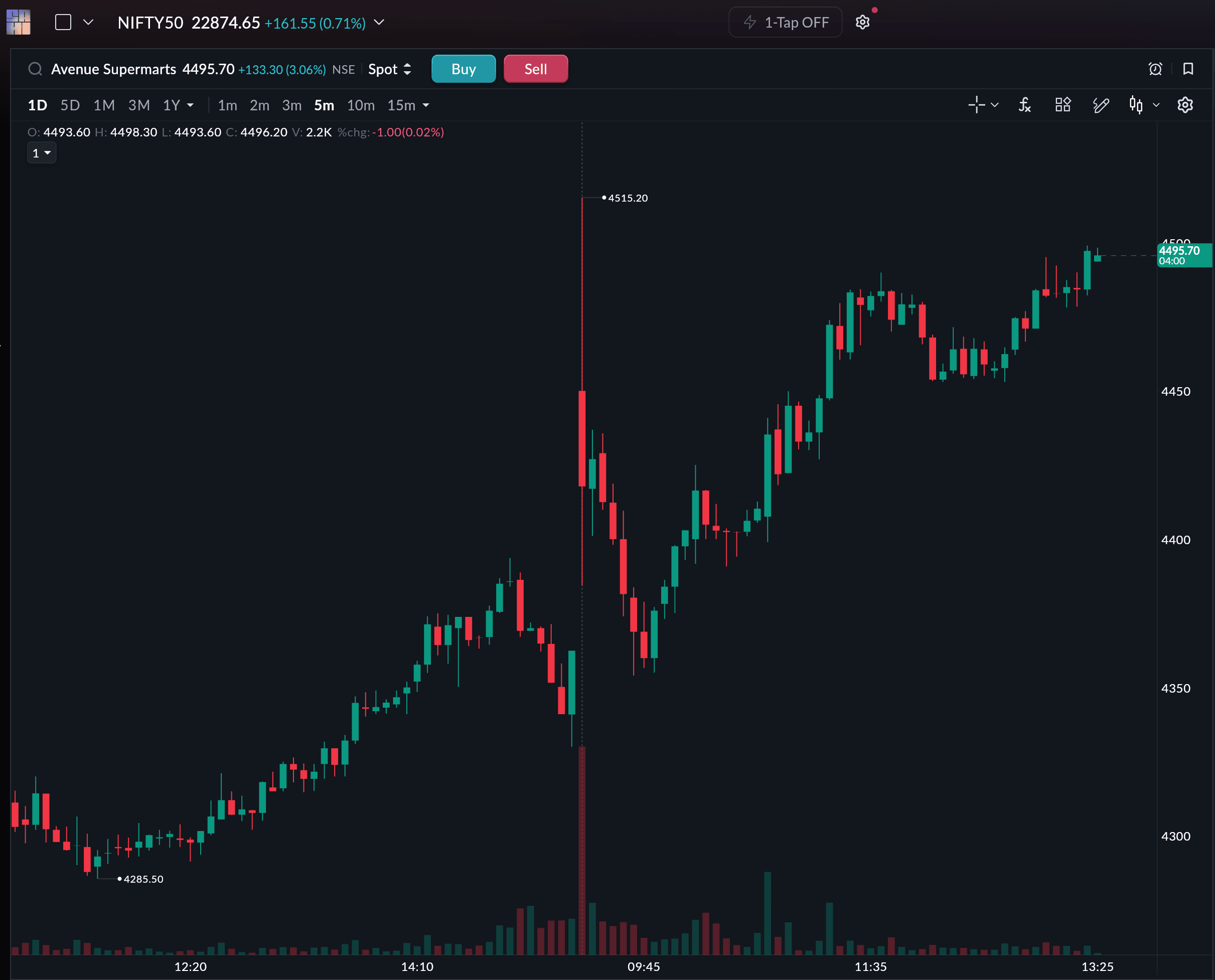
The Revenue Beat, In Context
DMart's Q4 print wasn't just strong in isolation. It was a sharp recovery from a disappointing Q3, where revenue growth had slipped to 13%. The jump to 19% in a single quarter surprised even the optimists.
| Quarter Ended | Revenue (₹ Crore) | YoY Growth |
|---|---|---|
| March 31, 2023 | ₹10,337.12 | — |
| March 31, 2024 | ₹12,393.46 | ~20% |
| March 31, 2025 | ₹14,462.39 | ~17% |
| March 31, 2026 | ₹17,204.50 | ~19% |
Revenue has grown over 66% in three years (from ₹10,337 crore in Q4 FY23 to ₹17,204 crore in Q4 FY26, a CAGR of ~18.5%). But the more telling number is same-store sales growth. For a company of DMart's scale, where the challenge is not just opening new stores but making existing ones work harder, that acceleration matters. It suggests the core retail engine is genuinely picking up pace, not just being flattered by new store additions.
JM Financial, which is a research agency, did flag something unusual, though. The swing from 13% revenue growth in Q3 to 19% in Q4 and SSSG jumping from 6–7% to 10% in a single quarter is the kind of volatility DMart has simply never produced before. The company has historically been the most predictable compounder in Indian listed retail. That consistency is part of what justifies its premium valuation. When that consistency breaks, even in a positive direction, it raises questions about what actually drove it and whether it holds.
500 Stores and a Record Quarter for Expansion
The store opening numbers are where this quarter becomes genuinely historic. DMart added 58 stores in Q4 alone, the highest single-quarter addition in the company's history. Full-year additions for FY26 totalled 85, also an annual record. New stores came up across Maharashtra, Tamil Nadu, Uttar Pradesh, Haryana, Gujarat, Odisha, and Chhattisgarh.
The detail that stands out most is this: 12 of those 58 stores were opened on March 31 alone, pushing the chain over the 500-store mark on the very last day of the fiscal year. That means a significant portion of Q4's new openings contributed almost nothing to Q4 revenue. They are essentially a deferred tailwind for Q1 FY27. DMart had flagged accelerating store openings at its last analyst call. The execution delivered. But the timing means the full financial benefit of this expansion wave is still ahead.
Note: One of the 500 stores (in Sanpada, Navi Mumbai) is currently undergoing reconstruction and is not fully operational.
The Cost of Growing This Fast
Here is where the quarter gets more complicated. DMart's model has always been defined by financial conservatism. Own the stores, keep debt low, and fund growth from internal cash flows. That discipline was central to the investment thesis for years.
Eighty-five stores in a single year is a different gear. And it comes with a price.
At those levels, DMart's operating cash flows and existing cash balance are no longer sufficient to fund the expansion independently. Free cash flow is expected to stay negative through FY28. The balance sheet, which has historically sat comfortably in net cash territory, is on course to become net debt over the same period.
This is not a distress signal. DMart is a fundamentally strong business. But it is a structural shift in how the company finances itself, and for investors who priced in financial conservatism as a feature of the stock, it is a shift that changes the calculus.
What the Market Will Be Watching
The numbers filed on April 3 are provisional. Full audited results, with complete margin and cash flow disclosures, are yet to come. That is when the picture will be complete.
When management speaks, the Street will be listening for specific answers. What drove the sharp SSSG acceleration in Q4? Is the 10% level sustainable, or was it partly seasonal? How does the company plan to manage the balance sheet through a period of elevated capex? And what is the roadmap for DMart Ready — the company's online and quick-delivery platform — in a market where Blinkit, Zepto, and Swiggy Instamart are aggressively competing for the same urban grocery wallet?
DMart at 500 stores is a larger, faster, and more capital-intensive business than it has ever been. The Q4 execution was strong by almost any measure. But at 99x trailing earnings, the stock prices reflect a great deal of future success. The quarter delivered. Whether the quarters ahead can sustain that, and at what cost to the balance sheet, is the question that will define the stock's next move.
Disclaimer: This article is for informational purposes only and does not constitute financial, investment, or trading advice. The information presented, including analyst ratings, target prices, and financial figures, is based on publicly available data and provisional results as of the date of publication. Please consult a SEBI-registered financial advisor before making any investment decisions.
Disclaimer: This news section may include AI-generated or AI-assisted news, summaries, drafts, or insights. All content is subject to human review before publication. While we aim for accuracy, readers should independently verify information before relying on it.
Open Free AccountRecent
Venus Pipes Approves Re-Appointment Of Directors For 5 Years At AGM
Clean Science Approves ₹4 Final Dividend and Confirms ₹2 Interim Payout at 23rd AGM
Focus Lighting Secures ₹5–10 Crore LED Fixtures Order From Ingka Centres
NTPC Green Energy Starts 6.3 MW Vanki Wind Operations, Total Capacity At 10,842.86 MW
HDFC Bank Approves CEO Transition and Executive Directors, Seeking RBI Approval for Board Expansion
Frequently Asked Questions (FAQs)
All topics
Click the link, confirm the box next to sahi.com is checked — ignore any other results.