
VBL Q1 2026 Earnings: Varun Beverages Posts ₹879 Crore Profit, Acquires Twizza in South Africa
Volume up 16%, profit up 20%, EBITDA margins expanding — and a completed acquisition in Africa's biggest soft drinks market.

Varun Beverages (VBL) reported Q1 CY2026 consolidated revenue of ₹6,574 crore (up 18.1%), EBITDA of ₹1,529 crore (up 21%), and net profit of ₹879 crore (up 20.1%), a strong performance for what is structurally the slowest quarter of the year. Volume growth of 16.3% to 363.4 million cases drove the results, while VBL also completed the acquisition of Twizza in South Africa, marking its most significant Africa move yet.
The Numbers First
Varun Beverages reported consolidated net revenue of ₹6,574 crore for Q1 CY2026, up 18.1% year-on-year. EBITDA came in at ₹1,529 crore, up 21% from ₹1,264 crore a year ago, with margins expanding 55 basis points to 23.3%. Profit after tax grew 20.1% to ₹879 crore from ₹731 crore in Q1 CY2025. The company also declared an interim dividend of ₹0.50 per share, with May 1 as the record date.
One context-setting note before we go further: VBL follows a calendar year, not a financial year. And given the business it is in, cold drinks, heat, and outdoor consumption, the April to June quarter is where the real money is made. Q1, which covers January to March, is structurally the weakest quarter of the year. So the fact that even this shoulder quarter delivered 18% revenue growth and 20% profit growth tells you something meaningful about the underlying momentum.
Volume-Led, Not Price-Led: The Distinction Matters
The headline growth came almost entirely from selling more, not charging more.
Consolidated sales volumes grew 16.3% to 363.4 million cases in Q1 CY2026, up from 312.4 million cases a year ago. India grew 14.4% and international territories grew an impressive 21.4%. These are strong numbers for what is typically a slow quarter.
Here's the twist: net realization per case in India actually declined 1.5%. VBL was consciously trading price for volume — upsizing packs, launching at lower price points in newer markets, and onboarding first-time consumers who might never have bought a Pepsi at the standard price point. This is a patient, long-game strategy. Get more households into the funnel now and monetize them later through premiumisation and habit formation.
At the consolidated level, net realization per case still improved 1.6%, because international markets delivered better realizations, helped partly by favourable currency movements in Africa and other territories.
Furthermore, gross margins expanded 62 basis points to 55.2%, which is genuinely impressive in an environment where raw material costs remain elevated. The company's decision to front-load raw material procurement, stocking up key inputs early in the year, gave it a meaningful buffer. Good inventory management, quietly executed.
A detail worth flagging: low-sugar and no-sugar products now make up approximately 63% of consolidated sales volumes. Carbonated soft drinks still dominate the mix at 74%, with packaged water at 19% and non-carbonated beverages at 7%. But the direction of travel is unmistakable. Pepsi Zero, Sting Zero, and the broader health-forward portfolio are no longer niche; they're the majority of what VBL sells by volume. That's a meaningful shift in consumer preference, and one VBL is clearly ahead of.
The P&L: Reading Between the Lines
Two cost lines in the income statement deserve attention.
Depreciation jumped 30.9%, from ₹272.5 crore to ₹356.8 crore. This isn't a red flag. It's a direct consequence of four new plants commissioned last year, Buxar, Prayagraj, Damtal, and Meghalaya, that weren't in the comparable base quarter. New plants mean higher depreciation. They also mean higher capacity, which is exactly what VBL needs heading into Q2, its biggest revenue quarter.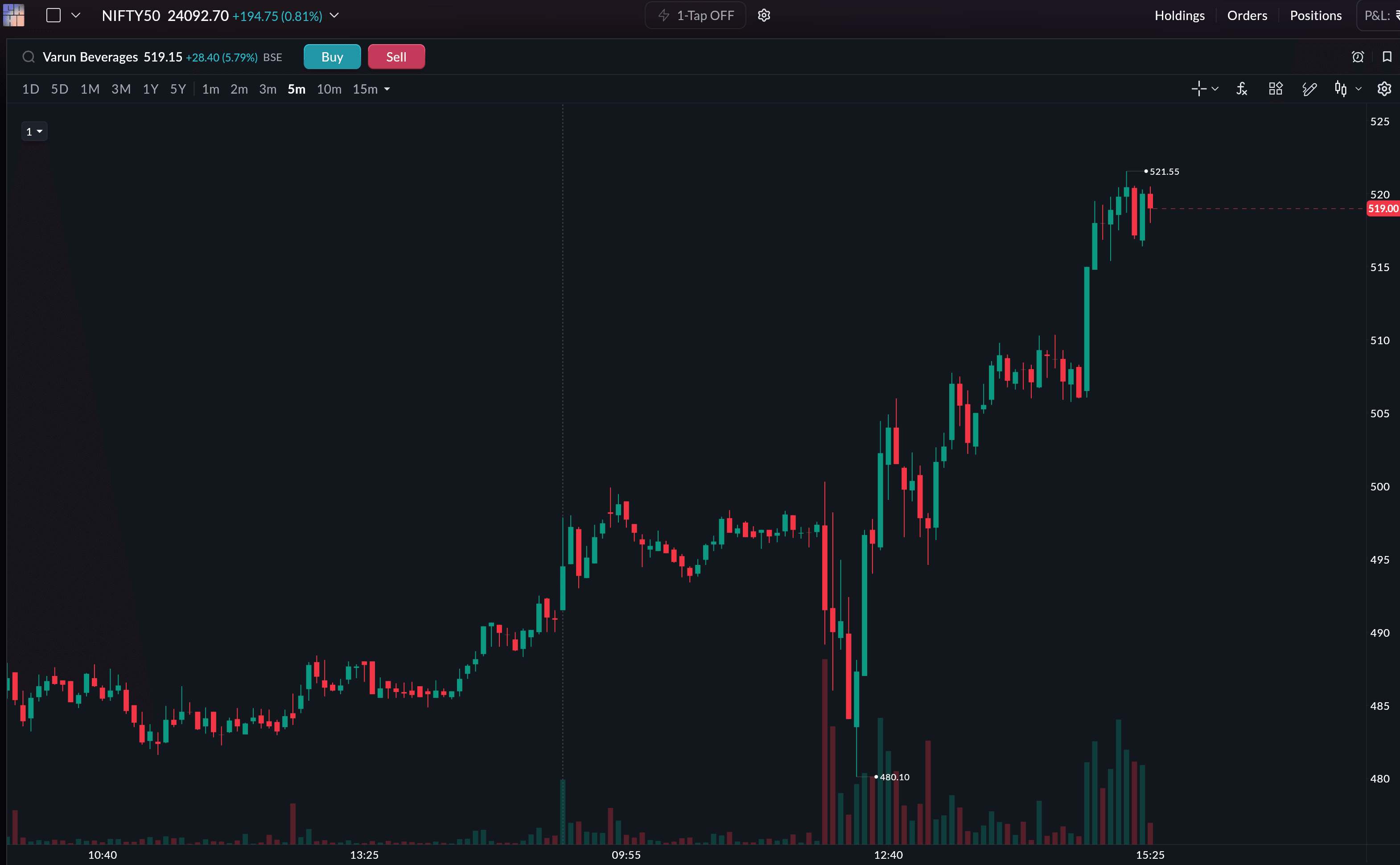 (Price as of 27th April, 2026)
Finance costs rose 18% to ₹48.5 crore, driven by debt taken on for the Twizza acquisition in South Africa. Again, not alarming in context. The income on surplus cash in India, which the company parks separately, is actually being captured as other income, which rose 55% to ₹43.5 crore. The net picture is cleaner than the headline finance cost number suggests.
The Africa Chapter: Twizza and What Comes Next
This quarter had a strategic development that deserves more attention than it's getting in the quarterly P&L discussion.
VBL completed the acquisition of Twizza, a South African beverage company, through its subsidiary BevCo, at an enterprise value of ZAR 2,053 million — roughly ₹950 crore at current rates. Twizza brings established manufacturing infrastructure and a route-to-market network in South Africa, which is Africa's largest soft drinks market. This isn't VBL buying a startup — it's buying a business with existing capacity, existing distribution, and existing consumer relationships. That's the fastest way to build genuine market presence in an unfamiliar geography.
And they're not stopping there. VBL has also signed an agreement to acquire Crickley Dairy in South Africa through BevCo, at an enterprise value of approximately ZAR 238 million, subject to regulatory approvals. A dairy company might seem like an odd fit for a beverages business at first glance. But think about it as a cold-chain and distribution asset play in a market where that infrastructure is both scarce and enormously valuable. You buy the pipes, not just the product.
The broader Africa strategy is now clearly moving from intent to execution. VBL already operates across Zambia, Zimbabwe, Morocco, Lesotho, Eswatini, DRC, and several distribution-only territories. South Africa adds the anchor. Across the continent, the company is also building its snacks business, distributing Lay's, Cheetos, and Doritos in Morocco and Zimbabwe, creating a multi-category footprint that mirrors what it built in India over three decades.
The Five-Year Picture: What Compounding Looks Like
Step back from the quarterly noise, and the long-term numbers are striking. Between 2020 and 2025, VBL's revenue grew at a CAGR of 27.4%, EBITDA at 33.3%, and profit after tax at 53.7%. Net worth compounded at 40.6% annually. The company has gone from essentially zero net debt to a net debt-to-equity of zero; it is now essentially debt-free at the India standalone level, with the international expansion creating some temporary leverage.
Sales volumes grew from 425 million cases in 2020 to 1,213 million cases in 2025, nearly a 3x increase in five years, at a CAGR of 23.3%. International volumes have gone from 88 million cases to 374 million cases in the same period. The international business, once an afterthought, now contributes over 30% of total volumes.
On sustainability, which increasingly matters to institutional investors, VBL has cut water usage per liter of beverage produced by 21% since 2021, maintains 300+ water bodies, targets 2x water replenishment versus consumption, has 21% renewable energy in its total energy mix, and has achieved 100% plastic waste recycling compliance ahead of statutory EPR requirements. It targets net zero by 2050 and is already rated A- by CDP on both climate and water.
The Honest Read Going Into Q2
The real test is imminent. Q2, April through June, is when VBL earns the bulk of its annual revenues and profits. The summer of 2026 sets up well: early heat forecasts suggest above-normal temperatures across North India, consumer sentiment in urban areas has improved, and the company enters the season with four new plants that have now stabilised and are ready to operate at fuller utilisation.
The risks are real but manageable. Raw material inflation hasn't fully abated. The Twizza integration will take time to generate the synergies promised. Currency volatility in African markets adds complexity to the consolidated numbers. And VBL remains structurally dependent on its PepsiCo franchise, a relationship that runs till April 2039 in India but which creates a ceiling on how independently the company can innovate on brand and product.
But none of these are new risks. They've existed for years, and VBL has compounded through all of them.
The Bottom Line
Q1 CY2026 is a confident quarter from a business that doesn't often make bold headlines, it just keeps executing. Volumes are strong, margins are expanding despite input cost pressure, the domestic capacity build is paying off, and the Africa growth chapter is moving from announcement to reality.
The numbers that matter most — volume growth of 16.3%, EBITDA growth of 21%, PAT growth of 20.1% — are all higher than revenue growth, which means the business is getting more profitable as it scales. That's exactly what operating leverage is supposed to look like.
Disclaimer: This article is for informational purposes only and does not constitute investment advice. Stock prices can be volatile, and past performance does not guarantee future results. Please do your own research or consult a financial advisor before making any investment decisions.