
Urban Company Share Price Jumps 16% — What's Driving the Sudden Surge?
SBI Mutual Fund's ₹632 crore bulk deal reverses the lock-in expiry sell-off — here's what it means for URBANCO investors.

Urban Company's share price has been on a volatile ride since its stock market debut.
After listing at a sharp premium in September 2025 and briefly touching highs above ₹200, compared to its IPO issue price of ₹103, the stock gradually lost momentum in the following months. Concerns around profitability, continued investments, and investor exits kept pressure on Urban Company's stock, leading to a meaningful correction from its post-listing highs.
And just when it seemed like the downward trend was settling in, the share price reversed course sharply.
In a single session on March 18, 2026, Urban Company's share price surged nearly 16% from the previous close of ₹110.11, trading around ₹124.70 in early hours and later hovering near ₹129 at 1:53 PM, and closing around 10.50% higher. At first glance, this appears to be a typical short-term bounce.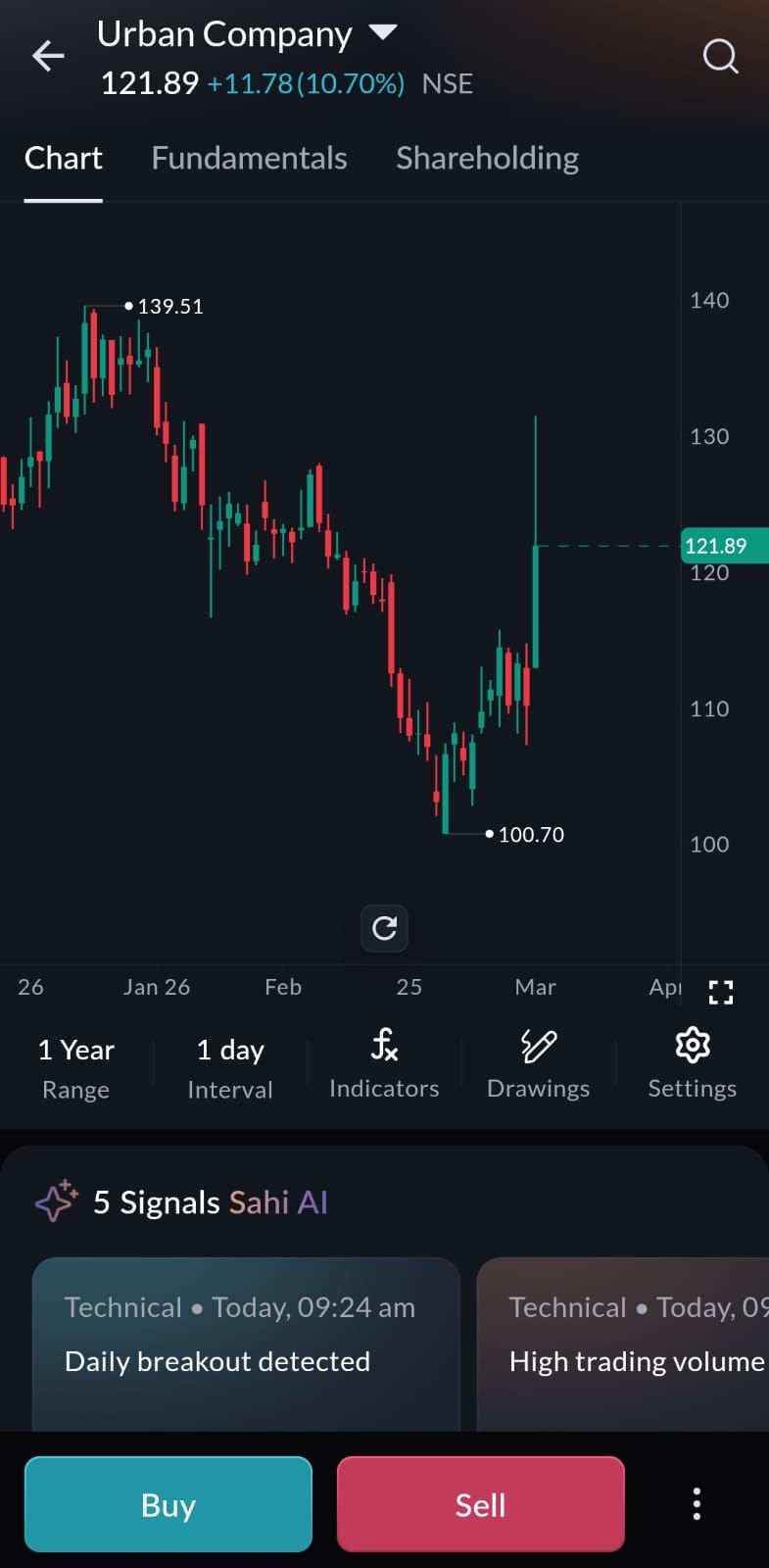
Price as of 3:05 PM
But the movement is tied to something more structural: how ownership is shifting and how market sentiment is evolving around the company.
What Triggered the Sudden Rise in Urban Company's Share Price?
The immediate reason is clear: strong institutional buying.
SBI Mutual Fund acquired shares worth over ₹632 crore through bulk deals, significantly increasing its stake in the company. Moves like these tend to influence sentiment quickly, particularly in recently listed companies where institutional participation is closely tracked.
Such buying often signals that large investors see value at current levels, even if Urban Company's stock has been under pressure in the recent past.
Why Was Urban Company Stock Falling Before This?
To understand the recent sharp jump in Urban Company's (URBANCO) share price, it's important to first look at what happened just before it. The stock had come under significant pressure, falling over 5% to ₹107.2 in a single session on March 17, 2026, after around 67 million shares, roughly a 4.6% stake, changed hands through block deals across the NSE and BSE.
At its lowest, the URBANCO stock slipped to ₹107.2 on 17th March, marking its sharpest intraday fall in weeks, before recovering slightly to trade near ₹110. This came even as the broader market remained relatively stable, indicating that the pressure was largely stock-specific.
Since its listing on September 17, 2025, Urban Company's share price has declined by about -32% from its listing price and is down about -7.3% this year (year-to-date).
The key trigger behind this decline was the expiry of the six-month lock-in period for pre-IPO shareholders.
Once the lock-in ended, a substantial portion of shares, around 66% (940.9 million shares) of the company's equity, became eligible for trading, leading to early investors offloading stakes in the open market. Three investors together sold approximately ₹734 crore worth of shares, with some exiting their positions entirely, creating a temporary oversupply and putting pressure on Urban Company's stock price.
However, this phase appears to have been short-lived. The recent rally suggests that this excess supply has now been absorbed, with fresh buying, particularly from institutional players stepping in and supporting the price.
Beyond these near-term movements, Urban Company operates in a large and still underpenetrated home services market in India, estimated at around ₹5 trillion, with online penetration of less than 1%, as per Business Standard.
The company commands around 65% market share in the online segment and remains the only scaled multi-category player, supported by network effects and relatively high entry barriers.
Putting it all together, the recent price action reflects a shift in supply and demand dynamics. Heavy selling following the lock-in expiry created pressure, which has now been offset by strong institutional buying.
At the same time, the broader story remains unchanged. Urban Company continues to operate in a high-growth market, but execution, profitability, and ownership transitions will remain key factors influencing how URBANCO stock is valued going forward.
The Business Story: Growth Is Strong, Profitability Still Evolving
Operationally, Urban Company continues to show growth.
In the latest quarter (Q3 FY26):
- Revenue rose 33% year-on-year to ₹383 crore
- Net transaction value increased 36% to ₹1,081 crore
At the same time, Urban Company reported a net loss of ₹21 crore, compared to a profit of ₹16 crore in the same quarter last year.
This was largely driven by continued investments in newer verticals like InstaHelp, (includes quick house help solutions for users, which are scaling quickly but remain loss-making.
Therefore, the business is currently experiencing visible growth, but it is still in the process of building profitability.
Conclusion
Urban Company's recent share price rally reflects a shift in sentiment rather than a fundamental turnaround. The company continues to deliver growth, but ongoing investments are still weighing on near-term profitability. The stock, therefore, sits at a point where growth visibility and execution challenges coexist.
The recent surge indicates improved short-term sentiment driven by strong institutional buying. At the same time, the underlying dynamics remain unchanged, with profitability, growth sustainability, and competitive pressures continuing to define where Urban Company's stock is headed.
Disclaimer: This article is for informational purposes only and does not constitute financial advice. Please consult a SEBI-registered advisor before making investment decisions.