
Swan Defence’s Ammonia Bet Could Redefine India’s Shipbuilding Story
This isn’t just an order win — it’s a strategic pivot into green shipping, where execution will decide whether the turnaround becomes a structural story.

Swan Defence & Heavy Industries (SDHI) just delivered a development that goes beyond a typical order win. The company’s stock hit a 5% upper circuit after it secured a contract to build India’s first dual-fuel ammonia bulk carriers, a move that places it directly at the intersection of industrial revival and the global shift toward green shipping.
At the surface, this looks like a large engineering contract. In reality, it signals something more fundamental: India is beginning to participate in the next phase of global maritime infrastructure.
The Order That Changed the Narrative
Swan Defence has been awarded a contract to build four 92,500 DWT bulk carriers, with an estimated value in the ₹1,500–₹3,000 crore range. These are not conventional vessels. Each ship will be equipped with dual-fuel ammonia propulsion, a technology still in its early stages globally but increasingly viewed as a serious pathway toward zero-carbon shipping.
The scale is equally important. At over 229 meters in length, these are among the largest commercial vessels ever built in an Indian yard. This is not incremental capacity utilisation it is a step-up in complexity, engineering depth, and execution capability.
Why Ammonia Changes the Equation
Shipping is one of the hardest sectors to decarbonise. Unlike road transport, electrification is not viable at scale for long-haul cargo. That leaves fuels, and ammonia is emerging as a strong contender.
Unlike traditional marine fuels, ammonia does not emit carbon when burned. That makes it highly relevant in the context of tightening emission norms driven by the International Maritime Organization. Over the next decade, compliance will no longer be optional; it will be embedded into fleet economics.
By entering ammonia-capable shipbuilding early, Swan Defence is not just executing an order. It is positioning itself in a future compliance-driven market, where demand will increasingly shift toward low-carbon vessels.
From Turnaround Story to Strategic Player
It’s important to contextualise where Swan Defence is coming from. The company, earlier known as Reliance Naval and Engineering Ltd, was long seen as a distressed asset struggling with execution and financial challenges.
This order reframes that perception.
The vessels will be designed by South Korea’s KMS-EMEC and classed by DNV. These are not peripheral partners. Their involvement effectively validates the technical credibility of Swan Defence’s Pipavav facility on a global stage.
What the market is reacting to, therefore, is not just revenue visibility but credibility restoration.
Why the Market Reacted So Sharply
The 5% upper circuit move needs to be read in context. This is a stock that had already rallied significantly over the past six months, indicating that the market was anticipating a turnaround.
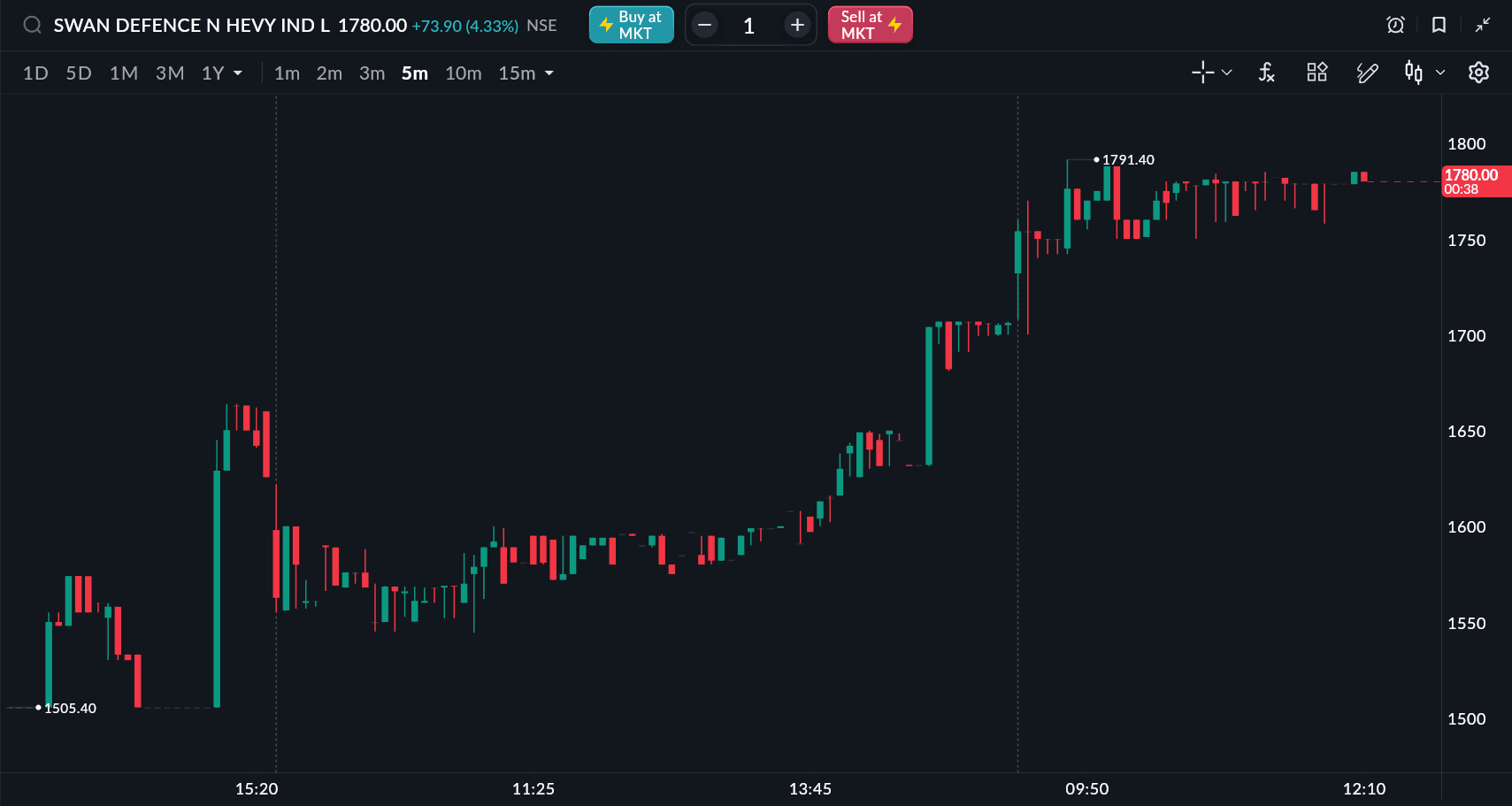
What this order does is remove a layer of uncertainty.
It brings together three elements that equity markets tend to reward disproportionately: long-duration revenue visibility, entry into a high-growth thematic (green shipping), and validation through credible global partnerships. That combination shifts the narrative from “potential turnaround” to “emerging strategic player.”
A Larger Policy and Industry Shift
This development also aligns neatly with India’s broader industrial priorities. There has been a clear push toward strengthening domestic shipbuilding capacity, reducing reliance on imports, and participating more meaningfully in global supply chains.
Green shipping adds another layer to this ambition. Countries that can build vessels compatible with future fuels and eventually integrate fuel production ecosystems stand to capture outsized value.
Swan Defence’s move positions it at the asset creation stage of that transition, which is typically where long-term industrial value gets anchored.
What Actually Matters Going Forward
The narrative from here is no longer about winning attention it is about sustaining execution.
The delivery timeline stretches into 2029, which gives the company both an opportunity and a risk. If execution remains on track, this order could act as a template for future contracts in the same segment. If not, the strategic premium currently being priced in could unwind just as quickly.
In other words, the market has acknowledged the shift. It is now waiting to see if Swan Defence can operationalise it.
Bottom Line
This is not just a stock reacting to an order. It is a company attempting to reposition itself within a structurally evolving global industry.
If ammonia does become a meaningful part of maritime fuel economics and current regulatory trends suggest it might Swan Defence has placed an early bet in the right direction.
The only question that remains is execution.