
RailTel's ₹700 Crore Spark: Decoding the Surge in Two Sessions
Multiple contract wins totalling over ₹700 crore triggered a sharp rally in RailTel shares. Here's what the contracts are, what the financials show, and why markets reacted the way they did.

If you have been tracking the markets this week, you probably noticed RailTel Corporation of India making some serious noise. The stock gained approximately 20% on a closing basis over two trading sessions, touching an intraday high of ₹354 on the BSE — roughly 24–25% above pre-rally closing levels. That is not a small move for a government-owned PSU. Moves like these usually signal that something meaningful has shifted beneath the surface.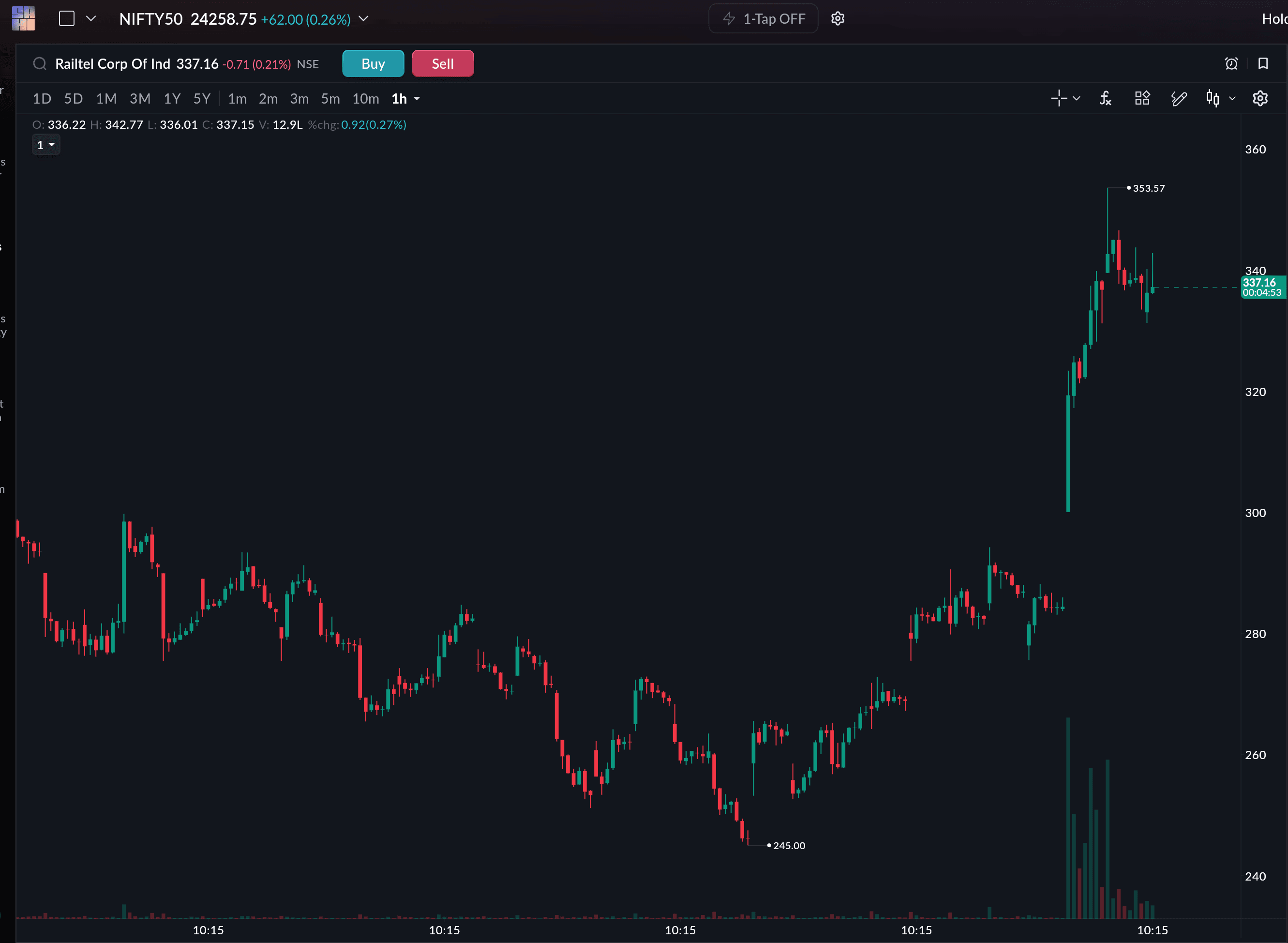 (as of 11:11 am, 17th August)
In RailTel’s case, it is not just one thing. It is a combination of strong order inflows, improving sector sentiment, and a subtle shift in how the market views the company.
So what exactly happened? Let us break it down.
First, Who Is RailTel?
RailTel is a Navratna PSU under the Ministry of Railways, incorporated in 2000. If Indian Railways is the physical backbone of transport, RailTel is quietly becoming part of its digital backbone.
The company operates one of the largest optical fiber networks in India, built along railway tracks. This gives it a structural advantage that is difficult to replicate. It monetises this network by providing broadband, leased lines, VPN connectivity, and enterprise telecom solutions.
But that is only one side of the story.
RailTel has also emerged as a government IT solutions provider. It works on cloud platforms, data centers, surveillance systems, and large-scale digitisation projects for various government departments.
Its business can broadly be divided into two segments:
| Segment | What it does | Revenue nature |
|---|---|---|
| Telecom Services | Broadband, leased lines, VPN, data services | Recurring |
| Project Work Services | Government IT and infrastructure projects | Order-driven |
The telecom segment provides stability. The project segment drives growth. And right now, growth is accelerating.
So What Triggered the Rally?
The rally was driven by a burst of contract wins that landed almost back-to-back.
RailTel secured confirmed contracts worth approximately ₹608 crore, comprising ₹564.55 crore from Rail Vikas Nigam Ltd (RVNL) and ₹43.96 crore from the Uttar Pradesh Police Recruitment and Promotion Board. Including a ₹100 crore IT contract for minor minerals monitoring, total order inflows crossed ₹700 crore within a very short span.
The biggest trigger came from RVNL, which awarded RailTel two major contracts worth ₹564.55 crore in total.
These projects involve deploying integrated tunnel communication systems across railway networks. This includes VHF communication, CCTV surveillance, public address systems, and emergency call infrastructure inside tunnels.
One of these contracts alone is valued at ₹255.27 crore.
These are not routine installations. They are high-complexity, safety-critical systems with execution timelines extending up to April 2028. That means revenue visibility stretches over multiple years.
Alongside this, RailTel secured a ₹100 crore, five-year contract from the Divisional Commissioner, Konkan Division — a Maharashtra state government body — to develop and maintain an integrated IT system for monitoring minor minerals. The project runs until April 2031. This is significant not because of its size, but because of what it represents: RailTel expanding beyond railway-linked work into broader government digitisation.
Another ₹43.96 crore contract from the Uttar Pradesh Police Recruitment and Promotion Board adds to the mix, focused on providing security and infrastructure support for large-scale examinations.
Individually, these contracts are meaningful. Together, they signal momentum.
Why the Market Reacted So Sharply
Order wins are common in infrastructure businesses. But the timing and clustering of these announcements made the difference.
Markets respond to acceleration, not just growth.
When multiple contracts arrive within a compressed time frame, it signals that the pipeline is active and execution capabilities are being recognised. It creates a perception of sustained demand rather than isolated wins.
There is also a positioning angle.
RailTel had not been a crowded trade. The stock was not sitting at euphoric highs before the rally. That meant expectations were relatively muted. When positive surprises arrived, the reaction was sharper.
Add to that the broader railway and infrastructure narrative in India, and you get the perfect setup for a momentum-driven move.
Is the Business Actually Doing Well?
On the fundamentals side, the answer is yes, but with caveats.
RailTel reported quarterly revenue of ₹913.45 crore, marking a 19% year-on-year increase. Growth is being driven largely by the Project Work Services segment, which contributed ₹564 crore. The Telecom Services segment added ₹349 crore, providing steady recurring income.
The company’s total order book stands at approximately ₹8,500 crore.
That number matters. An order book represents future revenue that is already contracted but not yet recognised. It provides visibility into how the business is likely to perform over the coming quarters.
Here is a clean snapshot of the key numbers:
| Metric | Value |
|---|---|
| 2-day stock gain (closing basis) | ~20% |
| Intraday high (BSE) | ₹354 |
| Quarterly revenue | ₹913.45 crore |
| YoY revenue growth | 19% |
| Net profit | ₹62.40 crore |
| YoY profit growth | -4% |
| Total order book | ~₹8,500 crore |
| RVNL contracts (combined) | ₹564.55 crore |
| Total confirmed order batch | ~₹708 crore |
| UP Police contract | ₹43.96 crore |
Source: NSE/BSE filings, RailTel SEBI Regulation 30 disclosures
But there is a catch.
Despite strong revenue growth, net profit declined about 4% year-on-year to ₹62.40 crore. This suggests that margins are under pressure.
In project-heavy businesses, this is not unusual. Large contracts often come with tight margins, and execution costs can fluctuate. Delays, cost overruns, or operational complexities can impact profitability even when revenue is growing.
So while the top line is expanding, the bottom line is not keeping pace.
Why This Rally Feels Bigger Than Just Contracts
There is a deeper shift happening in how RailTel is being perceived.
Traditionally, it has been viewed as a railway PSU. But that label is starting to feel incomplete.
The minor minerals IT contract is a clear example. It has nothing to do with railways. It is about data, governance, and digital monitoring.
Similarly, RailTel’s growing presence in cloud services, data centres, and government IT solutions places it within India’s broader digitisation push.
This matters because markets reward narratives.
A company tied only to railway infrastructure might be valued conservatively. But a company that sits at the intersection of infrastructure and digital transformation can attract a different kind of investor interest.
RailTel is slowly moving into that second category.
The Role of Momentum and Trading Activity
Not all of the rally is driven by fundamentals.
Trading volumes surged significantly during the two-day move, with turnover crossing ₹300 crore in a single session. This suggests strong participation from short-term traders and momentum-driven strategies.
When a stock starts moving rapidly, it tends to attract additional buying simply because of price action. Technical breakouts, moving averages, and algorithmic triggers all come into play.
But there is an important nuance.
Delivery volumes did not rise proportionately with trading volumes. This indicates that a portion of the activity may have been short-term or intraday trades rather than long-term accumulation.
That does not invalidate the rally, but it does introduce volatility risk.
A Familiar Pattern, But at a Larger Scale
RailTel has shown similar behaviour in the past.
The stock tends to react sharply to order announcements. Even smaller contracts have triggered price spikes.
But this time feels different because of scale and clustering.
A ₹700 crore-plus order inflow within days is materially larger than typical announcements. It creates a stronger narrative of sustained demand and execution capability.
It also reinforces RailTel’s positioning within large-ticket infrastructure and IT projects.
What Should You Make of This?
The rally is not purely speculative. It is backed by real developments.
RailTel is winning contracts, expanding its scope, and aligning itself with two powerful themes: infrastructure and digitisation. But there are also risks.
Margins are under pressure. Execution remains critical. And part of the rally appears to be driven by short-term trading activity.
The stock is also still below its earlier highs, which means the recent move may partly be a recovery rather than a complete re-rating.
The Bottom Line
RailTel is doing what a well-functioning PSU is expected to do. It is winning contracts, building an order pipeline, and gradually expanding into adjacent sectors.
The surge reflects a sudden alignment of positive triggers rather than a single event.
But markets do not reward order books alone. They reward execution.
The order book tells you what could happen. Earnings tell you what actually did. For now, RailTel has captured attention. The next few quarters will determine whether it can convert that attention into sustained re-rating.
Disclaimer: This article was researched and drafted with the assistance of AI tools, based on publicly available information including NSE/BSE filings and RailTel’s SEBI Regulation 30 disclosures. All numbers have been verified against source documents. This article is for informational purposes only and does not constitute financial advice. Please consult a SEBI-registered advisor before making investment decisions.