
LIC Bonus Issue 2026: Record Date, 1:1 Ratio, and What It Means for Shareholders
LIC approved a 1:1 bonus issue on April 13, 2026, capitalising ₹6,325 crore from reserves. Here's what changes, what doesn't, and why the government's May 2027 SEBI deadline matters.

Quick Answer: LIC Bonus Issue 2026 — Key Details
LIC (Life Insurance Corporation of India) announced a 1:1 bonus issue in 2026 — its first since listing on exchanges in May 2022. For every 1 share held on the record date, shareholders receive 1 additional bonus shares at no cost. The share price adjusts proportionally on the ex-bonus date, so the total portfolio value remains the same immediately after the issue.
Update: May 21, 2026
LIC confirmed the dates for its 2026 bonus issue alongside its Q4 FY26 results. The record date is May 29, 2026. Shareholders holding LIC shares as of this date will receive one bonus share for every share held. The ex-bonus date is May 29, 2026 and the deemed allotment date is June 1, 2026.
- Bonus ratio: 1:1 (1 bonus shares for every 1 share held)
- Who is eligible: Shareholders holding LIC shares as of the record date
- Price impact: Share price adjusts downward by 80% on the ex-date (e.g., if LIC was at ₹1,000, it adjusts to ~ ₹200 post-bonus)
- Why companies issue bonus shares: To improve liquidity, reward long-term shareholders, and signal confidence without cash outflow
- Tax note: Bonus shares are not taxable at the time of issue; capital gains tax applies only when you sell them
LIC Bonus Issue 2026: LIC's board approved India's largest insurer's first-ever 1:1 bonus issue on April 13, 2026 — one free share for every share held. The issue capitalises ₹6,325 crore from reserves, doubling paid-up capital to ₹12,650 crore with no cash outflow. The record date is pending shareholder approval. LIC shares rose ~4.4% on April 15 on the news. The strategic motive: the government holds 96.5% of LIC and must increase public float to 10% by May 2027 per SEBI norms — doubling the share count makes future OFS stake sales easier to execute without disrupting the market.
Shares of Life Insurance Corporation of India (LIC) moved higher following the announcement of its first-ever 1:1 bonus issue since listing, with the stock gaining approximately 4.40% as of 2:34 p.m. on April 15, 2026, and trading volumes picking up during the session. The board approved the bonus issue at its meeting on April 13, 2026, with the announcement made via a regulatory filing after market hours.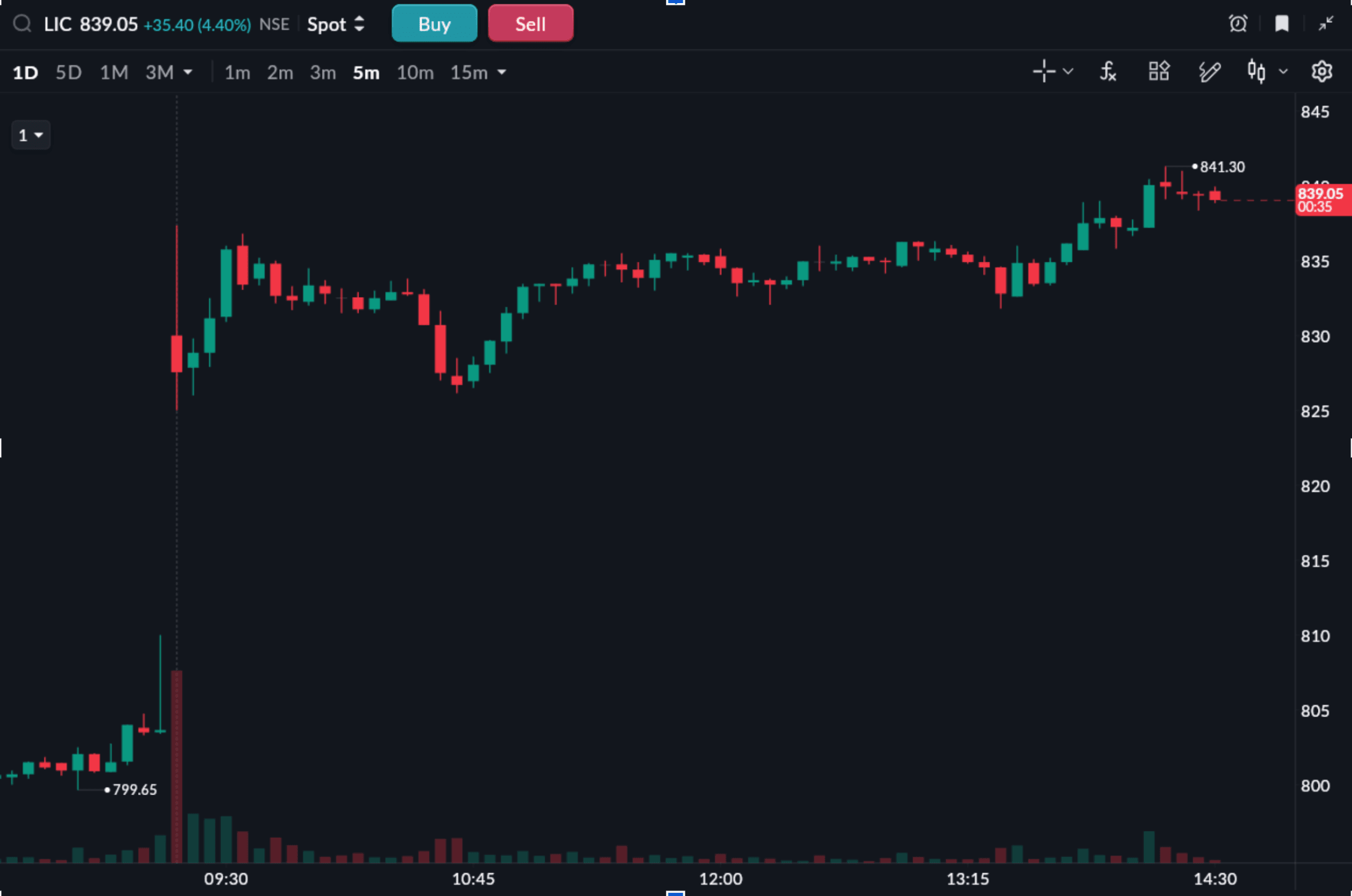
This development comes at a time when the Government of India, which holds a 96.5% stake in the insurer, is required to gradually reduce its ownership to meet minimum public shareholding norms; specifically, SEBI requires LIC's public float to reach 10% by May 16, 2027, up from the current 3.5%. The bonus issue is expected to support this process by expanding the company's equity base and improving market liquidity.
Understanding the Bonus Issue
A 1:1 bonus issue means shareholders will receive one additional share for every share they currently hold. If an investor owns 100 shares, they will receive 100 additional shares at no cost, taking their total holding to 200. While the number of shares doubles, the overall investment value remains the same — the share price adjusts proportionately on the ex-date.
In LIC's case, the bonus issue involves capitalising approximately ₹6,325 crore from its reserves and surplus into equity capital. There is no cash outflow — only a restructuring of the company's balance sheet.
| Parameter | Before Bonus Issue | After Bonus Issue |
|---|---|---|
| Paid-up equity share capital | ₹6,324.99 crore | ₹12,649.99 crore |
| Total shares outstanding | ~632.5 crore shares | ~1,265 crore shares (doubled) |
| Face value per share | ₹10 | ₹10 (unchanged) |
| Authorised share capital | ₹25,000 crore | ₹25,000 crore (unchanged) |
| Cash outflow to shareholders | — | Nil |
Source: LIC exchange filing, April 13, 2026 (BSE/NSE regulatory disclosure)
Improving Liquidity and Retail Participation
One of the most immediate impacts of a bonus issue is improved liquidity. A lower post-adjustment share price typically makes the stock more accessible to a wider set of investors, especially retail participants.
For LIC, this is particularly relevant. Despite being India's largest insurer and one of its largest institutional investors, the stock has not always seen consistent retail trading activity. LIC's share price had been trading in the ₹780–810 range ahead of the announcement, which is already below its IPO price of ₹949. Post-bonus, the effective price would adjust to roughly half that level, potentially drawing in a broader investor base.
The surge in volumes following the announcement suggests that market sentiment around the move is positive. However, it is worth noting that a bonus issue does not change the company's market capitalisation or intrinsic value, only the number of shares and the price per share.
Strategic Context: Government Stake Dilution
The Government of India currently holds a 96.5% stake in LIC, well above the minimum public shareholding requirement. Under SEBI regulations, LIC is required to increase public shareholding to 10% by May 16, 2027 (from 3.5% currently) and eventually to 25%.
| Stakeholder | Current Holding | SEBI Target (by May 2027) |
|---|---|---|
| Government of India (Promoter) | 96.5% | 90% (maximum) |
| Public shareholders | 3.5% | 10% (minimum) |
| Additional stake to be divested | — | ~6.5% via OFS or other routes |
Source: SEBI minimum public shareholding norms; LIC shareholding pattern as of December 2025
The bonus issue serves a strategic purpose here. By doubling the number of shares in the market, LIC creates more shares through which the government can execute future Offer for Sale (OFS) transactions, potentially making stake sales smoother without disrupting the market by offloading large blocks from a smaller share count.
Backed by Strong Financials
LIC's ability to issue bonus shares is supported by its substantial reserve base. As per the exchange filing, the company's Reserves and Surplus (India) stood at ₹1,46,440.58 crore (approximately ₹1.46 lakh crore) as of December 31, 2025. The ₹6,325 crore being capitalised into equity represents a small fraction of this reserve base.
In its most recently reported quarterly results (Q3 FY26, for the October–December 2025 quarter), LIC delivered solid numbers:
| Metric | Q3 FY26 | Q3 FY25 | YoY Change |
|---|---|---|---|
| Consolidated net profit | ₹12,930 crore | ₹11,008 crore | +17.5% |
| Total income | ₹2,36,776 crore | ₹2,04,567 crore | +15.7% |
| 9-month (Apr–Dec 2025) PAT | ₹33,998 crore | — | — |
Source: LIC Q3 FY26 consolidated results; exchange filing, February 2026
LIC has also clarified that the bonus issue will not impact its solvency margin or core financial health, ensuring that policyholder and investor interests remain protected.
Stock Performance
| Time Period | LIC Performance | Context |
|---|---|---|
| April 15, 2026 (intraday) | +4.40% (as of 2:34 p.m.) | Post bonus announcement reaction |
| April 2026 (month-to-date) | ~+12% | Rally on bonus issue expectations and announcements |
| Past 6 months | ~−6% | Broader market pressure and valuation concerns |
| Past 1 year | ~+7% | Modest return; below IPO price of ₹949 |
Source: NSE/BSE live data; April 14–15, 2026
The recent rally is largely sentiment-driven, reflecting optimism around the bonus issue and its implications for future liquidity. The broader six-month underperformance suggests the stock has faced sustained pressure, and the fundamental case for LIC rests more on its long-term business trajectory — premium growth, embedded value expansion, and the ongoing shift toward non-participating products — than on the bonus issue alone.
What the Bonus Issue Does and Does Not Do
| What It Does | What It Does Not Do |
|---|---|
| Doubles the number of shares outstanding | Change the company's market capitalisation |
| Halves the share price on ex-date (proportionate adjustment) | Increase the intrinsic value of the business |
| Improves liquidity and retail accessibility | Affect LIC's solvency margin or financial health |
| Facilitates smoother future OFS transactions by the government | Generate any cash for LIC or its shareholders |
| Rewards existing shareholders with more shares | Change proportionate ownership (all shareholders' % stays the same) |
Source: Compiled from LIC exchange filing and standard bonus issue mechanics under SEBI regulations
Key Dates to Watch
The record date, which determines which shareholders are eligible for the bonus shares, has not yet been announced. The bonus issue is also subject to shareholder approval, which will be sought at a general meeting. Once the record date is announced, the ex-bonus date will typically fall one trading day before it. Investors must hold shares on or before the ex-date to be eligible.
Final Thoughts
LIC's bonus issue is not about changing fundamentals — it is about improving accessibility, enhancing liquidity, and aligning with long-term structural goals like government stake dilution. The capitalisation of ₹6,325 crore from a reserve base of over ₹1.46 lakh crore is a minor balance sheet adjustment, not a transformative financial event.
As LIC continues to evolve as a listed entity, such moves indicate a gradual shift toward a more market-oriented approach. While the immediate impact is visible in stock movement, the real significance lies in how this positions LIC for the future — particularly as the government works toward meeting SEBI's public shareholding deadline of May 2027.
Disclaimer: This article is for informational purposes only and does not constitute financial advice. Stock price data is indicative and reflects intraday levels as of April 15, 2026. Please consult a SEBI-registered advisor before making investment decisions.
Frequently Asked Questions (FAQs)
All topics
Click the link, confirm the box next to sahi.com is checked — ignore any other results.