
IDBI Bank Shares Fall 15% After Reports of Divestment Pause: Know the Details Here.
The government's reported pause on IDBI Bank's privatisation sent shares tumbling 15% — here's what the divestment history, ownership data, and Q3 results actually say.

IDBI Bank suddenly came into the spotlight this week (on 16th March, 2026) after its stock fell nearly 15% in a single day (as of 2:00 pm). The fall came after reports suggested that the Indian government might pause or scrap the ongoing process to sell a majority stake in the bank.
Markets reacted quickly. As the news spread, the stock dropped to around ₹77 per share on the NSE, bringing it close to its 52-week low of ₹71.90. Trading volumes were also higher than usual, showing that investors were closely tracking the development.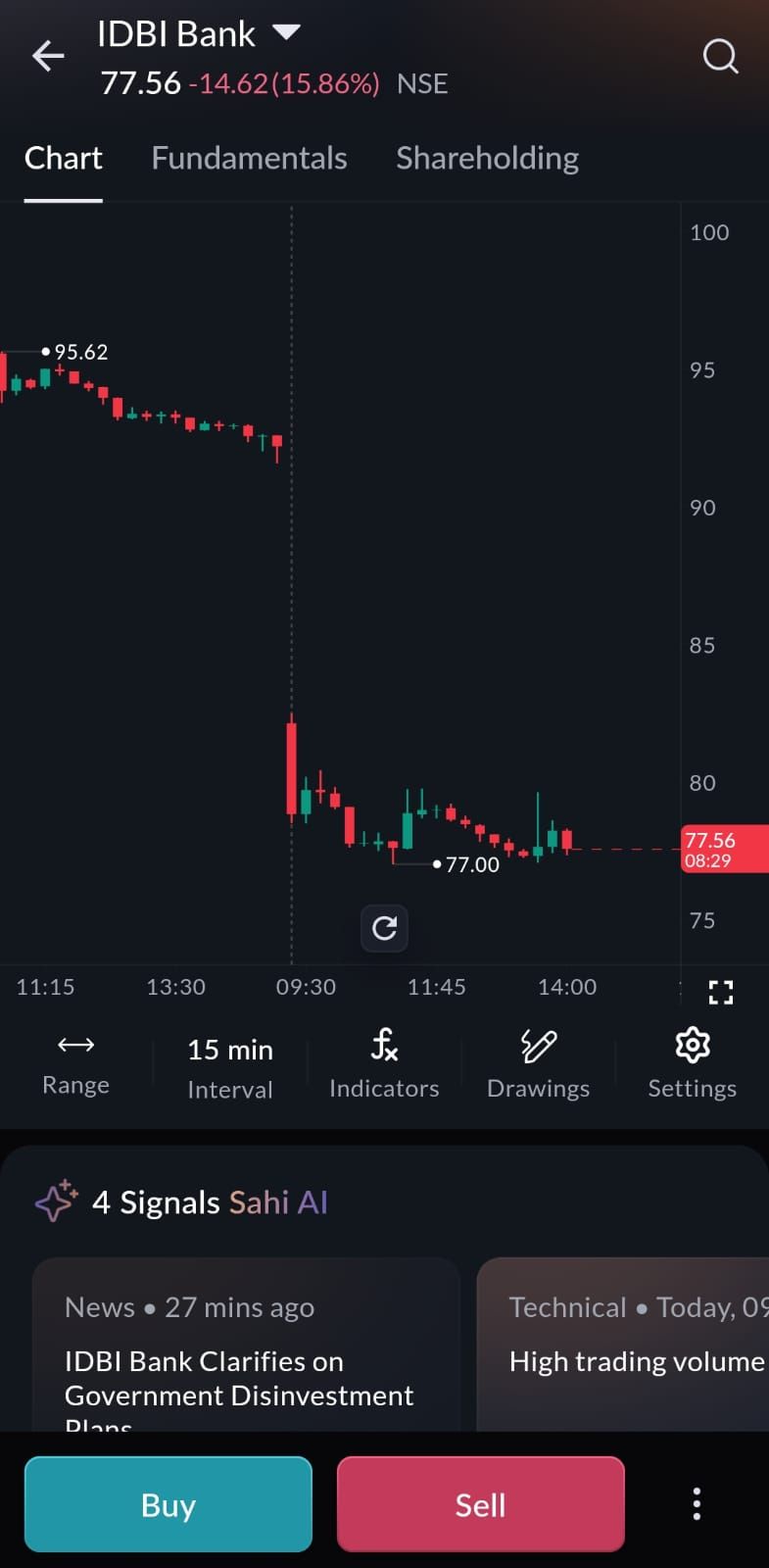
So what exactly happened, and why is the potential halt of this deal such a big deal?
The Main Reason Behind the Fall
For the past few years, the government has been trying to privatise IDBI Bank as part of a broader push to reduce state ownership in banks and bring in private capital.
The plan was fairly straightforward. The government and Life Insurance Corporation of India (LIC) together hold a massive majority stake in the bank. As of the December quarter of FY26, the ownership looked like this:
- Government of India: 45.48%
- LIC: 49.24%
- Together, they control over 94.72% of the bank.
(Source: IDBI Bank shareholding pattern, BSE filing, Q3 FY26)
The idea was to sell a controlling stake of around 60.72% to a strategic investor and transfer management control. This would effectively turn IDBI Bank into a privately controlled lender.
But the latest reports suggest that the financial bids submitted by interested buyers came in below the minimum price the government was willing to accept. Because of that gap in valuation expectations, authorities are reportedly considering scrapping the current bidding process altogether.
If that happens, the entire sale process may have to start again from scratch.
Why the Deal Matters So Much?
The sale of IDBI Bank is not just another divestment. It has been seen as one of the most important privatisation efforts in India's banking sector.
In October 2022, the government issued an Expression of Interest (EOI), formally inviting bids from qualified buyers. The government and LIC subsequently moved forward with the plan to sell their combined stake of 60.72%.
(Source: Department of Investment and Public Asset Management (DIPAM), GOI; PSU Connect)
At current market prices, the 60.72% stake being considered for sale is valued at approximately ₹51,000 crore (around $6.1 billion at post-announcement prices), making it one of the largest potential foreign investments in India's banking sector.
Because of its size and significance, the transaction has often been described as a test case for future banking privatisations.
Who Was Interested in Buying the Bank?
The divestment process had attracted interest from several large financial players.
Reports suggested that two major international groups had submitted financial bids:
- Fairfax Financial Holdings — a Canada-based investment company
- Emirates NBD — one of the largest banks in the Middle East
Even though there was interest, the bids reportedly did not meet the reserve price set by the government, which is why the process may now be halted.
(Source: Bloomberg, Business Standard)
A Bank That Has Already Gone Through Major Changes
To understand why the sale of IDBI Bank has been such a long process, it helps to look at the bank's recent history.
The lender had struggled earlier in the decade due to rising bad loans and weakening financial health. The situation became serious enough that in 2019, LIC stepped in and acquired a majority stake, effectively rescuing the bank and stabilising its operations.
Since then, the bank has gradually improved its financial performance.
For the third quarter of FY26, IDBI Bank reported:
- Net profit: ₹1,935 crore, slightly higher than ₹1,908 crore in the same quarter last year
- Net interest income: ₹3,209.5 crore, down 24% year-on-year from ₹4,228.2 crore
- Gross NPA ratio: 2.57%, improving from 3.57% a year earlier
- Net NPA ratio: 0.18%
(Source: IDBI Bank Q3 FY26 results, Business Today)
The improvement in asset quality shows that the bank has been cleaning up its balance sheet over the past few years.
What This Means for India's Privatisation Push
If the government ultimately decides to cancel or delay the current sale process, it could have wider implications beyond just IDBI Bank.
The government has set a disinvestment and asset monetisation target of ₹80,000 crore for FY27, and the IDBI transaction has been seen as one of the major deals contributing to that goal.
A delay would not necessarily end the privatisation plan, but it could mean that authorities revisit the process, reassess valuations, and potentially invite fresh bids in the future.
Conclusion
The sharp drop in IDBI Bank's stock price reflects how closely the market is watching the bank's privatisation story.
For years, the proposed stake sale has been seen as a major milestone in India's efforts to bring private capital into the banking sector. Reports that the government may pause the process have therefore created immediate uncertainty.
What happens next — whether the sale is restarted, restructured, or delayed further — will play an important role in shaping the next chapter of IDBI Bank's transformation and India's broader privatisation journey.
Disclaimer: This article is for informational purposes only and does not constitute financial advice. Please consult a SEBI-registered advisor before making investment decisions.