
Why did HDFC Bank Share Fall? What Happened, What It Signals, and Why Markets Reacted
Atanu Chakraborty's exit sent HDFC Bank shares tumbling 9% — here's what actually happened, what the RBI said, and what it means for investors.

Some developments don't come with loud headlines but still manage to shake confidence. That's exactly what happened with the HDFC Bank chairman's resignation on March 18, 2026.
In a sudden move, its part-time chairman, Atanu Chakraborty, resigned with immediate effect, citing differences related to "values and ethics." No detailed explanation, no specific incident, just a short statement that certain developments over the past two years didn't align with his personal principles.
And in a bank of this scale, even a single line like that is enough to trigger a reaction.
The market response reflected that almost instantly. The HDFC Bank share price fell sharply, dropping as much as 8–9% to an intraday low of ₹770, a fresh 52-week low, at the open before recovering slightly and continuing to remain under pressure through the session.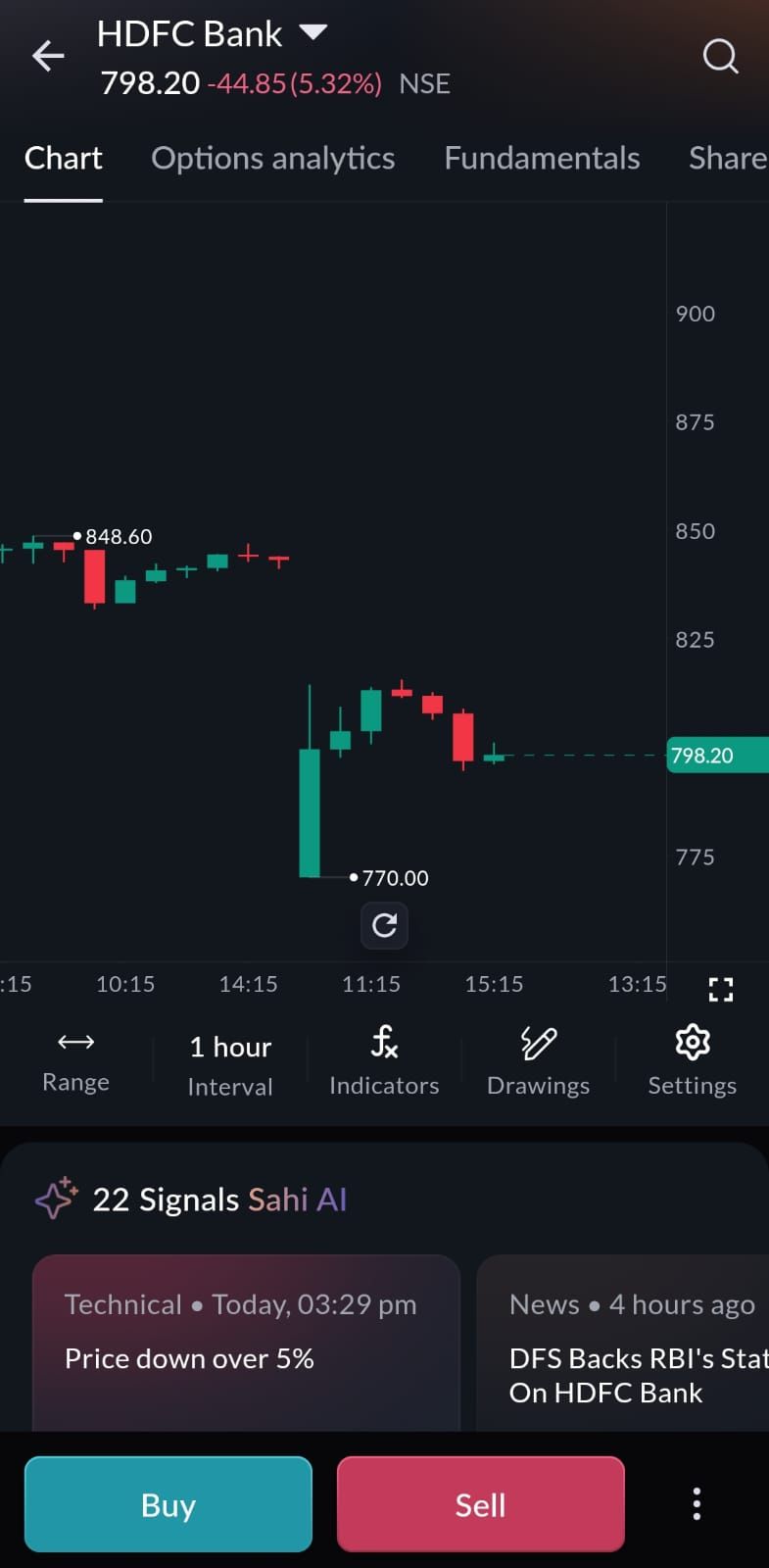
What Makes This Resignation Different?
Leadership exits are not unusual. But the wording here is what made it stand out.
Chakraborty didn't point to any wrong doing. He explicitly stated that there were no other material reasons behind his resignation. Yet, referencing "ethical misalignment" creates a grey area, it suggests discomfort, but without clarity.
Shortly after, he described the resignation as 'routine,' which adds another layer to the narrative. On one hand, there's a mention of values not aligning; on the other, a suggestion that the exit isn't out of the ordinary.
This contrast is exactly what leaves markets trying to read between the lines.
What Caused the Market to React So Sharply?
The reaction was immediate, and quite sharp.
HDFC Bank's stock dropped significantly during early trade, falling as much as 8–9% before recovering partially to hover around ₹813.75 with a loss of 3.48% (as of 1:10 PM on March 19, 2026). Even its ADRs in the US saw a noticeable decline of over 7%.
What's important here is that this reaction wasn't driven by earnings, asset quality, or any financial metric. It was purely sentiment-driven.
In large financial institutions, HDFC Bank governance signals carry a lot of weight. Even a hint of internal misalignment, especially when phrased around ethics, can create uncertainty, and markets tend to price that in quickly.
The Regulator's Response Changed the Tone
If there was one thing that helped stabilise the situation, it was the speed and clarity of the RBI's response.
RBI not only approved Keki Mistry as HDFC Bank interim chairman for three months but also made a clear statement: there are no material concerns regarding the bank's governance, financial position, or conduct.
For context, Keki Mistry served as vice-chairman and CEO of HDFC Ltd. for over a decade before its merger with HDFC Bank in July 2023, making him one of the most familiar and credible figures in the group's leadership history. His appointment as interim chairman is a stable, well-recognised choice for this transition period.
The RBI also reiterated that HDFC Bank remains well-capitalised, liquid, and professionally managed, essentially reinforcing that the fundamentals remain intact.
In situations like this, such reassurance plays a critical role. It helps separate perception from reality, at least to some extent.
What the Bank Is Saying Internally
From the bank's side, the messaging has been consistent, this is not a structural issue.
Keki Mistry addressed concerns directly, stating that there are no major issues, no power struggles, and no impact on operations or profitability. He acknowledged that differences in opinion may exist but emphasised that nothing substantive has affected the bank's functioning.
He also noted that no evidence or details of the alleged unethical practices were provided to the board, a point that underscores how much of the market reaction is driven by perception rather than confirmed facts.
At the same time, the board has begun the process of identifying a full-time chairman, with a three-month transition window in place.
Why This Resignation Comes at a Critical Time for HDFC Bank
This development doesn't exist in isolation.
Over the last few years, HDFC Bank has gone through one of the biggest structural changes in India's financial sector: the merger with HDFC Ltd. That move significantly expanded the bank's scale, complexity, and operational scope.
Such large integrations often come with evolving governance frameworks, shifting priorities, and differing viewpoints at the leadership level.
Seen in that context, differences in perspective aren't entirely unexpected. But when they result in a resignation, especially with references to ethics, they tend to attract far more attention.
At its core, this episode highlights how markets react not just to facts, but to signals.
Conclusion
There is, so far, no indication of financial stress, operational disruption, or regulatory concern. In fact, both the RBI and the bank's leadership have clearly stated the opposite.
And yet, HDFC Bank stock reacted sharply.
This isn't new. Markets have behaved similarly in the past:
- Grasim Industries share price dipped 6.5% after the paints division CEO resigned
- PNB Housing Finance shares saw a steep fall following its CEO's exit
- Britannia Industries shares dropped nearly 7% after its MD and CEO stepped down.
In each of these cases, the reaction was less about immediate business impact and more about uncertainty around leadership and direction. That's because perception moves faster than clarity.
A single phrase in a resignation letter can create questions that take much longer to answer. Until those questions are addressed or simply fade with time, stocks like HDFC Bank stock tend to remain under pressure, even if fundamentals remain unchanged.
So, what happens next? The immediate focus now shifts to the transition. With an interim chairman in place, the board has a defined window to appoint a permanent leader. How smoothly this process unfolds will likely shape sentiment around the HDFC Bank share price in the near term.
Because at this stage, it's not just about why the chairman stepped down. It's about how confidently the institution moves ahead from here.
And in markets, that confidence often matters just as much as the event itself.
Disclaimer: This article is for informational purposes only and does not constitute financial advice. Please consult a SEBI-registered advisor before making investment decisions.