
Delhi EV Policy 2026–2030: What It Says, and Why EV Stocks Are Already Reacting
Delhi's draft EV policy bans new petrol two-wheelers from April 2028 and mandates electric three-wheelers from 2027. Here's why EV stocks surged and traditional OEMs fell on the same day.

The Delhi government's draft Electric Vehicle Policy 2026–2030, released on April 11, 2026, triggered an immediate and distinct reaction in the stock market on April 13. EV-focused companies: Ather Energy, JBM Auto, and Olectra Greentech, gained between 5–7% even as broader markets remained under pressure. Meanwhile, traditional two-wheeler manufacturers like Eicher Motors, Hero MotoCorp, and TVS Motor Company fell 3–5%.
The same policy announcement, the same day, pushed one set of stocks up and another down. To understand why, you need to understand what the policy actually says, and why it is more significant than a typical government incentive scheme.
What Is Delhi's EV Policy 2026–2030 Trying to Do?
At its core, the policy aims to reduce pollution in Delhi by accelerating the shift to electric vehicles. But instead of offering incentives broadly across all vehicle types, the government has taken a targeted, mandate-driven approach.
The focus is on vehicles that are used the most every day — two-wheelers, auto-rickshaws, delivery vehicles, and fleet cars. Two-wheelers alone constitute approximately 67% of Delhi's total vehicle stock, making their rapid electrification the single most impactful lever for reducing vehicular emissions. According to the policy document, vehicular emissions account for approximately 23% of Delhi's winter air pollution.
The policy combines four tools to drive this shift: phased bans on new ICE (petrol/diesel) vehicle registrations, financial incentives to make EVs more affordable, mandatory fleet electrification rules, and an expansion of charging infrastructure. The total budgetary outlay is ₹3,954.25 crore, of which ₹1,236.25 crore is for purchase incentives, ₹1,718 crore for scrappage incentives, and ₹1,000 crore for charging infrastructure.
The key word here is "mandate." This policy is not just encouraging EV adoption — it is setting timelines that make it compulsory in key segments.
Key Features of the Policy That Matter
The most important aspect of the draft is the introduction of hard timelines. These give both companies and consumers visibility into exactly how and when the transition will happen:
- From January 1, 2026: Fleet aggregators and delivery service providers cannot add any new petrol or diesel two-wheelers or light goods vehicles (up to 3.5 tonnes) to their fleets. Existing BS6 two-wheelers in aggregator fleets have until December 31, 2026 to be replaced.
- From January 1, 2027: Only electric three-wheelers will be permitted for new registrations in Delhi. This applies to all new auto-rickshaws and three-wheelers across fuel types.
- From April 1, 2028: Only electric two-wheelers will be permitted for new registrations. New petrol and CNG two-wheelers cannot be registered in Delhi from this date.
Beyond these registration mandates, all vehicles hired or leased by the Delhi government will be electric from the date of policy notification. New intra-state buses under the Delhi Transport Corporation will also be electric. School buses face phased electrification targets: 10% by Year 2, 20% by Year 3, and 30% by March 2030.
This is a crucial shift in approach. Fleet vehicles run for longer hours and create significantly higher emissions per unit. Electrifying them creates faster, more visible impact on air quality than targeting private vehicles alone.
Incentives: Where the Real Push Lies
The policy provides financial incentives, but these are targeted and time-bound — deliberately front-loaded to encourage early adoption, with support declining over three years.
Electric two-wheelers (priced up to ₹2.25 lakh ex-factory) receive purchase incentives linked to battery capacity:
- Year 1: ₹10,000 per kWh, up to a maximum of ₹30,000
- Year 2: ₹6,600 per kWh, up to ₹20,000
- Year 3: ₹3,300 per kWh, up to ₹10,000
- Additional ₹10,000 scrappage benefit for replacing a Delhi-registered BS-IV or older two-wheeler
Electric three-wheelers (auto-rickshaws, L5M category):
- Year 1: ₹50,000
- Year 2: ₹40,000
- Year 3: ₹30,000
Electric goods vehicles (N1 category — four-wheeler light commercial):
- Year 1: ₹1,00,000
- Year 2: ₹75,000
- Year 3: ₹50,000
Electric cars do not receive direct purchase subsidies. Instead, they receive:
- 100% road tax and registration fee exemption (only for cars priced up to ₹30 lakh)
- A ₹1,00,000 scrappage incentive linked to scrapping a Delhi-registered BS-IV or older car (limited to the first 1,00,000 eligible applicants)
Hybrid vehicles receive a 50% road tax concession for vehicles under ₹30 lakh — a limited benefit compared to full EVs, signalling a clear preference for fully electric solutions over intermediate technology.
Why EV Stocks Like Ather, JBM Auto, and Olectra Greentech Rose
The market reaction to the policy is directly tied to how closely each company's business model aligns with the segments the policy is pushing hardest. India's auto retail sector has been showing strong volume growth — the Delhi policy adds a structural demand tailwind on top of that.
Ather Energy: Direct Play on Two-Wheeler Electrification
Ather operates in the electric scooter segment — one of the biggest beneficiaries of the policy. With new petrol two-wheelers set to be banned from registration in Delhi from April 2028, and strong front-loaded incentives for EV scooters in the interim, Ather stands to benefit from increased urban demand, faster market expansion, and improved affordability for its target customer. The stock rose approximately 5.84% by 2:38 p.m. on April 13.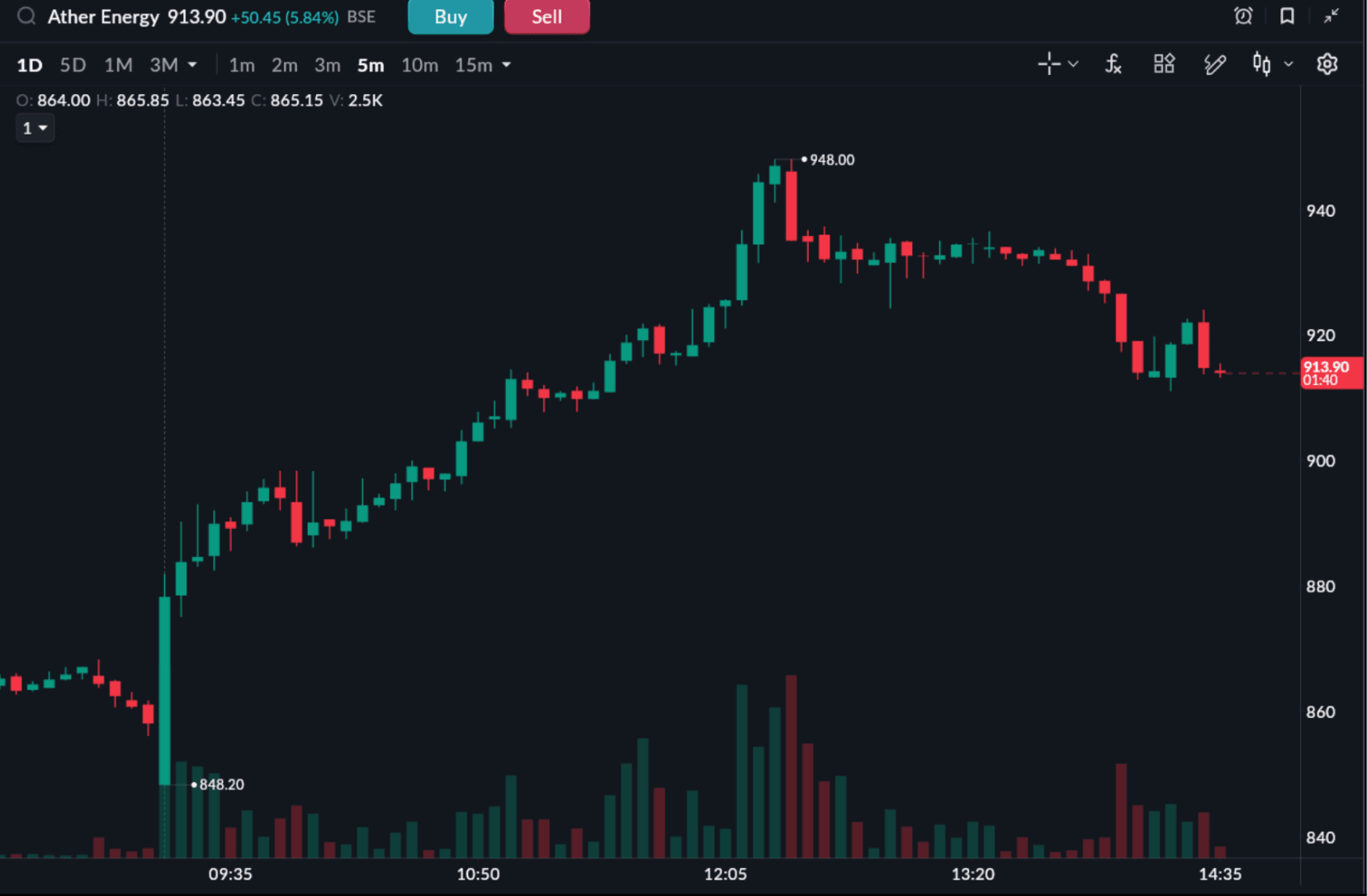
(As of 2:38 p.m. on April 13, 2026)
JBM Auto: Benefiting from Government and Infrastructure Push
JBM Auto is a manufacturer of electric buses and is active in EV infrastructure. The policy mandates that all new intra-state Delhi Transport Corporation buses be electric, all government-hired vehicles be electric, and school bus fleets progressively electrify to 30% by 2030. This creates predictable, long-term order pipelines for electric bus manufacturers — exactly the kind of revenue visibility that justifies a re-rating. The stock rose approximately 5.4% intraday on April 13.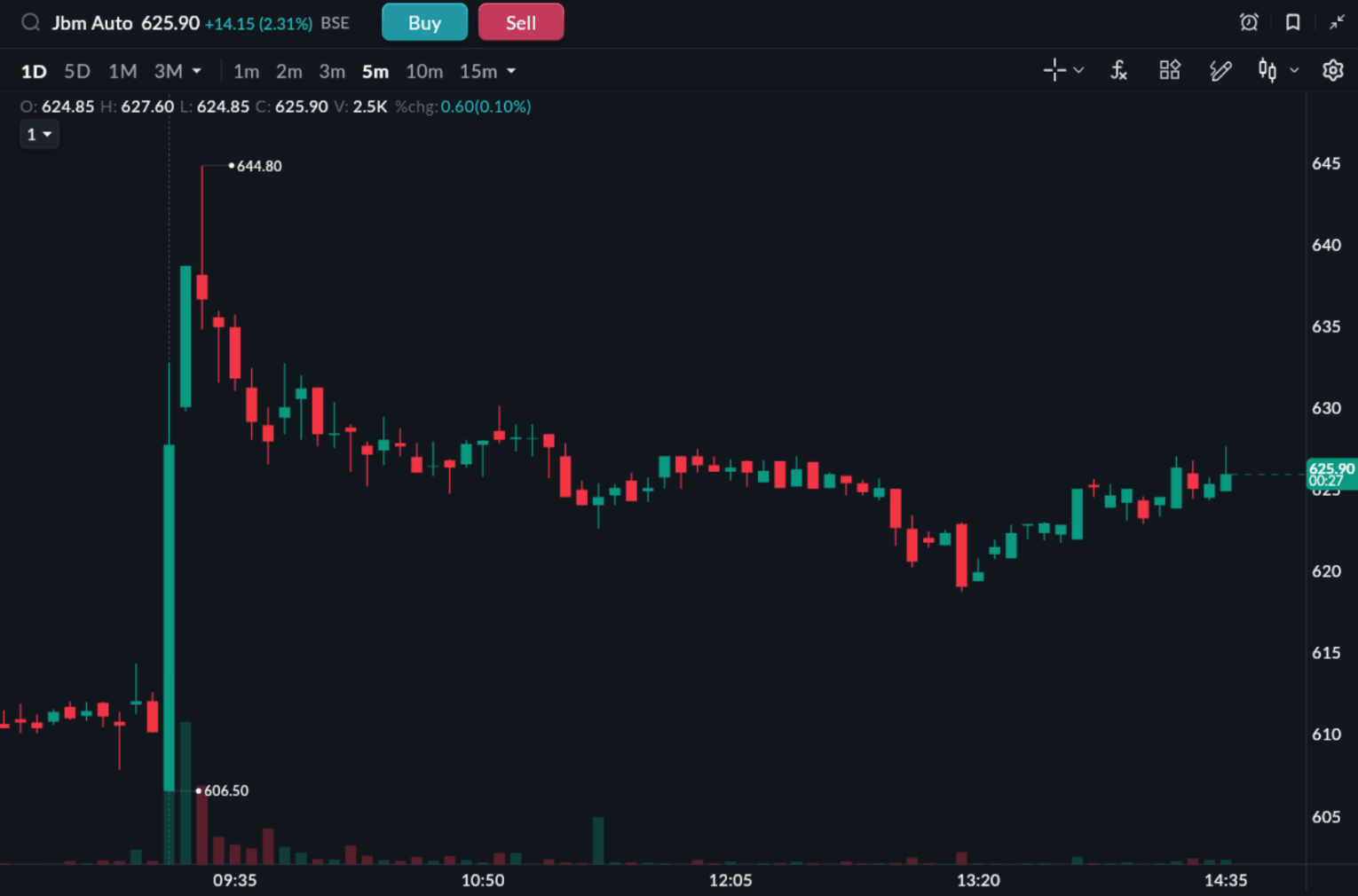
(As of 2:40 p.m. on April 13, 2026)
Olectra Greentech: Leveraging Public Transport Electrification
Olectra Greentech also manufactures electric buses and is expanding into electric trucks and commercial EVs. With Delhi planning large-scale electrification of public transport and government fleets, the company is positioned to benefit from increased government tenders and structural demand growth in the commercial EV segment. The stock rose approximately 6.5% intraday on April 13.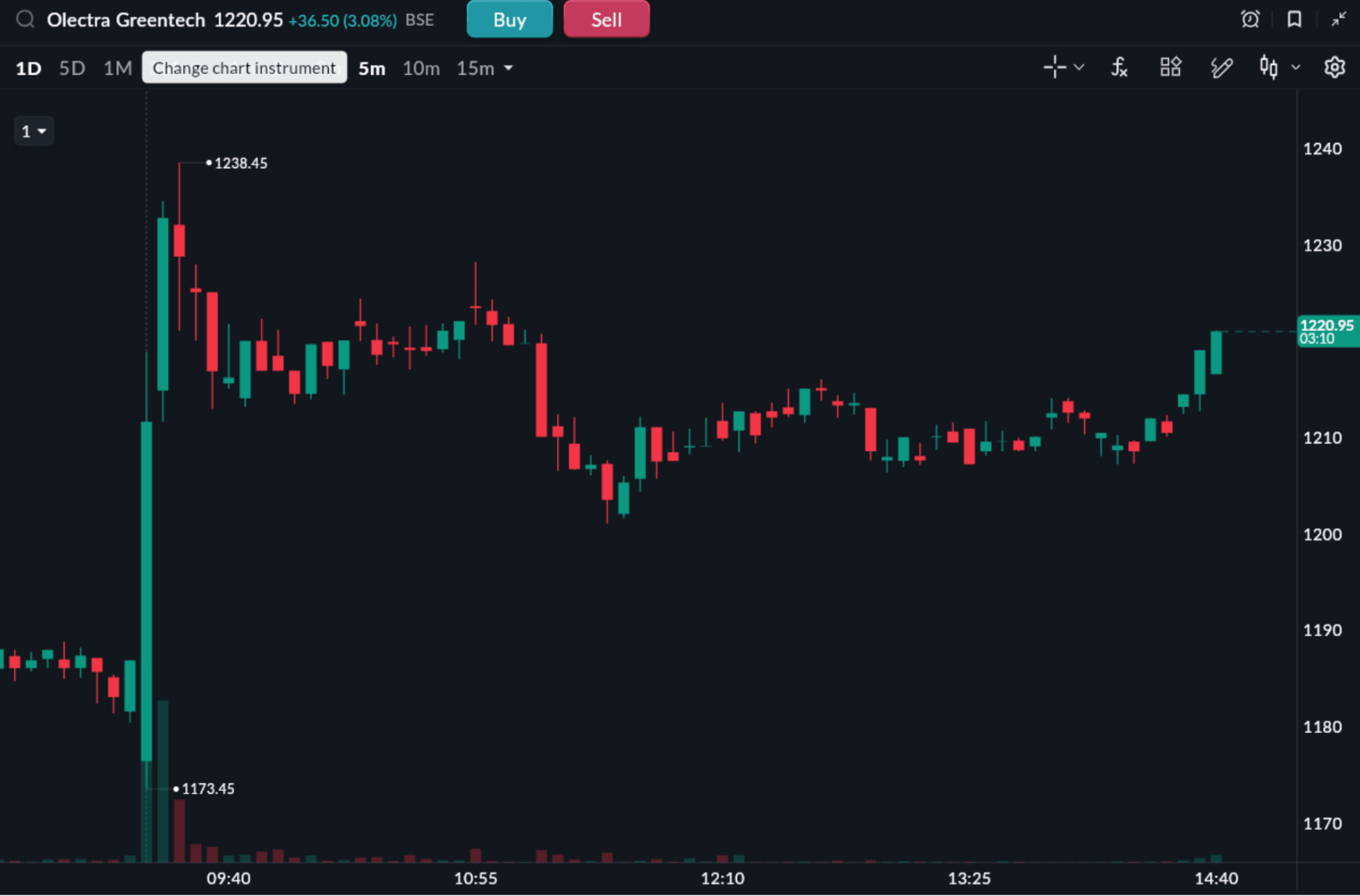
(As of 2:41 p.m. on April 13, 2026)
Which Companies Are Under Pressure and Why
While EV-focused companies gained, traditional automobile players saw declines. Companies like Eicher Motors, Hero MotoCorp, and TVS Motor Company fell approximately 3–5% on April 13.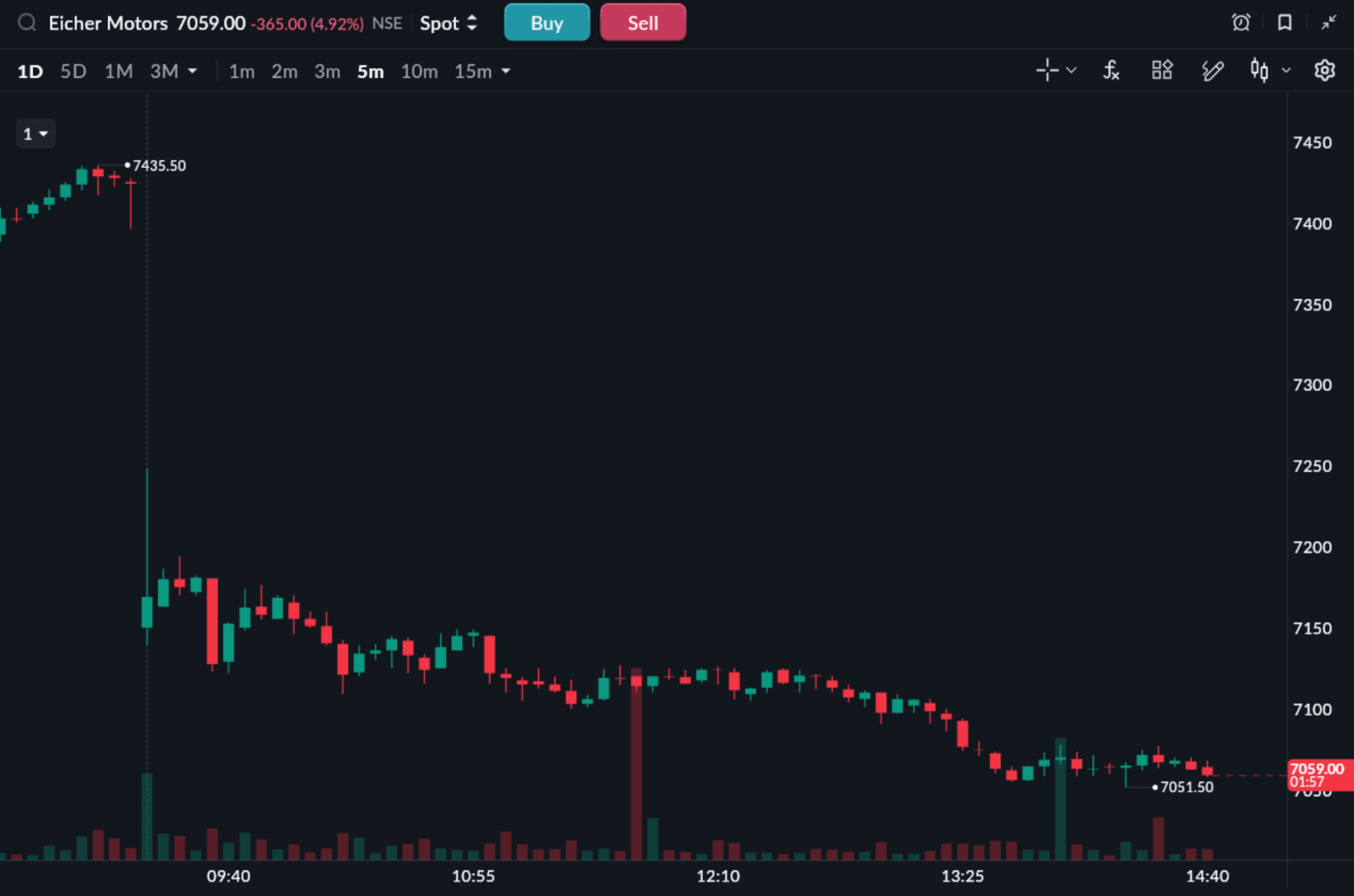
(As of 2:43 p.m. on April 13, 2026)
The reason is straightforward. Their core business depends heavily on petrol two-wheelers — a segment that faces a new registration ban in Delhi from April 2028 and will see gradually declining demand in the capital even before that as the mandate approaches. Delhi is India's largest two-wheeler market by registration volume, and a ban in the capital has national signalling effects on consumer expectations and policy direction.
Even though the impact will not be immediate — the ban applies only to new registrations from April 2028, and only in Delhi — markets are forward-looking. The policy introduces long-term uncertainty in a key revenue segment, and that uncertainty is now priced in. It is worth noting, however, that legacy OEMs with their own EV product lines — Hero MotoCorp (Vida), TVS Motor (iQube), and Bajaj Auto (Chetak) — are also positioned to benefit from the incentives on the EV side. 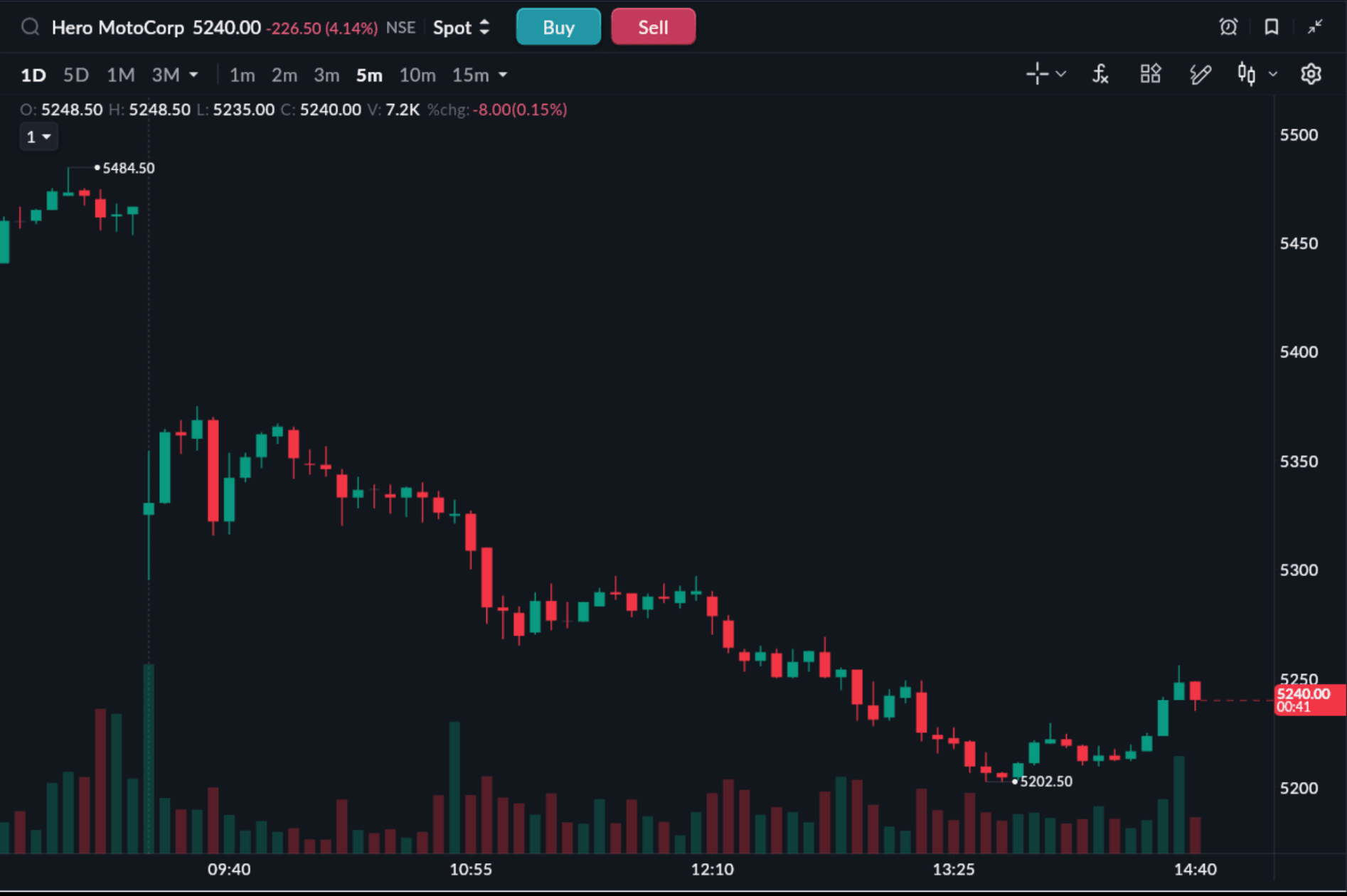
The market reaction reflects the net impact on their combined ICE-plus-EV business, where ICE dominates today.
The Bigger Picture: Why Markets Reacted So Quickly
The Delhi EV Policy is still in draft stage, with public feedback open until May 10, 2026. Yet markets moved immediately. The reason is that this policy does not merely offer incentives — it redefines the direction of demand through binding timelines. The broader context matters here too: elevated crude oil prices since the Iran war began in February 2026 have made the economic case for EVs stronger than at any point in recent years — the Delhi policy adds regulatory force to what oil prices are already signalling to consumers.
The combination of factors driving the market reaction is clear:
- Hard timelines that make EV adoption mandatory in high-volume segments, not optional
- Bulk demand creation through mandatory fleet electrification
- Long-term visibility through government procurement mandates
- A phased phase-out of traditional fuel vehicles that creates a structural ceiling on ICE demand
That combination makes EV adoption in Delhi not optional but inevitable in key vehicle categories, and markets are pricing in who benefits and who faces headwinds from that inevitability.
What This Means Beyond Delhi
Delhi's EV policy historically sets the tone for what other states follow. The 2020 Delhi EV policy was among the first state-level frameworks in India to combine mandates with targeted incentives, and several states replicated elements of it in subsequent years. If the 2026–2030 draft is notified in its current form, the mandate-plus-incentive model is likely to influence EV policy design in other major cities and states. That gives the policy implications well beyond Delhi's city limits, and is part of why markets are reacting to it as a structural shift, not a local event.
Disclaimer: This article is for informational and educational purposes only and does not constitute investment advice or a recommendation to buy or sell any securities. Stock price movements cited are intraday figures as of April 13, 2026, and are subject to change. The Delhi EV Policy 2026–2030 is currently in draft stage and subject to revision following public consultation. Please consult a SEBI-registered financial advisor before making any investment decisions. SAHI is not responsible for any investment decisions made based on this content.