
BHEL Share Price Falls 6% After Government OFS: What Happened?
Discounted stake sale, weak quarterly numbers, and policy uncertainty trigger fresh volatility in the PSU stock

BHEL share price declined sharply in February 2026 after the government announced an Offer for Sale (OFS), adding fresh pressure to an already volatile phase for the PSU stock.
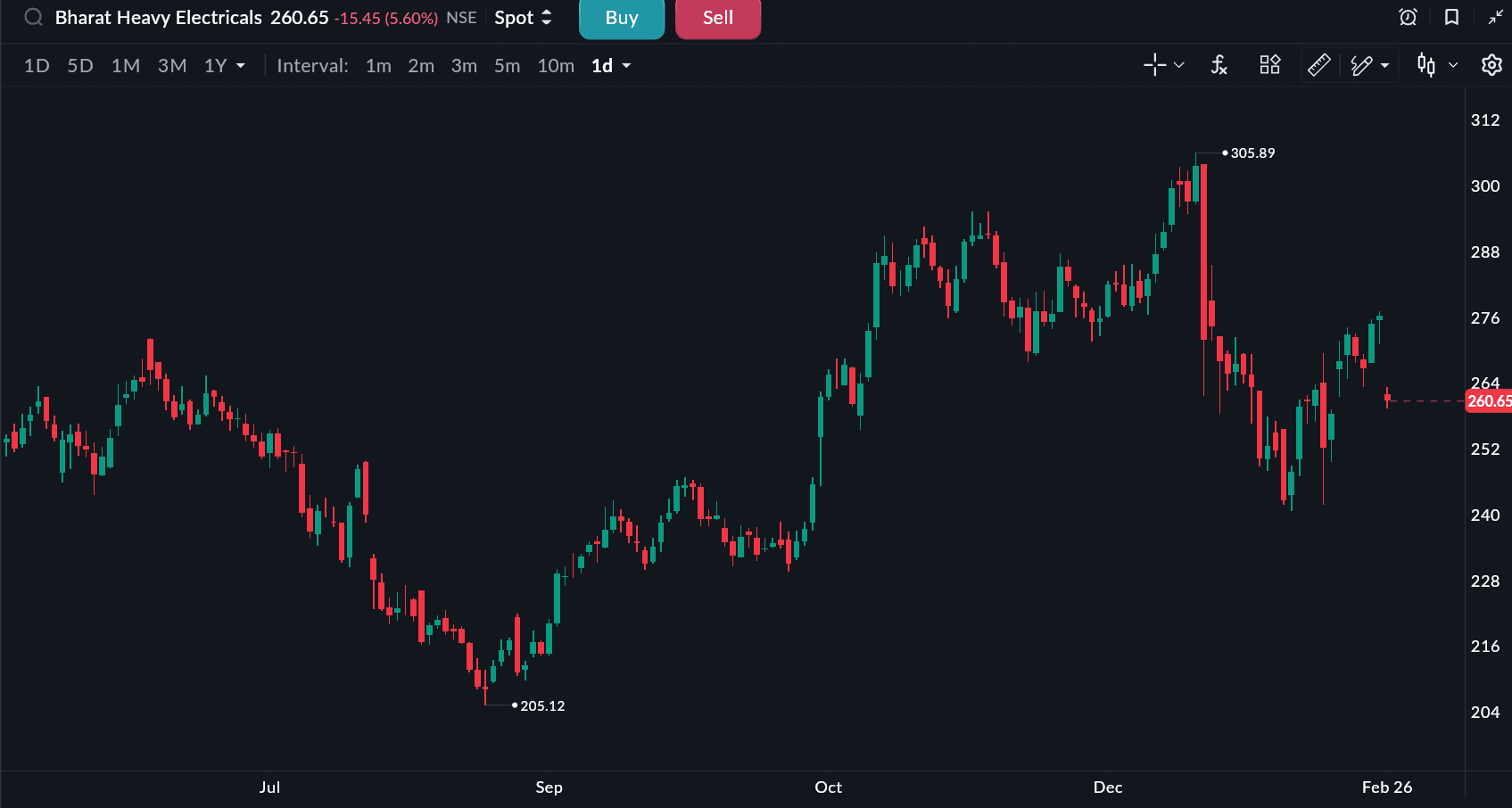
Bharat Heavy Electricals Ltd (BHEL) was trading near ₹260 on February 11, 2026. The stock had earlier touched a 52-week high of ₹305–306. The correction follows multiple developments, including government disinvestment, quarterly performance concerns, and policy discussions.
Year-to-date, the stock is down around 15% from its January peak. Market capitalisation stands near ₹92,000–90,000 crore.
What Triggered the Recent Fall?
Three main factors led to the recent volatility:
- Government offer for sale
- Weak Q1 FY26 results
- Policy concerns related to Chinese power equipment participation
These events occurred within a short time frame. This intensified PSU stock volatility in BHEL.
Government Disinvestment Through Offer for Sale
The government announced a stake dilution of up to 5% in BHEL through an OFS route.
Key OFS Details
- Base issue: 3%
- Greenshoe option: 2%
- Floor price: ₹254
- Discount: Around 8% to previous close
- Non-retail bidding: February 11
- Retail bidding: February 12
The discounted floor price increased near-term supply in the market. On February 11 2026, BHEL shares fell over 6%. Intraday levels dropped to ₹259–261.
Government disinvestment through OFS often creates temporary supply pressure. This can lead to short-term price adjustments.
Price Movement Since 52-Week High
In January 2026, BHEL had already corrected 12-15% after reports suggested possible easing of restrictions on Chinese power equipment imports.
The stock had earlier reached a 52-week high of around ₹305–306.
The combination of:
- Policy uncertainty
- OFS announcement
- Earnings weakness
resulted in a sharp correction from peak levels.
BHEL Q1 FY26 Results: Key Numbers
| Metric | Q1 FY26 | YoY Change | Remarks |
|---|---|---|---|
| Net Loss | ₹455 crore | Doubled from ₹213 crore | Higher costs |
| Revenue | ₹5,487 crore | Flat | Execution delays |
| EBITDA Margin | -9.8% | Worsened from -3.1% | Input cost rise |
| Order Book | ₹2.04 lakh crore | +42% inflows | Strong pipeline |
The widening net loss was linked to:
- Rising raw material costs (up 10.8%)
- Execution delays
- Higher provisions
Despite weak Q1 performance, the company later reported a Q3 profit of ₹390 crore. This was supported by other income and improved operational traction. Fresh orders worth about ₹2,800 crore were also secured.
Policy Concerns Around Chinese Competition
In early January 2026, reports indicated that 2020 curbs on Chinese bidders in Indian power projects may be relaxed.
BHEL holds around 90% market share in domestic thermal power equipment. Any change in competitive rules can affect pricing and order inflows.
Although no final policy change has been fully implemented, markets reacted cautiously to the reports.
Policy-related uncertainty often increases volatility in PSU stocks.
BHEL Order Book Remains Strong
One of the key structural strengths for BHEL is its order book.
- Current order book: Over ₹2 lakh crore
- Q1 FY26 inflow growth: 42% YoY
- Fresh orders secured: ₹2,800 crore
The order pipeline is linked to:
- Thermal capacity expansion
- Government infrastructure push
- Manufacturing-led capex cycle
A strong order book provides revenue visibility. However, conversion into profitability depends on execution and cost control.
Technical Price Zones
Recent trading levels indicate defined price zones:
- Support range: ₹190–240
- Resistance range: ₹270–300
The stock’s movement near ₹260 places it closer to the resistance band.
Technical zones often reflect recent trading behaviour and supply-demand dynamics.
Understanding PSU Stock Volatility in Context
Public sector undertakings (PSUs) are often influenced by:
- Government disinvestment plans
- Policy announcements
- Budget-related developments
- Sector-specific reforms
In BHEL’s case, multiple triggers aligned within months:
- Weak quarterly performance
- Policy discussion on imports
- Government OFS
This clustering of events increased short-term volatility.
Event-Driven vs Structural Factors
Recent developments can be broadly categorised:
Event-Driven Factors
- OFS discount pricing
- Policy speculation
- Quarterly loss
These factors typically influence short-term price action.
Structural Factors
- Order book size
- Power sector demand
- Infrastructure capex cycle
Structural drivers influence long-term revenue visibility.
The distinction between these categories helps explain recent stock behaviour without drawing forward-looking conclusions.
Market Capitalisation and Valuation Context
With a market capitalisation near ₹95,000–96,000 crore, BHEL remains one of the larger engineering PSUs in India.
The correction from ₹305 to ₹260–276 levels reflects:
- Supply impact from OFS
- Earnings-related adjustments
- Policy sensitivity
Valuation multiples and future earnings will depend on reported performance in upcoming quarters.
Frequently Asked Questions (FAQs)
All topics
Click the link, confirm the box next to sahi.com is checked — ignore any other results.